A Quarrel, a Bus Ticket, the Sea: Why Bangladesh's Children Are Leaving Home
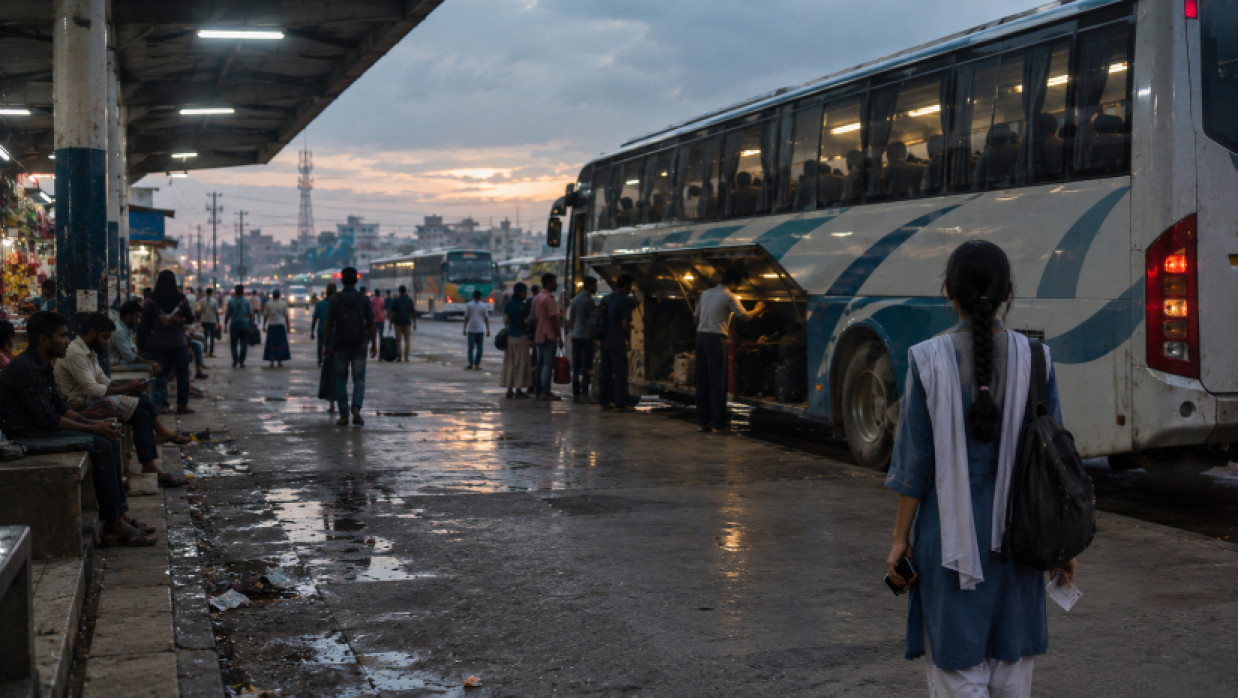
The ticket lay beside the body of a 15-year-old girl in a paddy field in Lalmai, Cumilla, on the morning of 8 October 2026. It was for a coach run by a company called Iconic. Police followed it back along a route her family never knew she had taken.
She had left her rented home in Cumilla city on 4 October after an argument with her mother. The quarrel was over whether she could give a wristwatch to a female friend. She told her family she was going to a friend's house and went to Brahmanbaria instead.
From there she phoned a 20-year-old hotel employee in Cox's Bazar, whom she knew from Facebook and Instagram. He sent her Tk 500 by bKash, and she travelled on.
A resort register in Kolatoli shows a check-in at 7:25pm on 6 October. She was registered under a false name as the man's wife, and both were listed as 18. The resort's front-desk manager says staff took the man's national ID card and nothing from the girl.
The next day she boarded a bus home on a Tk 900 ticket. CCTV shows her stepping off at Paduar Bazar Bishwa Road at about 11:45pm on 7 October. Police say she hired a CNG auto-rickshaw for the roughly eight kilometres to her home, at Tk 300.
The driver did not take her there. He has told a Cumilla magistrate, in a statement recorded under section 164 of the criminal procedure code, that he raped and killed her. Forensic DNA tests are under way, and the case has not gone to trial.
One case, and a larger question
Lalmai is the gravest case we verified, and the most visible. It has fed a widespread belief that more Bangladeshi children in Classes 5 to 8 are slipping away from home and travelling in secret. This two-part investigation set out to test that belief.
The evidence does not support it. Police data cannot show whether secret travel is rising, and the cases we verified are too few and too different to prove a trend. They do show a recurring pattern: children aged 10 to 17 leave after a family quarrel, with a friend or at an older contact's invitation. Most come home within days.
Episode One asks why they go. Episode Two examines what waits for them on the road, and what Bangladesh can do to make the trip less dangerous.
What the case shows, and what it does not
It is tempting to read Lalmai as a story about a reckless trip. The record points elsewhere.
The girl's journey ended without harm to her. She returned to her home district on a public bus. She was killed in Cumilla, not Cox's Bazar, and police say the driver chose her because she was alone near midnight.
Two facts matter most to anyone trying to prevent a repeat. An adult she knew only online paid for her trip and checked her into a hotel as his wife. On 15 October a Cox's Bazar court ordered a rape case recorded against him under section 9(1) of the Women and Children Repression Prevention Act. He denies any part in her death, and neither allegation has been tested at trial.
The second fact is simpler. The hotel took no ID from her.
Some details conflict. People have given her age as 13, 14 and 15, and this article uses 15, the figure in most accounts. Her online relationship has been described as lasting anywhere from 17 days to five months.
Four ways a child disappears
Sorting the cases by what happened to each child shows how different they are.
Children who choose to leave. On 24 September, two girls aged 12 and 14 left Chauddagram, Cumilla, at 8:30am, saying they were going to madrasa. About six days later, detectives from Cumilla and Cox's Bazar found them unharmed in a room at Sugandha Point. They traced the girls through "information technology," which usually means their phones.
Additional Superintendent of Police Lutfor Rahman told reporters the girls left voluntarily out of abhiman toward family members.
In August, two madrasa students left their school in Shah Makhdum, Rajshahi. One was 13. Rajshahi Metropolitan Police found them in Cox's Bazar within 72 hours, and the boys told officers they had gone to see the sea. Their families had filed a general diary, the police report Bangladeshis call a GD.
Children who lose contact during a journey. In February, a 12-year-old hifz student (a Quran memorisation student) left Lohagara, Chattogram, after a quarrel, carrying Tk 100. He says a campaign truck gave him a free ride to Cox's Bazar, where he spent about two months begging from tourists. A man who promised better earnings then took him to Dhaka.
He came home in September missing his right leg. He alleges a begging ring had it amputated. His family filed no GD while he was gone, and police say the claim must be investigated in Dhaka. It remains an allegation.
Children who are deceived or taken. On 6 May, a Class 8 student was taken from outside her home in Dhanmondi, Dhaka. RAB-15 says the main suspect was a man whose proposal she had rejected. RAB found her in Cox's Bazar a week later. Nobody would call her a runaway, yet police count her among the missing.
Children who vanish without explanation. In May, a 13-year-old Class 7 boy from Barishal went out to buy khichuri for his mother. Four days later he was found semi-conscious near Eidgaon bridge in Cox's Bazar, with two long-distance bus tickets and Tk 10 in his pocket. His mother says Tk 8,500 and two phones were gone.
Police first suspected scopolamine, known locally as "devil's breath." Investigators have not published a final account.
This series concerns mostly the first two groups. The last two show how one headline, "missing student found in Cox's Bazar," can cover events with nothing in common.
Four girls and a group chat
Not every case fits the lone-runaway picture. On 5 October, four girls from Kushtia, aged 15 to 17, left home together. They had become friends in a TikTok group. Police found them six days later in Savar, and a court returned them to their families.
No reported quarrel set the trip off. The girls left as a group that had formed online, and a group can make a plan feel safer than it is. We have left out the details of their lives that circulated online, because the public gains nothing from knowing more.
One word, two meanings
Abhiman appears in the Chauddagram and Lohagara cases, and by the family's account in Lalmai too. It means hurt pride, sulking and wounded love at once. English has no single word for it.
Police Headquarters lists the reasons it has found for children aged 10 to 17 going missing: anger, study pressure, hiding after what police call "unethical activities," a wish to live independently, trying to extract money or concessions from family, family disputes, and the influence of friends or classmates. That list is a police classification, not research. It does not say how often each reason occurs.
Dr. Md. Shaheen Mollah, an assistant professor in the Department of Psychology at the University of Dhaka, says the shorthand hides more than it explains. He spoke to The Daily Campus in Bangla, and his remarks are translated here.
"For the police it is abhiman. For us, the explanation is different."
Dr. Md. Shaheen Mollah, University of Dhaka
His explanation starts with the parents. When a mother and father quarrel constantly, he says, a child feels isolated and may conclude that being outside is better than being at home. The child cannot pick a side, because both parents belong to them.
"Every child wants a warm, loving relationship between their parents," he said. Without it, the child has fewer places to share what hurts, and sadness and isolation can grow.
Police accounts of these cases describe family quarrels but not their causes. His reading is a professional interpretation, not a finding about any child in this series.
Why the teenage years hit harder now
Mollah calls adolescence the age of emotion, a stage of hormonal change that many parents struggle to match. Many of them, he says, never understood their own adolescence. They grew up in joint families, where cousins and playmates absorbed the strain. Today's nuclear families leave parent and child facing each other.
Both parents often work, he says, and what time remains goes to cooking and phones. The child turns to a device, watches stories on YouTube and other sites, and starts to measure real life against the virtual one.
He goes a step further. Children who are heavily attached to devices show more impulsiveness, anxiety, restlessness and anger, he says, because they talk to people less. "A machine has no feelings." In his view, that is why some children make sudden decisions and walk out the door.
None of the cases we verified recorded a child's screen use, so we could not test his account against them. It offers a plausible mechanism, not proof.
Why a friend in the room changes the math
International research fits these cases on one point. In a 2005 experiment, Temple University psychologists Margo Gardner and Laurence Steinberg had 306 people play a computerised driving game. Early adolescents, average age 14, took about twice as many risks with same-age peers in the room as when they played alone. Late adolescents took about 50 percent more. Adults showed no change.
A 2011 brain-imaging study from Steinberg's group found that reward regions of the adolescent brain grew more active when peers watched. In 2015, an Illinois team led by Eva Telzer found the reverse for a parent. Fourteen-year-olds made risky choices about 45 percent of the time with their mother watching, against about 55 percent without.
A 13-year-old usually knows Cox's Bazar is far away and that leaving without permission is wrong. A friend's presence changes how loudly the excitement competes with that knowledge. That helps explain why so many cases involve pairs or groups: two girls from Chauddagram, two boys from Rajshahi, four girls from Kushtia.
Peers can also protect, Mollah says. Asked whether a healthy peer group can dilute these risks, he answered "absolutely." A school can run section-by-section football or cricket tournaments, he suggests, and parents can set aside one day a week for supervised play. A team gives a child a network, motivation and a chance to lead.
Understanding is different from excusing, and neither idea tells us how a given child decided. Laboratories in the United States cannot show how abhiman works inside a Bangladeshi household, or how fear of a beating can make vanishing feel safer than confessing.
Is this new, or newly visible?
Inspector General of Police Ali Hossain Fakir said in early September that children have always gone missing but now draw more media attention. Additional IGP Khandker Rafiqul Islam said police had never before kept a separate list of children found after a missing-person report.
Both statements point the same way. Without baseline data, nobody can say whether more children leave home now than ten years ago. What has changed is visible: a GD can be filed online, a phone can lead police to a child within days, and a family's Facebook appeal can reach thousands of people in hours.
What may have changed for children themselves is the harder question. It is the subject of the second episode: what children see on their phones, who can reach them through those phones, how cheap a journey looks, and what reception a child expects at home when something goes wrong.
 Follow The Daily Campus on Google News