Happy Birthday, Leo: The Boy from Rosario
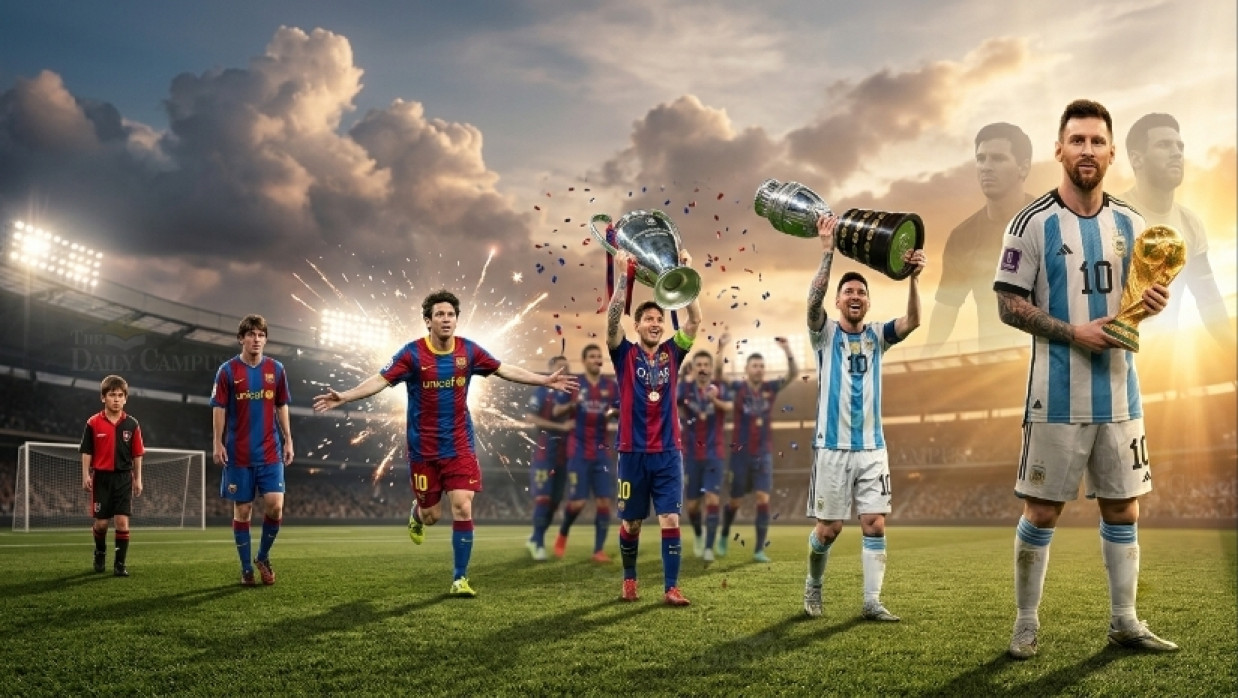
Today is June 24, 2026. Somewhere in North America, a World Cup is underway, and Argentina has already advanced from the group stage. And the man who made it happen turns 39 years old. Lionel Andrés Messi, a boy who was once told his body would not grow, stands at the summit of everything football has ever produced.
He scored 91 goals in a single calendar year. He scored 474 goals in La Liga, a number no player has reached in the entire history of the Spanish top flight. He has won eight Ballon d'Or awards, collected 44 senior trophies, and holds more records in the game than any individual in its history. He has also, across two brutal decades, lost more than most men could bear, only to rise and win the one thing that had escaped him.
This is his story. It begins on a street in Rosario.
Rosario: The Boy Who Almost Was Not
Lionel Messi was born on June 24, 1987, in Rosario, Argentina, into a working-class family. His father Jorge worked at a steel factory. His mother Celia cleaned houses. The city was not poor in spirit, but it was a city without shortcuts. The neighbourhood gave children football the way other cities give children libraries: it was simply there, on every corner, waiting to be used.
Messi could barely walk before he had a ball at his feet. At four years old, he joined the local club Grandoli, where the coach initially turned him away for being too small. His grandmother Celia stepped forward. She told the coach to put the boy on the pitch. He did. Messi never left it. His grandmother watched every training session, stood at every game. He was ten years old when she died. Every time Messi scores today, he points to the sky. He has never explained it at length. He does not need to.
At Newell's Old Boys, Messi was so dominant that opposition coaches filed complaints before matches, insisting a child that size could not possibly be the age listed on the registration form. He reportedly scored close to 500 goals in youth football. They made him the team's penalty taker at eight years old. His team was called 'La Maquina del '87,' the Machine of '87, and they were terrifying.
Then came the diagnosis that threatened to end everything.
At ten years old, Messi was found to have Growth Hormone Deficiency, a condition that had stopped his body from growing since he was nine. At four feet and four inches tall, his doctor predicted he would reach a maximum height of around four feet and seven inches without intervention. The treatment required daily injections of synthetic growth hormone. It cost the family approximately 1,500 US dollars per month. Jorge Messi's health insurance covered two years of the treatment. After that, the money ran out.
River Plate saw the child and passed. They would not cover the medical costs. Newell's offered brief support but would not commit long-term to a boy so young, however brilliant. The Messi family had relatives in Catalonia and, holding everything they had in their hands, they flew to Barcelona.
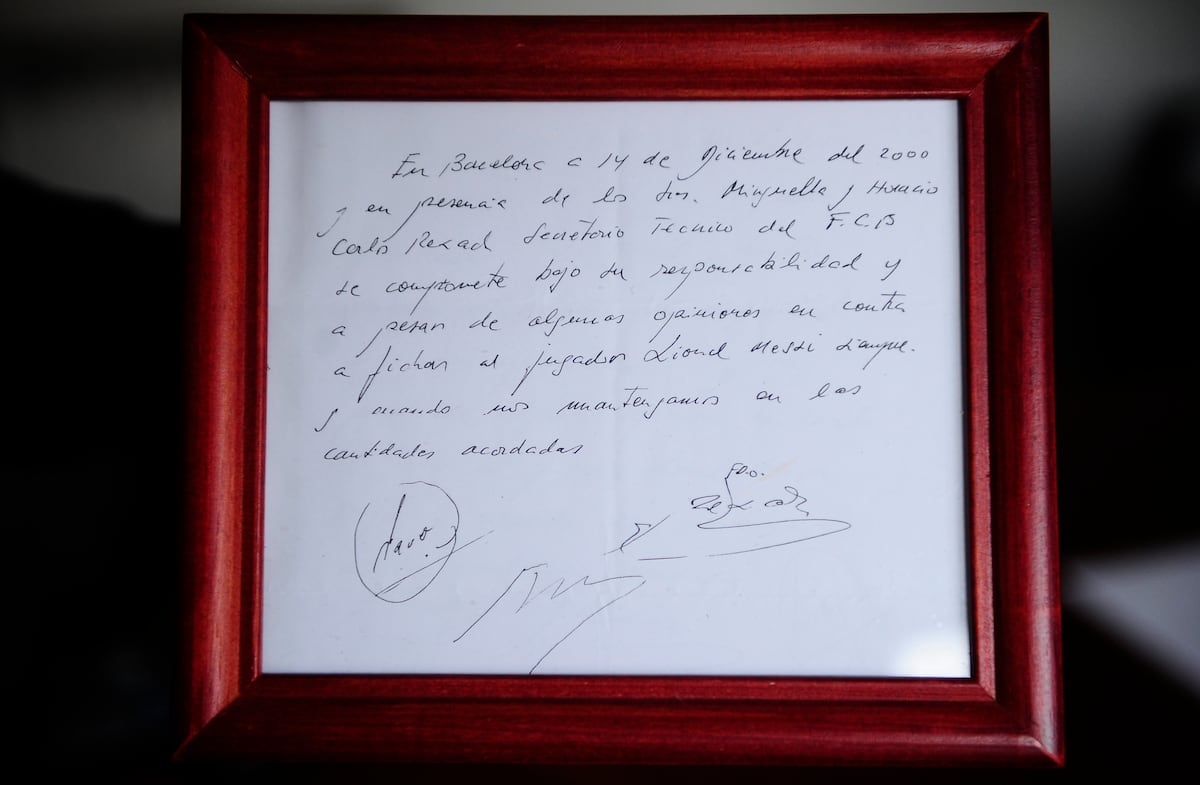
Carles Rexach, then Barcelona's sporting director, watched Messi for a handful of minutes during a trial and refused to let him leave. There was no contract paper available. It was December 14, 2000. So Rexach wrote the terms on a paper napkin: Barcelona would sign the boy and pay for his medical treatment in full. That napkin is now a relic of football history, sitting behind glass somewhere, the most improbable document in sport.
Messi arrived in Barcelona at thirteen. He did not speak Catalan. He barely spoke Spanish. His mother and brothers returned to Rosario after a year. He stayed, with his father, in a foreign city, homesick to the bone. Some of his new teammates at La Masia thought he was mute, so seldom did he speak. He was not mute. He was quietly building something the world was not ready for.
La Masia and the Making of a Phenomenon
La Masia, Barcelona's famous youth academy, is not merely a training ground. It is a school of football philosophy, a place where the principles of possession, pressing, movement, and intelligence are drilled into young bodies until they become instinct. Messi absorbed all of it and then transcended it. He completed his growth hormone therapy at fourteen and, by the time he reached Barcelona's reserve teams, he was playing against grown men and embarrassing them.
He made his official first-team debut for FC Barcelona on October 16, 2004, in a La Liga match against Espanyol. He was seventeen years old. His first senior goal came against Albacete on May 1, 2005, a chip over the goalkeeper assisted by Ronaldinho, who ran to celebrate with the teenager as though he already knew he was watching history happen. Ronaldinho, the best player in the world at that moment, would later say that Messi's arrival changed everything, including his own sense of what was possible.
The rise through the ranks was rapid and then total. Pep Guardiola arrived as head coach in 2008 and moved Messi into the 'false nine' role, a position with no real precedent at that level: a forward who dropped deep, collected the ball, and then drove at defenders from unexpected angles with the ball as though attached to his left boot by an invisible thread. The effect on opponents was paralysing. Barcelona between 2009 and 2012 played the most dominant club football the modern game has seen.

The 2010-11 season produced the semifinal against Real Madrid that is remembered with something close to reverence by anyone who watched it. Messi received the ball in a wide position, drove past two defenders, and placed the ball in the far corner of the net at the Bernabéu with a composure that defied the occasion. He stood still for a moment after it went in. The stadium stood still with him.
In the 2011-12 season, Messi scored 91 goals across all competitions for club and country, breaking Gerd Müller's 39-year-old European record for goals in a calendar year. He scored 50 goals in La Liga alone that season, the highest single-season total in the history of Spain's top division. He scored in 21 consecutive La Liga games. He scored four goals against Arsenal in a Champions League round of 16 second leg, four against Bayer Leverkusen in the quarterfinals.
The Ballon d'Or became almost annual furniture. He won it in 2009, 2010, 2011, 2012, then again in 2015, 2019, 2021, and finally 2023, an eighth award that no other player in history has remotely approached. These were not gifts. Each one was earned against a field that included Cristiano Ronaldo, a player of such exceptional quality that their decade-long rivalry elevated both of them to heights the game had never imagined.
The Blue and White Wound
For all the gold and glass that accumulated at the Camp Nou, Argentina was a wound that would not close.
Messi made his senior debut for Argentina in August 2005 but was sent off after just 47 seconds, a red card for a foul in his first touch of international football. It was an omen, not of his character, but of the particular cruelty the game had reserved for him at the international level. In 2008, he won an Olympic gold medal with Argentina's under-23 side in Beijing, and the joy was real, but Olympic gold was not what the nation demanded of him. Argentina demanded the World Cup.
In 2014, Messi led Argentina to the final in Brazil. He scored four goals and collected the Golden Ball as the tournament's best player. Argentina lost the final 1-0 to Germany, in extra time, through a Mario Götze goal that broke the hearts of an entire continent. Messi had been extraordinary throughout the tournament. The result was immovable.
The Copa América became its own particular purgatory. In 2015, Argentina reached the final of the Copa América in Chile. They lost to Chile on penalties. In 2016, they reached the final of the Copa América Centenario in the United States. They lost to Chile again, on penalties again, and Messi, who had missed his spot-kick in the shootout, walked to a press conference and told the world he was retiring from international football. He was 29 years old.
The retirement lasted less than two months. He came back, because where else was there to go. Argentina was not just a national team to him; it was a debt he felt he owed to a country that had given him everything before Barcelona gave him anything.
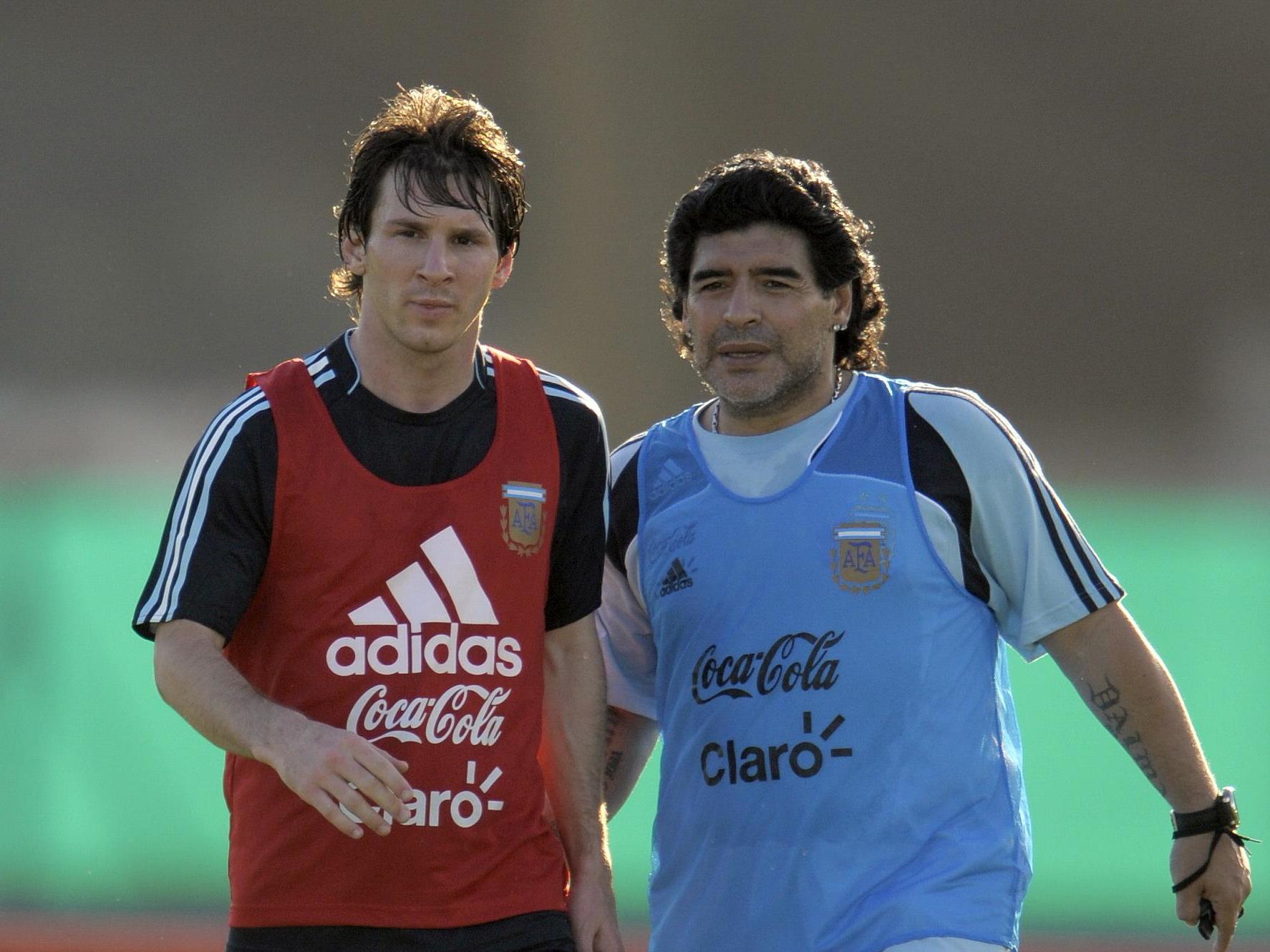
The criticism in Argentina was fierce and, at times, personal. Diego Maradona, who famously carried Argentina to World Cup glory in 1986, was a figure of volcanic passion, a man from the Buenos Aires slums who wore his heart on his sleeve and often wore his instability there too. Messi was different: quiet, private, introverted, a man who had lived in Barcelona since he was thirteen. Some Argentines questioned whether he cared enough. Some questioned his leadership. The weight of Maradona's shadow was real, and Messi wore it without complaint, without melodrama, only with a persistence that, in the end, said more about him than any speech could.
At the 2018 World Cup in Russia, Argentina scraped through the group stage and then fell to France in the round of 16, eliminated by a player called Kylian Mbappé who was nineteen years old and would later become his Paris Saint-Germain teammate. At the 2019 Copa América, Argentina finished third.
The accumulation of near-misses had become a defining narrative: the greatest club player in history, unable to deliver for his country. Critics across the world used it as an argument. Messi absorbed all of it and kept playing.
The Redemption: Copa América and the World Cup
In July 2021, at the Estádio do Maracanã in Rio de Janeiro, Argentina played Brazil in the final of the Copa América. Messi had not won a major trophy with Argentina in 28 years of the nation's attempts. He was 33 years old. Angel Di María scored the only goal. Argentina held on. When the final whistle came, Messi sat on the pitch and wept.
It was the first of three consecutive major international trophies: the 2021 Copa América, the 2022 Finalissima against Italy, and then, in December 2022, in Lusail, Qatar, the World Cup.
The 2022 World Cup final between Argentina and France is widely regarded as the greatest final in the tournament's history. France, trailing 2-0 with ten minutes to play, scored twice through Kylian Mbappé to level the match in ordinary time and then scored again in extra time to make it 3-3. The game went to penalties. Messi had scored twice, including a composed finish in extra time to put Argentina 3-2 ahead. He took his penalty in the shootout. It went in.
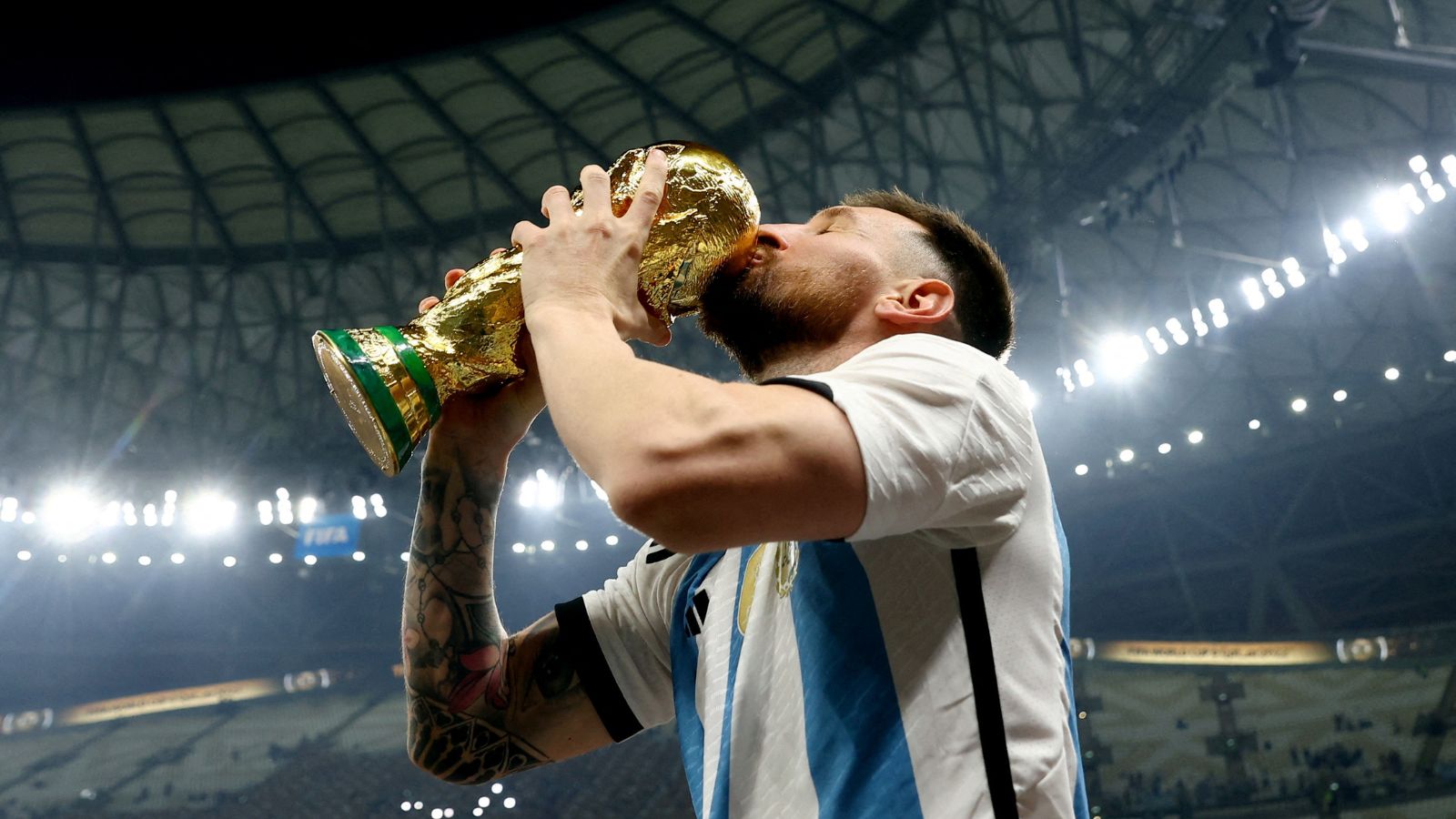
Argentina won 4-2 on penalties. Messi sank to his knees on the pitch in Lusail and the stadium, and beyond it the entire country of Argentina, lost its composure entirely. He had won every meaningful award the game offered, every record worth holding, every club title worth collecting. Now he had the World Cup. He was 35 years old. He won the Golden Ball as the tournament's best player, becoming the first man in history to receive the award twice.
Maradona had died two years earlier, in November 2020. Messi, asked to comment, had said only that Diego was eternal. The World Cup win did not settle the comparison in any clinical sense, but it settled it in the hearts of those who had watched both men play. A life-sized statue of Messi holding the World Cup trophy was unveiled outside CONMEBOL's headquarters in Luque, Paraguay, standing alongside statues of Pelé and Maradona.
In July 2024, Argentina won the Copa América again, defeating Colombia in the final in Miami. It was Messi's third major international title. He was 37. His country had never, in the history of its football, won three consecutive major tournaments. Argentina became only the second men's team in history to achieve that feat.
Paris and the Pink Jersey
In August 2021, Barcelona announced that Messi would not be re-signing with the club. The reasons were financial: La Liga's Financial Fair Play regulations meant that Barcelona, buried under the weight of years of mismanagement, could not register his contract. Messi, who had said he wanted to spend his entire career at the Camp Nou, stood at a press conference and wept again, but this time in departure rather than triumph.
He signed with Paris Saint-Germain, joining Neymar and Kylian Mbappé at a club assembling the most expensive squad in football history. The experiment produced mixed results at club level. Messi struggled with injury in his first season and never quite settled into a PSG side whose style did not suit his instincts. He won the Ligue 1 title twice, was named the Ligue 1 Foreign Player of the Year for 2022-23, and maintained his quality for Argentina throughout the World Cup cycle. But Paris was not Barcelona, and everyone, Messi included, understood that.
In July 2023, he joined Inter Miami CF of Major League Soccer. The club was at the bottom of the MLS standings. The reception was extraordinary: his unveiling at DRV PNK Stadium was watched by more people online than any previous MLS event in history. Within weeks, Messi had transformed the club. He led them to the Leagues Cup title, the first trophy in the franchise's brief history, scoring freely from the first game.
In the 2024 MLS season, he scored 20 goals and 16 assists in 19 appearances and was named the league's Most Valuable Player. In 2025, he scored 29 goals and 19 assists in 28 games, won the MLS Golden Boot, and led Inter Miami to their first-ever MLS Cup title. He was named MVP again, back-to-back, a first in league history. During the 2025 playoffs, an assist from Messi took his career total across all competitions past 405, surpassing Ferenc Puskás for the most career assists in football history.
On October 23, 2025, he signed a contract extension with Inter Miami through 2028. By then, he will be 41 years old. He is not done. He has already made that clear.
The Numbers That Have No Precedent
There is a category of statistics that exists simply to describe what Messi has done, because nothing in the game's prior history provides adequate comparison:
Eight Ballon d'Or awards, the most in history. Six European Golden Shoes. Eight FIFA World's Best Player awards. 672 goals for FC Barcelona in 778 appearances, the most any player has scored for a single European club. 474 goals in La Liga, the highest total in the competition's history. 91 goals in the 2012 calendar year. 18 goals in FIFA World Cup matches, the most in tournament history. 61 international assists, the most in men's international football. 414 career assists across all competitions, the highest recorded total in football history. 44 senior team trophies, the most won by any player. Named by the IFFHS as the All Time Men's World Best Player in 2025.
In 2020 and 2023, he became the first team-sport athlete to win the Laureus World Sportsman of the Year. In 2023, Time named him Athlete of the Year. In 2025, US President Joe Biden awarded him the Presidential Medal of Freedom. In 2026, his net worth exceeded one billion dollars for the first time, appearing on the Forbes World's Billionaires list.
The 2026 FIFA World Cup on North American soil is now underway, and Argentina has qualified from their group. Messi, at 39, is playing in it.
What the Great Ones Say
The testimony of footballers and athletes who have competed alongside or against Messi amounts to a sustained act of collective astonishment. These are people not given to hyperbole as a professional matter, and yet the language they reach for when asked about him is consistently extreme.
"I have seen the player who will inherit my place in Argentine football and his name is Messi. Messi is a genius." — Diego Maradona
"For the world of soccer, Messi is a treasure because he is a role model for children around the world. He will win five, six, seven Ballon d'Or. He is incomparable. He is in a different league." — Johan Cruyff
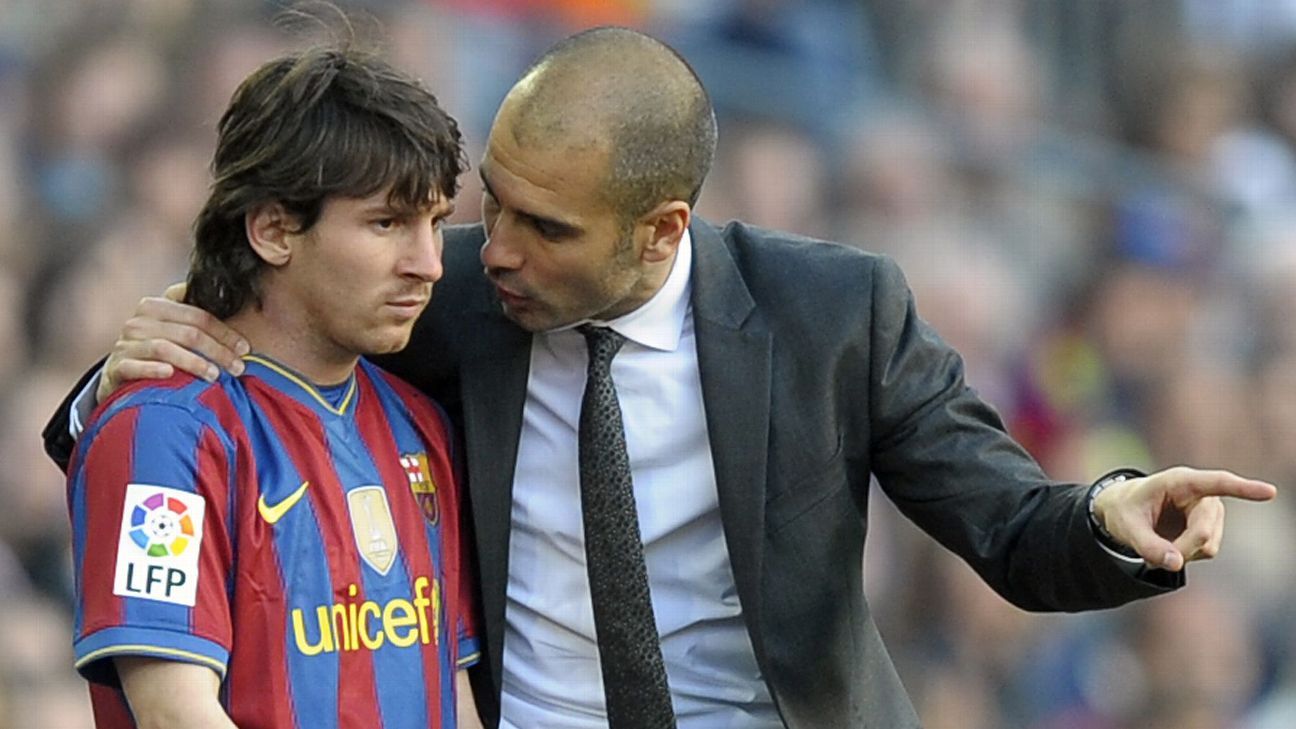
"I didn't see Pelé, but Leo is the best player ever. He is unique." — Pep Guardiola
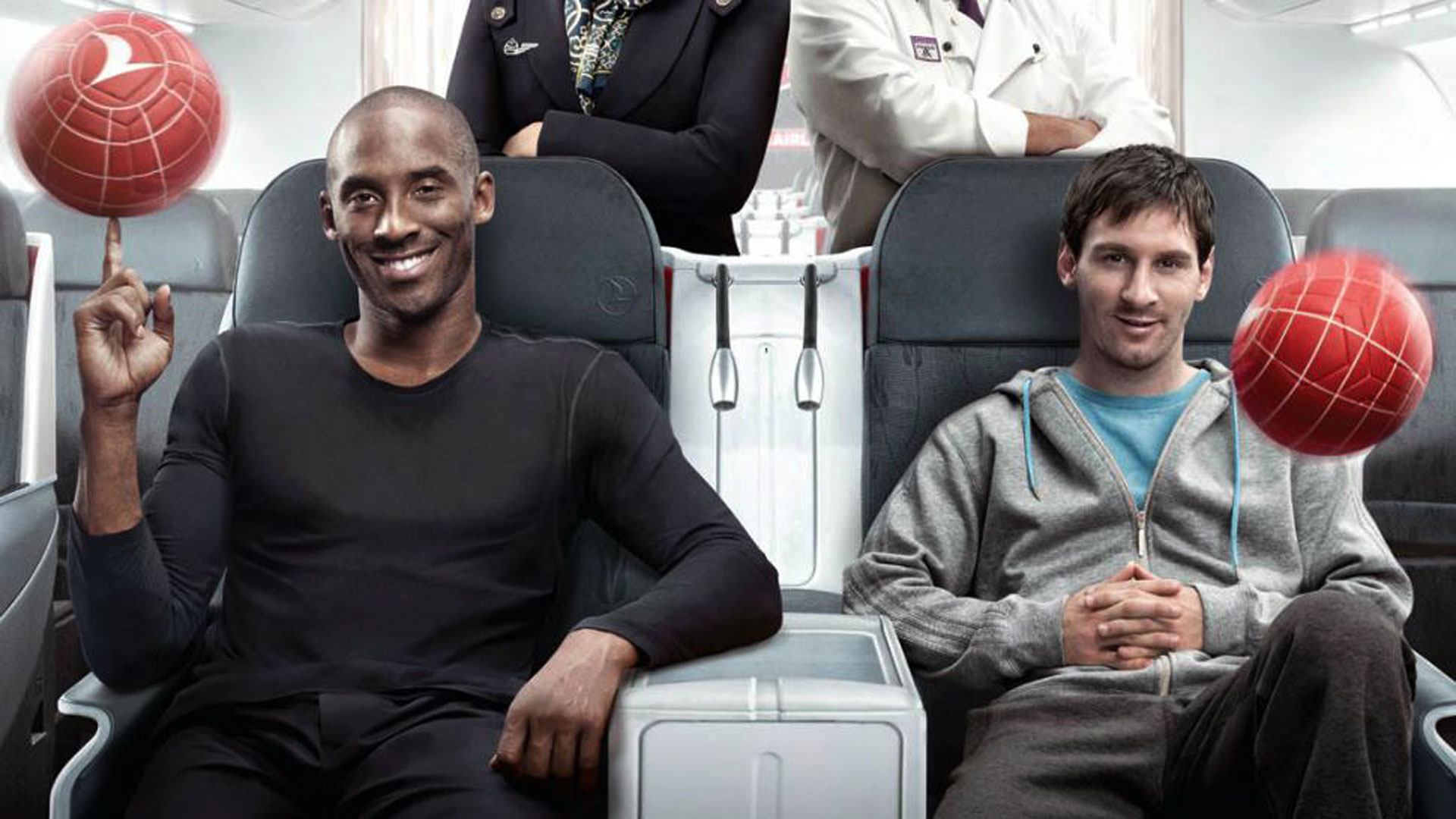
"I wear the number 10 jersey for the US National Team in honour of the greatest athlete I have ever seen: Messi." — Kobe Bryant
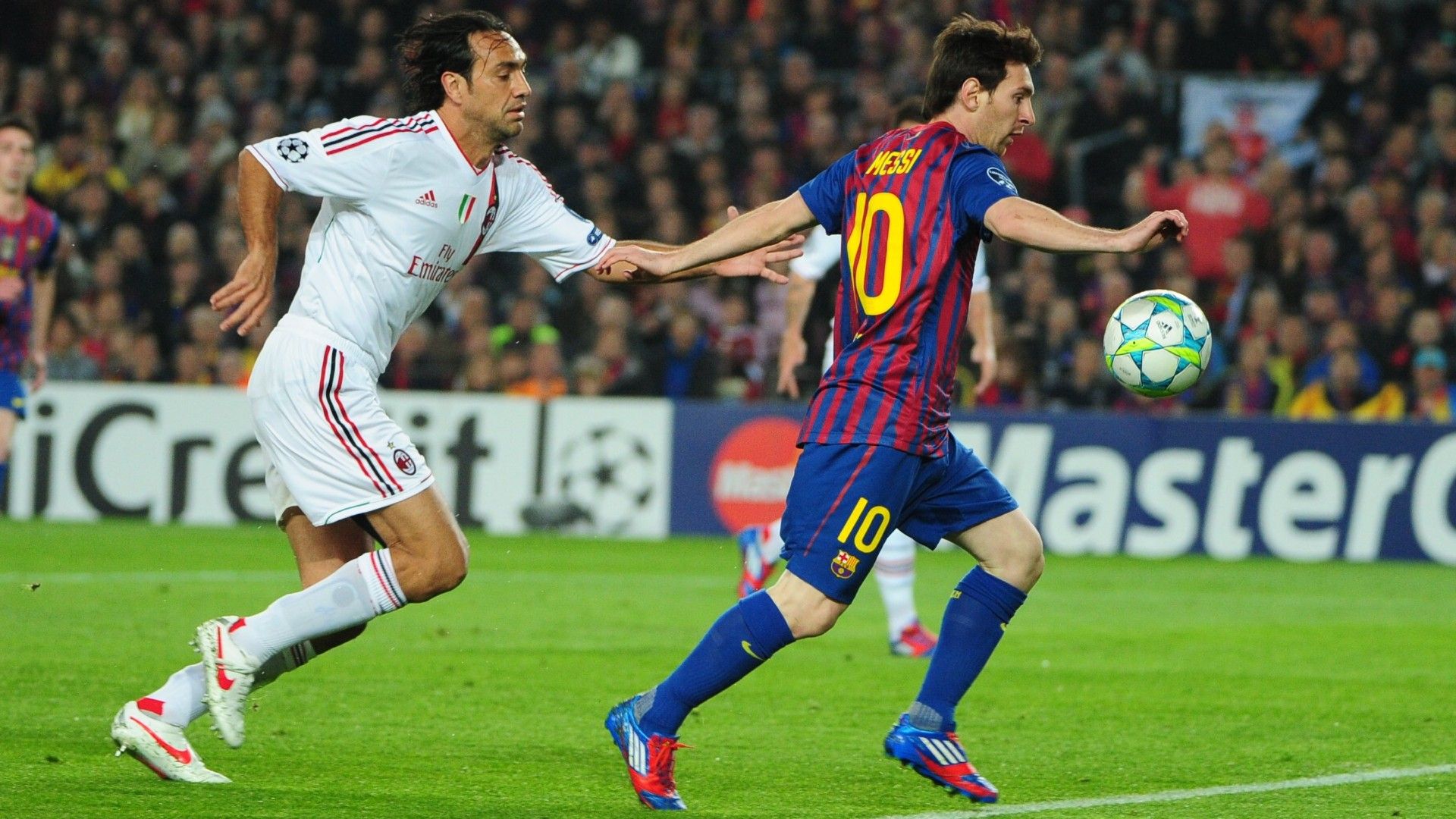
"Messi is the best player ever. And this is said by someone who has seen Maradona and Pelé play." — Adriano Galliani, AC Milan

"I watch a lot of football, and people pine on this whole Messi versus Ronaldo debate; there's no comparison, for me. Messi is on a different level to everybody else, it's as simple as that." — Sir Alex Ferguson
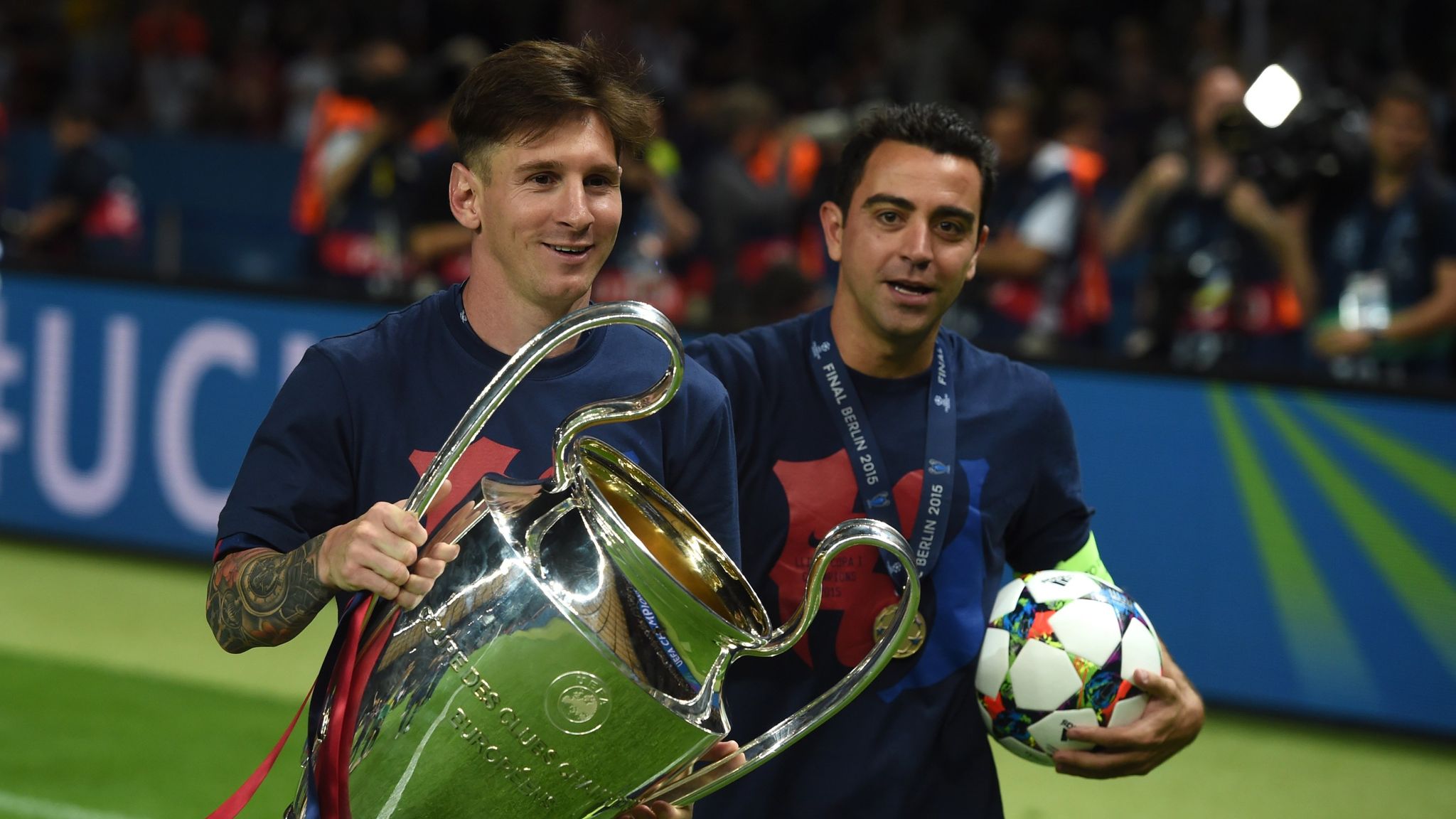
"It is clear that Messi is on a level above all others. Those who do not see that are blind." — Xavi

"He is always going forwards. He never passes the ball backwards or sideways. He has only one idea, to run towards the goal. So as a football fan, just enjoy the show." — Zinedine Zidane
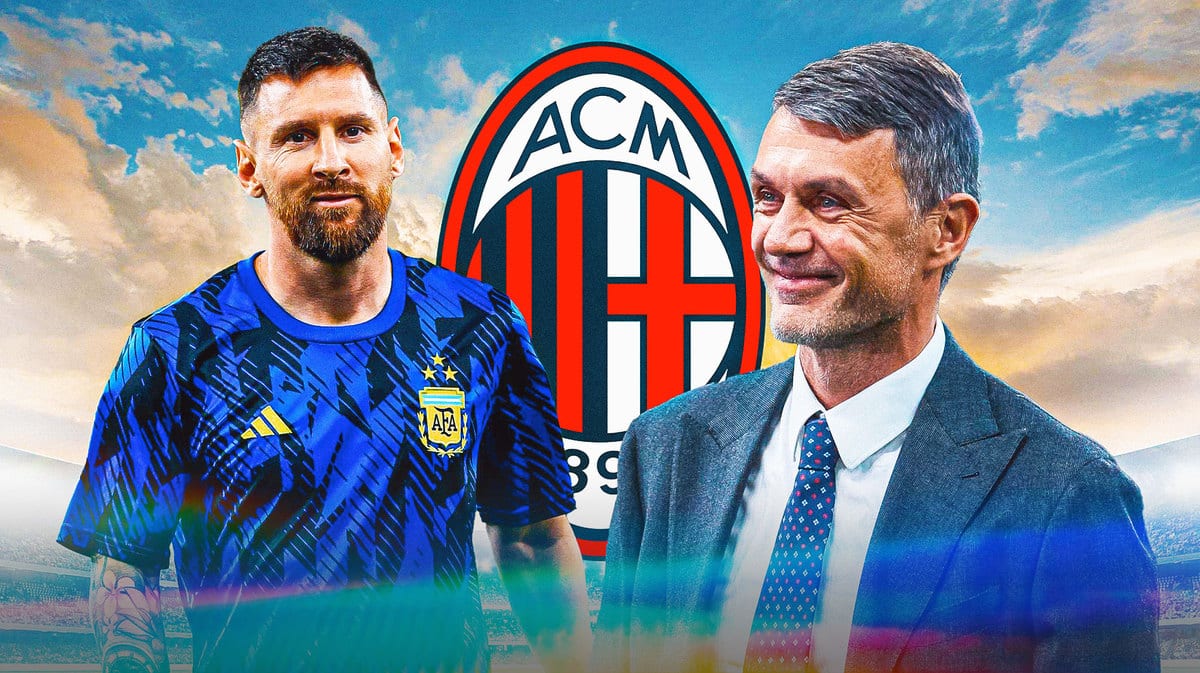
"I think he reached and surpassed the level of Maradona. He does incredible things, at a speed that is insane." — Paolo Maldini

Even Cristiano Ronaldo, the man who competed with Messi for every individual award across a decade and a half, said: "He is an amazing player. Magic. Top. As a person, we share the stage for 16 years. Imagine 16 years."
The Game Still Has More to Give
There is a boy somewhere in Bangladesh today, or Bolivia, or Burkina Faso, who stays up past midnight to watch Lionel Messi play. The time zones do not care about bedtimes. The boy watches the same thing that every generation before him has watched for twenty years: a small man with a low centre of gravity receiving the ball and, for a moment, making it seem as though the laws of physics have suspended themselves out of courtesy.
Messi himself has said: "I never think about the play or visualize anything. I do what comes to me at that moment. Instinct. It has always been that way." That answer is either the most modest thing a footballer has ever said about himself, or it is the most frightening.
He is 39 years old today. He is at a World Cup. Argentina are through. And somewhere in this tournament, on some ordinary Tuesday evening in a stadium full of people who drove hours to be there, Lionel Messi will receive the ball in a position that looks hopeless, and he will do something that nobody in the stadium predicted, and the crowd will go silent for one full second before it erupts.
That second of silence is the signature. It is the moment between seeing something and being able to believe it. It has followed Messi everywhere for thirty-five years of his life, from the streets of Rosario to the grandest stages the sport has ever staged.
Every record the game once thought permanent, he made provisional. Every ceiling the sport thought it had, he walked through without looking up. The boy who was told his body would not grow became the greatest footballer who has ever lived, and he is not finished yet.
Happy Birthday, Leo.
Born: June 24, 1987, Rosario, Argentina
 Follow The Daily Campus on Google News