PM Tarique Rahman Announced 8 Cards in 2 Months
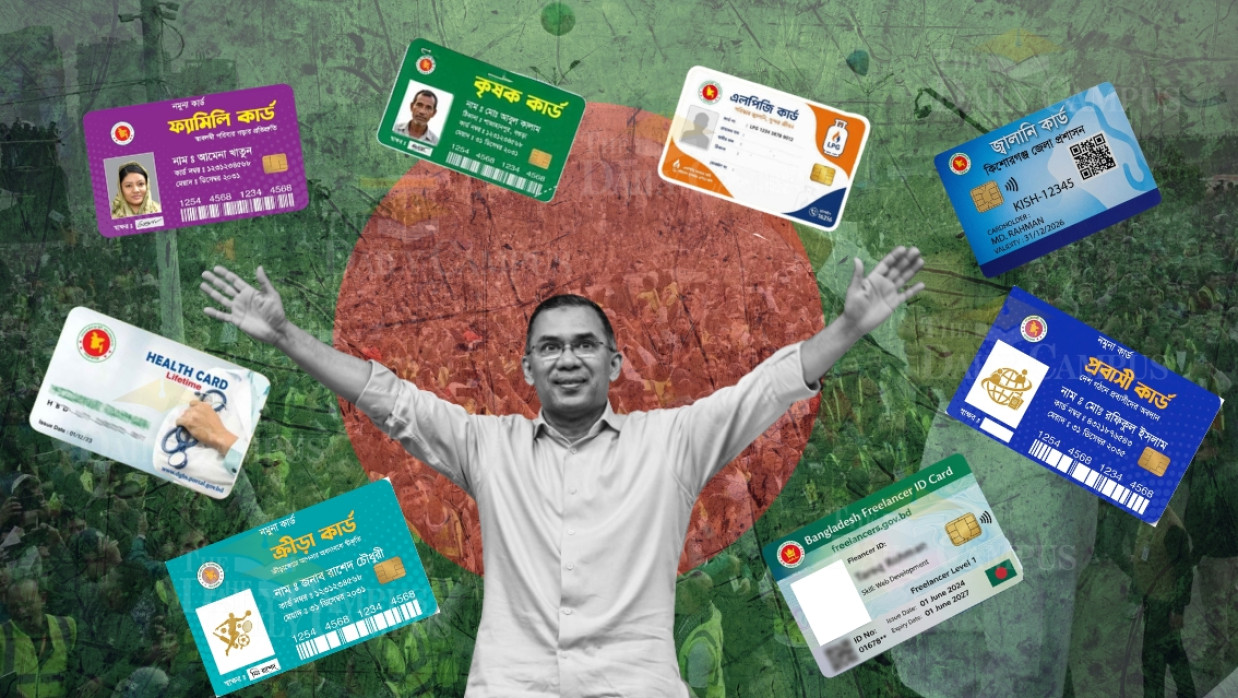
After returning to the country following nearly 17 years in exile due to political persecution, BNP Chairman Tarique Rahman shared his vision for national development with the declaration, “I have a plan.” Ahead of the 13th National Parliamentary Elections, he made several pledges, among which the 'Family Card' sparked widespread discussion and public interest. Following a landslide victory in the February 12 elections, the new government assumed office on February 17 and promptly launched the Family Card initiative.
While the election manifesto highlighted three primary service cards, Prime Minister Tarique Rahman has introduced several additional welfare cards within the first two months of his administration. To turn his commitment into reality, he officially inaugurated the program on March 10 in his constituency, Dhaka-17. Since then, the government has been moving forward with the implementation of the Farmer Card, Sports Card, Freelancer ID Card, E-Health Card, and LPG Card. Additionally, a 'Fuel Card' or 'Fuel Pass' has been introduced to manage the energy crisis.
1. Family Card
Initially announced to protect marginalized and low-income families, the Prime Minister has stated that all housewives will eventually receive this card to promote women's economic empowerment. The card is issued in the name of the female head of the household and functions as a digital database-based smart card.
-
Financial Benefits: A monthly cash allowance of BDT 2,500 or equivalent essential commodities. This amount is subject to periodic increases.
-
Affordable Commodities: Cardholders can purchase rice, pulses, soybean oil, and sugar at prices significantly lower than the market rate.
-
Distribution Method: Funds are transferred directly to the beneficiary's bank account or mobile financial service (e.g., bKash) without any middlemen.
-
Eligibility: Government employees, regular pensioners, owners of luxury assets (AC, private cars), and those with commercial licenses or large businesses are ineligible.
2. Farmer Card
The government is distributing 'Farmer Cards' nationwide in five categories. Through this, farmers receive 10 types of benefits, including agricultural inputs at fair prices, irrigation facilities, and easy-term loans. The Prime Minister inaugurated the pre-piloting phase in Tangail on April 14 (Pahela Baishakh).
-
POS Transactions: Farmers can directly purchase fertilizer, seeds, and food using POS machines.
-
Financial Support: Access to low-interest agricultural loans and an annual direct financial grant for specific categories.
-
Insurance and Information: Insurance for crops, livestock, and fisheries, alongside mobile updates on weather and pest control.
-
Goal: The Ministry of Agriculture aims to reach approximately 2.75 crore farmers within the next 5 years.
3. Freelancer ID Card
The Tarique Rahman-led government has planned to issue ID cards to 200,000 freelancers over the next five years. Announced on April 22 during the first session of the 13th Parliament, this card provides institutional identity and formal recognition of income. Efforts are underway to make this digital ID acceptable across all banks and financial institutions for easier credit access.
4. Sports Card
Inaugurated on March 30, this card aims to establish sports as a profession and ensure the social and financial security of national-level athletes.
-
Monthly Allowance: Initially, 300 selected athletes receive BDT 1 lakh per month (to be expanded to 500 athletes).
-
Other Benefits: Access to international-standard training, specialized medical care, and financial security for the athlete's family.
-
New Kuri Sports: A special scholarship and training program for talented children aged 12–14. The Prime Minister will officially launch this nationwide on May 2 at the Sylhet District Stadium.
5. E-Health Card
Launched under the government's 180-day program, this digital health identity card stores a citizen's entire medical history electronically. It is expected to be rolled out nationwide by late June 2026.
-
Services: Stores digital medical records (history, prescriptions, test reports) and provides a Unique Health ID. This allows doctors at any hospital in the country to instantly view a patient’s medical history for faster and more accurate diagnosis.
6. Expatriate Card
This card was designed to ensure the social dignity and financial security of migrant workers.
-
Banking and Remittance: Facilitates easier remittance transfers with financial incentives higher than the standard government rate for legal channels.
-
Emergency Support: Automatic membership in the Expatriate Welfare Foundation, providing financial aid for accidents, job loss, or death abroad.
-
Reintegration: Returning migrants can access easy-term 'SME' and 'Venture Capital' loans to start businesses.
-
Fast-Track Service: Promises respectful and hassle-free services at airports and embassies.
7. LPG Card
Announced by the Prime Minister in Jessore on April 26, this card aims to alleviate the cooking fuel crisis and physical hardship of housewives. Registered female members can use this smart card to purchase LPG gas cylinders at a specialized subsidized rate, benefiting rural and urban middle-class families alike.
8. Special Fuel Card (Fuel Pass)
To bring discipline to fuel distribution, a QR-code-based 'Fuel Pass' has been launched for motorcycles and private cars. Motorcyclists can collect these from their respective Upazila Nirbahi Officer (UNO) offices by submitting their NID, registration card, driving license, and mobile number.
Manifesto and Future Roadmap
The BNP’s election manifesto, titled "Bangladesh First," outlines 9 core pledges and a 51-point roadmap, including:
-
Tenure Limits: No individual may serve as Prime Minister for more than two terms (10 years).
-
Structural Reform: Proposal to create the post of 'Vice President' alongside the President.
-
Education: Free school uniforms and Wi-Fi for students, and free education for girls up to the postgraduate level.
-
Environment: Re-excavation of 20,000 km of rivers and canals and planting 25 crore trees over five years.
-
Technology: Implementation of international payment systems (PayPal) and regional hubs for e-commerce.
This manifesto is presented as a new social contract between the state and its citizens. The government emphasizes that its politics centers on rights, justice, and humanity rather than revenge or discrimination, ensuring that every citizen can proudly say, "Bangladesh First."
 Follow The Daily Campus on Google News