The Fall of El Pibe
Why Diego Maradona Was Banned from the 1994 World Cup
As the 2026 FIFA World Cup gets underway across the United States, Canada, and Mexico, football historians are revisiting the most shocking saga from the last time North America hosted the tournament. The 1994 World Cup stateside was designed to convert a skeptical American public to "soccer," but it was ultimately stolen by a 173-minute whirlwind of genius, madness, and the abrupt international demise of the sport's most volatile icon: Diego Armando Maradona.
The Secret Plot to Revive a Legend
When the USA was awarded the 1994 tournament, FIFA officials knew the event lacked a singular, transcendent headline act to capture American media attention. Enter Maradona. The Argentine maestro was effectively retired from international football, battling weight issues, and fluctuating between severe cocaine addiction and brief stints on the pitch for Newell's Old Boys in his homeland.
Rumors have persisted for decades that FIFA executives covertly approached Maradona, offering an unwritten understanding regarding drug testing if he could get himself into match fitness. The logic was clear: a slim, firing Maradona made the US tournament a massively lucrative global commodity.
To power his frantic body transformation, a portly Maradona began consuming "Rip Fuel," a potent energy supplement. It was a choice that would systematically trigger his public downfall just months later.
A History of Addiction and the Shotgun Comeback
Maradona’s dependence on substance abuse was already an open secret. He had been introduced to cocaine as early as 1983 during his stint with Barcelona, using it to self-medicate through intense loneliness. By the time he arrived at Napoli in 1984, his life was entangled with the Neapolitan Camorra (mafia), high-profile escorts, and severe addiction. This culminated in a 15-month global ban in 1991 after testing positive for cocaine.
By 1993, Argentina’s national team was in freefall, capping off their qualification disaster with a humiliating 5-0 home loss to Colombia. Desperate, head coach Alfio Basile issued an SOS to Maradona. The veteran returned, captaining La Albiceleste to a narrow 2-1 aggregate playoff victory over Australia to secure a spot on the plane to America.
The pressure, however, was immense. In February 1994, a stressed Maradona briefly quit the squad again. When reporters besieged his home for an explanation, the erratic star opened fire on the press corps with an air rifle, drawing police intervention and lawsuits. Yet, fueled by rumors that FIFA would shield him from stringent anti-doping procedures, he was ultimately named in the final 22-man roster.
The Wide-Eyed Scream and the Nurse on the Pitch
Maradona arrived in Foxborough, Massachusetts, looking astonishingly lean and sharp. In Argentina's Group D opener against Greece, he rolled back the years. Following a fluid team sequence, Maradona picked up a pass at the edge of the box, set himself with a delicate touch, and rifled a brilliant strike into the top corner.
What followed became an indelible piece of football folklore. Maradona sprinted toward a sideline television camera, his eyes wide and manic, screaming directly into the lens. While his loyalists viewed it as pure, unfiltered passion, critics would later point to that exact frame as visual proof of a man chemically altered.
"It’s my fault. I did it. It’s me."
— Diego Maradona, speaking to a Buenos Aires TV station after his positive test.
In match day two against Nigeria, Maradona pulled the tactical strings in a 2-1 victory, securing Argentina's passage to the knockout stages. But the euphoria evaporated instantly on the pitch. In a bizarre, highly public spectacle, a medical nurse took a smiling Maradona by the hand right after the final whistle, walking him directly to the drug-testing station. Behind the grin, panic was setting in.
The Positive Test and the 'Rip Fuel' Defense
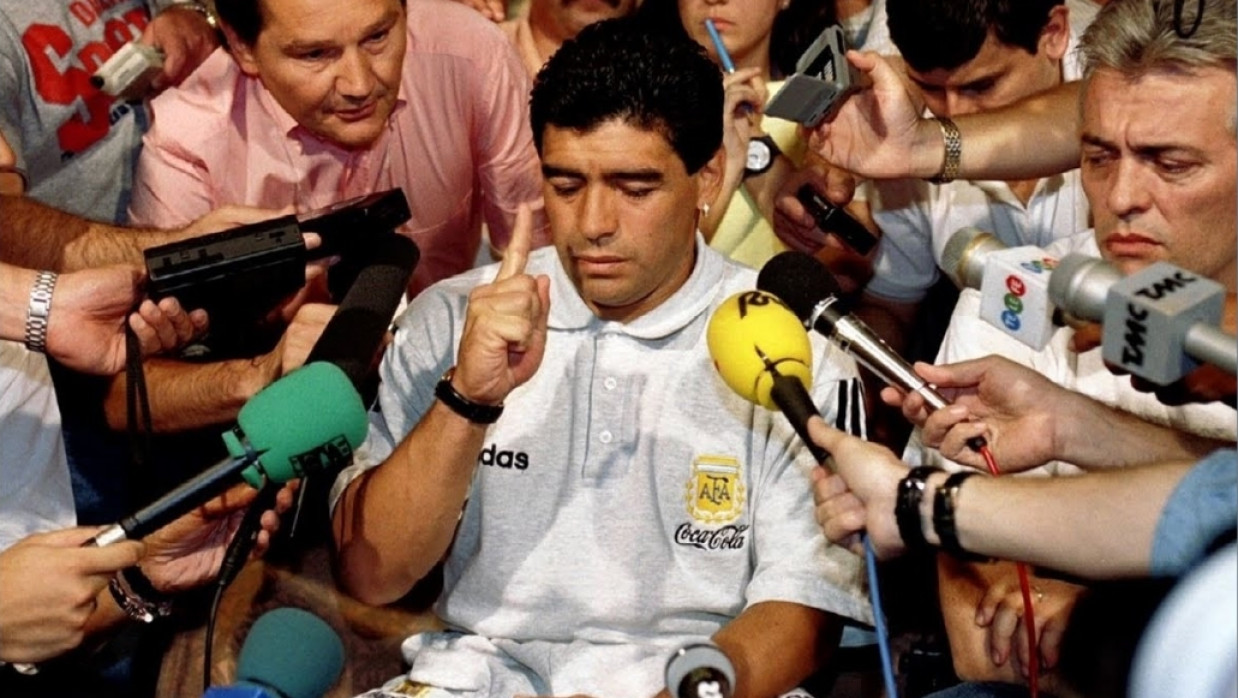
On June 29, 1994, FIFA General Secretary Sepp Blatter called a dramatic press conference to announce that both the 'A' and 'B' urine samples provided by the Argentine captain had tested positive for ephedrine—a banned stimulant that mimics adrenaline and aids weight loss. Maradona was instantly expelled from the tournament, ending his international career at 91 caps.
A bitter blame game immediately erupted within the Argentine camp:
-
The AFA Position: Julio Grondona, president of the Argentine Football Federation, claimed the ephedrine came from an over-the-counter nasal spray mistakenly given by Maradona's personal doctor.
-
The Rip Fuel Defense: In his autobiography, Maradona blamed the US version of his energy drink. He claimed his regular Argentine supply had run out, and his trainer purchased the American counterpart over the counter, unaware that the US formula contained the banned ephedrine stimulant.
Without their emotional anchor, a devastated Argentina squad lost their final group game 2-0 to Bulgaria and were promptly knocked out of the World Cup in the Round of 16 after a thrilling 3-2 defeat by Romania.
A Complicated Legacy
Maradona’s dramatic exit in 1994 cemented his status as football’s ultimate flawed genius. Decades later, comparisons are inevitably drawn between Maradona and Lionel Messi, who secured his own legendary status with the 2022 World Cup.
Where Messi is calculated, quiet, and pristine, Maradona was pure, unadulterated chaos. Yet, it is precisely that volatile charisma, combined with unmatched on-pitch brilliance, that ensures his legacy remains entirely untarnished in the hearts of football romantics worldwide.
 Follow The Daily Campus on Google News