Hemayet Jahan Promoted from Pro-VC to PSTU VC After Citation Fraud
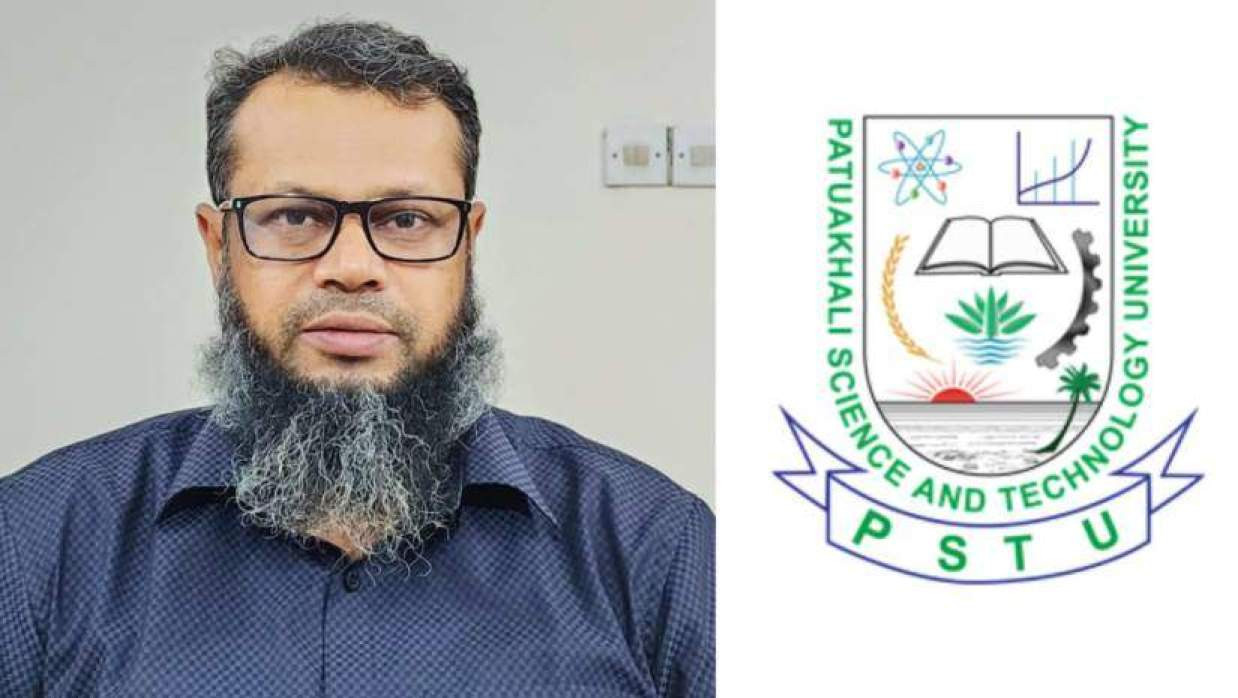
The Ministry of Education today issued an official gazette notification formally appointing Professor Dr. S.M. Hemayet Jahan as the new Vice-Chancellor of Patuakhali Science and Technology University (PSTU) on 8th June. However, the official publication of the gazette has ignited intense controversy across the academic sector, as the elevation to the university's apex executive seat comes amidst a widening probe into grave allegations of academic citation fraud that reportedly facilitated his swift administrative rise.
Investigative findings reveal that Professor Jahan allegedly manipulated his global digital research credentials by co-opting research papers authored by other scholars into his personal Google Scholar profile to artificially inflate his citation metrics. Curiously, shortly after his administrative promotion, the heavily engineered profile was altered or deleted entirely, causing his official state citation count to plunge drastically overnight.
Artificial Inflation to Influence High-Level Academic Screenings
In the global academic ecosystem, a scholar's total citations serve as a definitive indicator of their research impact, ethics, and credibility. Because these metrics directly influence high-profile university appointments, institutional promotions, and major government research grants, the practice of engineering artificial metrics has faced rigorous pushback.
The exposure of Professor Jahan's academic data follows a similar recent media scandal involving Professor Belal Hossain, the Pro-Vice-Chancellor and Professor of Plant Pathology at Sher-e-Bangla Agricultural University (SAU), which reportedly prompted Professor Jahan to systematically purge stolen foreign articles from his account to evade initial detection.
The timeline of the data manipulation points to an intentional strategy deployed during the public university leadership transitions. Following the July 2024 mass uprising, the interim government prioritized accomplished researchers alongside teaching credentials when appointing new Vice-Chancellors and Pro-Vice-Chancellors across state institutions.
Seeking a top executive seat, Professor Jahan allegedly exploited this policy framework by systematically claiming papers written by international researchers who shared similar surnames. Specifically, evidence indicates he appropriated the bulk of the extensive research portfolio belonging to Sayka Jahan, a researcher at Macquarie University in Australia and a former assistant professor at Jessore University of Science and Technology (JUST).
Leveraging these fabricated metrics during the state appraisal process, he successfully secured an escalation to the university's top administrative ranks on October 27, 2024. On September 23, 2024, his Google Scholar profile boasted an impressive 1,960 citations, whereas his currently active profile reflects a mere 326 citations.
Technical Glitch Defenses Draw Severe Academic Backlash
When confronted with the massive data discrepancies, the newly appointed Vice-Chancellor defended the occurrence as a technical anomaly, claiming the system acted on its own.
"The excessive citations were likely linked due to an automated system feature. Once the names of other researchers came to my attention, I took steps to rectify the matter. I had not monitored the profile's citation growth for a long time, which is how other authors' articles became attached to my account." — Professor Dr. S.M. Hemayet Jahan, Vice-Chancellor, PSTU
However, seasoned academics and national researchers have strongly rejected this explanation. Professor Dr. Md. Gulzar Hossain, a senior researcher at Bangladesh Agricultural University (BAU), explained that while keeping automated settings enabled can lead to accidental links, scholars are instantly notified of additions every time they log in.
He noted that the platform explicitly prompts users to confirm authorship, making the long-term retention of stolen citations for career advancement a serious ethical violation. He added that Google Scholar permanently bans accounts when provided with definitive proof of such fraud.
Prominent researcher and former Director General of the Bangladesh Agricultural Research Institute (BARI), Dr. M. Shahidur Islam, described the sudden metric surge as highly suspicious. "We classify individuals who deploy such manipulations as 'pseudo-scientists.'
The concerned teacher's career evaluation must be thoroughly re-examined. Under existing government service rules, if an individual secures a prestigious state rank through fraudulent manipulation, there are clear provisions mandating their demotion," Dr. Islam stated.
A History of Administrative and Political Frictions
This citation scandal adds to a growing list of administrative controversies surrounding Professor Jahan's tenure at PSTU. His very entry into the university's academic ranks remains highly irregular; despite holding a basic degree in Zoology from a conventional college, he was appointed to the specialized Department of Entomology in 2006. Records indicate that under the original lecturer recruitment circular, he had not even applied to the Entomology department, having filed his application under the Department of Agroforestry instead.
Furthermore, critics point out his history of leveraging shifting political ties for rapid career advancement. Immediately following his initial appointment, he secured the position of Private Secretary to the then-Jamaat-leaning Vice-Chancellor, Dr. Abdul Latif Masum.
While he later climbed the ranks to serve as the General Secretary of UTAB (a pro-BNP teachers' nationalist alliance), his political alignments fractured in 2025. His direct participation in a program organized by Islami Chhatra Shibir triggered intense internal conflicts and open disputes with pro-BNP faculty members and university officials, making the publication of today's gazette notification a highly polarizing event for the institution.
 Follow The Daily Campus on Google News