Why Do People Keep Asking, “Who’s Hadi?”
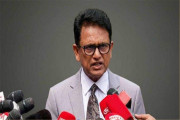
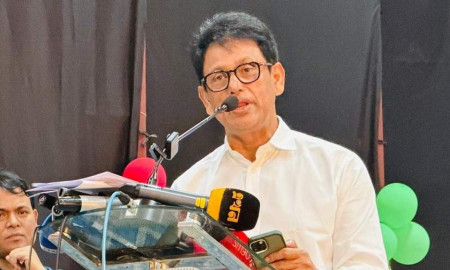
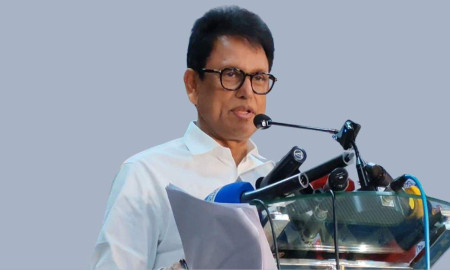
Earlier this month, Nurul Haq Nur appeared on a television talk show. Nur is a former vice-president of the Dhaka University Central Students’ Union (DUCSU) and is now state minister for expatriates’ welfare. He said Sharif Osman Hadi should not have been buried beside the national poet, Kazi Nazrul Islam. Five or ten years from now, he suggested, people may ask: “Who is Hadi? What is his contribution to the nation?”
The clip spread across Facebook within hours. Shadik Kayem, the current DUCSU vice-president, posted a video rebuttal. Leaders of the National Citizen Party (NCP) and the Islamic speaker Rafiqul Islam Madani also criticised the minister. By 10 October, Nur was telling reporters that Hadi is known by his own identity and that his objection concerned only the burial site.
The row supports part of Nur’s point and undercuts the rest. For many Bangladeshis under 35, the question is close to offensive. For many older readers, and for people who rarely watch political clips online, it is a fair one. It deserves a plain answer.
The record
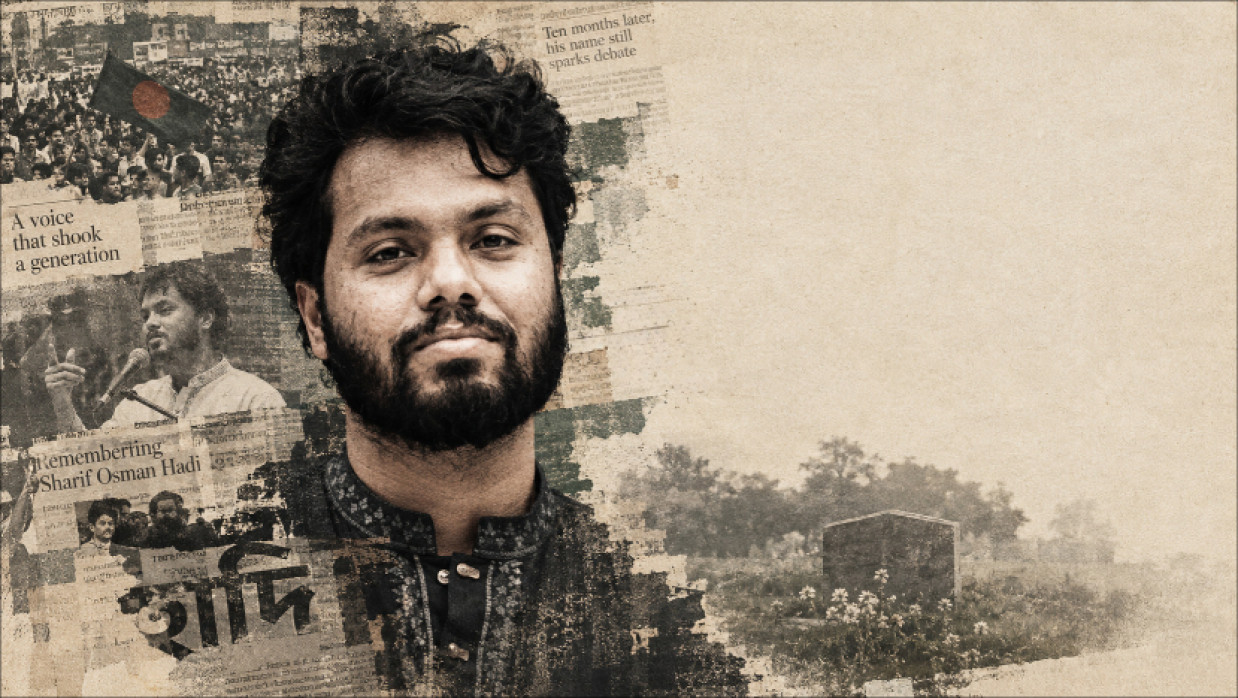
Hadi was born in 1993 in Nalchity, Jhalakathi, the youngest of six children of a madrasa teacher. He studied at Jhalakathi NS Kamil Madrasa through the Alim level, then entered Dhaka University’s political science department in the 2010–11 session. He paid his way by tutoring and taught English for years at a coaching chain. His last job was at a private university.
During the July 2024 uprising he lived in Rampura and joined protests there. He was not among its most recognisable faces. On 13 August 2024, he and Abdullah Al Jaber launched Inqilab Mancha, which described itself as a cultural platform against “all forms of domination.” Its early demands were a ban on the Awami League, trials for those responsible for killing protesters, and protection for those it called “July fighters.”
In 2025 he announced that he would contest the February 2026 election from Dhaka-8 as an independent. He raised money from the public and said he would publish every account. On 12 December 2025, the day after the Election Commission announced the schedule, he was riding a battery-powered rickshaw on Box Culvert Road in Paltan. CCTV footage shows a gunman on a motorcycle shot him in the head.
He was flown to Singapore General Hospital on 15 December and died there on the night of 18 December, aged 32. His janaza, led by his elder brother, was held outside the Jatiya Sangsad on 20 December. Crowd estimates ranged in the hundreds of thousands, depending on the agency. He was buried beside Nazrul at his family’s request.
A populist, but a cultural one
Hadi did not avoid the labels attached to him. He was nationalist, anti-hegemonic and openly comfortable with a religious vocabulary. Yet his politics was less a party programme than a cultural one, and that distinction explains much of what followed.
Bangladesh’s populist mood since 2024 has leaned toward the religious right. Hadi spoke to that mood and stood close to it, but he did not simply ride it. He tried to build a movement that faced the public: a library, reading circles, public accounting, door-to-door campaigning. He refused to be pulled wherever the rightward current ran. His supporters read this as principle, and his critics read it as ambiguity.
Hadi asked the public to fund his campaign and published the accounts regularly. He campaigned on muri and batasha, went out after the Fajr prayer and stayed away from home for days. Many may have disagreed with this view, but no ideology can be imposed by force, and Hadi understood this. For that reason, he founded the Inqilab Cultural Centre, inviting even those who disagreed with his ideas, including many of his critics, to reading circles.
Culture, religion and the parties
Hadi argued that for decades a secular-left establishment had controlled the country’s stages, newsrooms and prize committees. He called this “cultural fascism” and described the Awami League as closer to a cult than a political party. He saw the Shahbag Ganajagaran Mancha as the largest organised crowd of the past fifty years and, in his words, a parallel state.
His remedy was competition, not a ban. On religion, he told a conservative Muslim audience that he did not campaign for a caliphate. He described Islam as a cultural element in Bangladesh as well as a theology, and he called the mass prostration at one of his rallies a cultural act and not an act of worship. He cited Tunisia’s Rached Ghannouchi as an example of a religious politician who did not try to ban what he disliked. In the same talk he said religious Bangladeshis, though 90 percent of the population, hold little cultural power because they lack skills, and he urged them to learn languages, videography and press practice. He also suggested that Hindu-based political parties could give minority voices their own channel. Readers will judge that idea differently. It is reported here only as his view.
His view of the parties was mixed. He called Ziaur Rahman and Khaleda Zia symbols of sovereignty, yet said the BNP had no cultural strategy to rival Chhayanaut and Udichi. He told reporters the NCP had “axed the July movement” and gave the Yunus government six out of ten. When critics called Inqilab Mancha a Jamaat “B-team,” he said it never allied with Shibir in the DUCSU election and that some members had contested as individuals.
Press freedom and the “alternative” argument
His view of the press was critical but not hostile to its existence. He said mainstream media ignored stories such as enforced disappearances and the Pilkhana killings, while giving large coverage to others. But he did not call for closing newspapers. When crowds gathered outside Prothom Alo’s office after the uprising, he said Inqilab Mancha did not support them. “If you can,” he said, “create ten more alternatives to Prothom Alo.” In his view, the answer to a dominant narrative was a rival narrative, not a mob.
The Prothom Alo columnist recalled that during the internet shutdown of July 2024, when electronic media were under heavy pressure, its print edition showed the country how far the violence had gone. The columnist argued that Hadi believed in democratic methods, in which ideas are met by ideas.
During the internet shutdown of July 2024, when electronic media were under heavy pressure, national daily newspapers’ print editions showed the country how far the violence had gone. Hadi believed in democratic methods, in which ideas are met by ideas.
The attacks that followed his death make this passage harder to read. His critics noted the gap between what he said and what was done in his name.
What his critics heard
His critics’ strongest material came from his own mouth. After the clashes around the NCP’s “March to Gopalganj” in July 2025, he used profanity on air and called for the district to be dissolved. He later said he opposed identity politics and held nothing against the people of Gopalganj. He called Dhanmondi 32 a “place of worship of fascism,” and Hassan uz-Zaman Shamol, who is broadly sympathetic to Hadi, wrote that Hadi had a leading role in its demolition. Early in the post-uprising period, he faced criticism over alleged efforts to mobilise crowds before turning toward electoral politics.
On television, interviewers pointed to phrases such as “tear apart” and “kill” in his speeches. In one exchange, Hadi defended a similarly violent remark by NCP leader Sarjis Alam as political rhetoric, while Dr. Tushar objected. Dr. Tushar is known for his debating, his television work, his writing and his social activism. Hadi’s answer was that language depends on setting, and that a street rally, a policy roundtable and a studio each call for a different register. He described abuse as the weapon of the powerless against those he held responsible for mass killing, and said it is safe only in educated hands, because such people know whom not to target.
After the funeral, Dr. Tushar spoke on air about the same man. He called Hadi a rebel who could be abrasive on screen and who embraced him warmly once the cameras were off. He said Hadi criticised almost every party, spoke against corruption, and tried to build a library and a cultural centre. He added that he could accept much, but not the cruelty of hearing that Hadi’s own companions had reportedly turned on him.
The aftermath
The hours after the announcement of his death were violent. Inqilab Mancha’s own post called him a martyr in the struggle against Indian hegemony, though an international broadcaster reported that the group had earlier urged followers to avoid violence. Overnight, crowds attacked the Karwan Bazar offices of Prothom Alo and The Daily Star. One building was set alight, and some 30 to 35 journalists and staff were trapped on a rooftop until fire crews rescued them. Chhayanaut and Udichi were also attacked. Many called the attacks, done in Hadi’s name, terrorist acts and signs of fascist tendencies. Many Awami League supporters abroad celebrated the shooting online, while the nationwide grief that followed was rarely seen in recent memory.
The criminal case remains unresolved. On 6 January 2026, the Detective Branch charged 17 people and named Faisal Karim Masud, a former Chhatra League leader, as the shooter. Jaber, the complainant, rejected that charge sheet, and the court sent the case to the Criminal Investigation Department. Faisal and an alleged accomplice were arrested near the Indian border in March. In April, the foreign ministry said India had agreed to return them, but no handover has been reported. On 27 September, a Dhaka court deferred the CID’s report for the 20th time, to 3 November.
In February the BNP’s Mirza Abbas won Dhaka-8 with 59,366 votes, ahead of the NCP’s Nasiruddin Patwary on 54,127. Inqilab Mancha fielded no replacement. The state’s treatment of his memory is still unsettled: The Daily Campus reported in June that his story will not appear in the 2027 textbooks, with a Class 5 chapter under consideration only for 2028.
How a name becomes a symbol
Hadi’s fame came through platforms that many editors over 50 do not watch closely. Hadi taught English and IELTS for about a decade, and his former students became early followers. He also wrote poems, which found many new readers after he was shot. Short clips carried him further. A 40-second video leaves no room for qualification, and two clips of the same man can mislead in opposite directions.
One shows a cheerful candidate publishing his accounts. Another shows a man swearing about Gopalganj. Each reaches a different feed and forms a different picture. This is how a figure becomes unavoidable to one generation and barely known to another. After his death, supporters called him saint, martyr and hero, and opponents called him Jamaat’s B-team, the NCP’s B-team, an anti-India extremist and a mob instigator. Few of those words came from him.
The man behind the label
In interviews, Hadi said that if he were sent back to the world, two things he would choose again were his family and his madrasa. He described the madrasa warmly. Students there, he said, performed Rabindranath’s plays, sang Rabindra and Nazrul songs and practised jari and bhatiali. He also recalled being tagged as a Shibir sympathiser at Dhaka University because of his background.
His family paid a price for his work. He said his wife was pregnant during July 2024 and his relatives tried to keep him home. During his electoral campaign, he could not even see his infant child for days. The interim government later announced financial support for his wife and child.
He also seems to have expected the death that came. In an interview, Hadi said he would rather live five years that mattered than fifty that did not, and he pointed to Ziaur Rahman, who held office for only a few years. In remarks published after his death, he described a large march against injustice, himself at its front, a bullet striking his chest and himself dying “smiling.”
Hadi did not foresee how others would use his name. Shamol argued that Hadi’s image must be taken back from those who would worship it, and that criticism of him should begin early. That applies equally to those who would erase him.
So the honest answer to Nur's question is not a single label. Hadi was a gifted, abrasive and sometimes reckless speaker, but also, at times, a careful thinker. He tried to give a religious majority the cultural tools he believed it lacked, though his language sometimes gave cover to the very mobs he said he opposed. He paid for his politics with his life. The questions of who killed him, who will be held to account, and what responsibility others bear for the violence carried out in his name remain unanswered.
 Follow The Daily Campus on Google News