Compulsory ICT, Absent Teachers: Bangladesh Is Repeating an Old Mistake
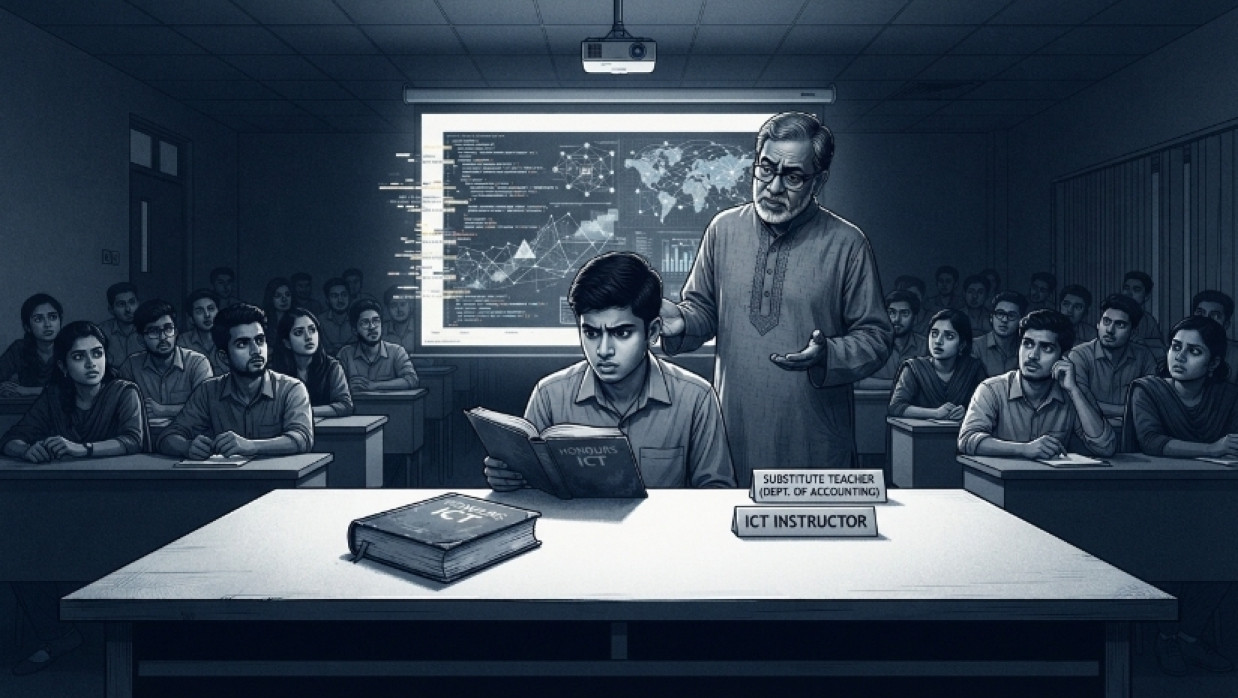
Walk into an Honours 1st year classroom at almost any government college under the National University this year, and you will likely find a compulsory ICT class in progress and a fair chance that the person teaching it has no formal training in the subject. This is not a hypothetical. It is the everyday reality in colleges like mine, and it exposes a policy built on an impressive syllabus but almost no plan for who will actually teach it.
The scale of what is at stake is worth pausing on. The National University is not a marginal player in Bangladesh's education system, it is the country's largest higher-education body, with hundreds of affiliated colleges offering Honours degrees to well over a million students, and it enrolls close to three-quarters of everyone pursuing higher education nationwide. Within the last two academic years, NU revised its Honours curriculum to make ICT compulsory, adding an advanced follow-up course in the second year, with real institutional weight behind it: partnerships with the ICT Division's Aspire to Innovate (a2i) programme and UNICEF, a four-credit structure combining theory and hands-on practical work, and hundreds of thousands of students enrolling in the very first phase, a number set to keep climbing as pass-course students are brought in as well.
On paper, this is exactly the kind of reform Bangladesh needs if it wants its graduates to compete in a digital economy. The National University's own vice-chancellor has spoken publicly about how a modernized ICT curriculum could meaningfully boost the country's freelancing and remittance earnings in the years ahead. But a curriculum is not an education. It requires a teacher in the room who actually knows the subject and this is where the reform quietly falls apart.
Take Sherpur Government College, Sherpur where I teach. There is exactly one sanctioned teaching post for ICT. That single teacher is expected to cover Higher Secondary (HSC) classes and Honours classes at once an impossible workload for one person, however capable. To fill the gap, colleges like ours routinely pull in teachers from entirely unrelated departments, including my own department of Accounting, to take ICT classes. We do our best. But "our best" is not the same as competent, specialized instruction in a field that changes every year and that students are meant to use for real digital and analytical skills, not just to pass an exam.
This is not a Sherpur problem, and it is not a new one. Bangladesh made ICT compulsory at the SSC and HSC level as far back as 2013, and more than a decade later, the same structural failure persists nationwide: teaching posts were never created in proportion to the subject's introduction, and government colleges and schools still lean on teachers of physics, Bangla, Islamic history and other unrelated subjects to deliver ICT classes.
Officials at the Directorate of Secondary and Higher Education have themselves acknowledged the shortage and said recruitment proposals are pending with the Ministry of Education and the Public Service Commission. A handful of ICT lecturers have since joined through the civil service exam a welcome step, but nowhere near enough to close a gap of this size. By layering a new compulsory ICT mandate onto the Honours system without first fixing this exact problem at the level below it, National University risks repeating a thirteen-year-old failure at an even larger scale.
The cost of getting this wrong is not abstract. Bangladesh already lags behind regional peers on basic digital-development indicators, with roughly half the population using the internet. A generation of Honours graduates who sit through an ICT course taught by a non-specialist will pass their exams and still leave college without the practical digital competence the policy was designed to build in spreadsheets, data tools, cybersecurity basics, and the emerging technologies now reshaping every profession, including my own field of accounting.
The burden falls hardest on rural and under-resourced colleges, widening the very inequality that a national curriculum is supposed to close. And ambitions like a sharply higher freelancing and remittance economy will remain slogans rather than outcomes if the classrooms meant to build those skills are left understaffed.
None of this is unfixable, but it does require the Ministry of Education, the University Grants Commission and National University authorities to treat teacher recruitment as inseparable from curriculum reform, not an afterthought to it. Four steps deserve immediate attention: Create dedicated ICT teacher posts in every Honours-offering college in proportion to actual student enrolment, rather than leaving colleges to absorb a national subject with a single, overstretched post. Fast-track recruitment through the Public Service Commission specifically for ICT positions at the college level, with clear timelines the Ministry is held to publicly.
Train and fairly compensate the non-specialist teachers currently filling the gap, so that what is now an unplanned burden becomes, at minimum, a properly supported interim measure rather than a permanent workaround. Prioritize under-resourced and rural colleges first in any recruitment drive, so that the students with the least access to private alternatives are not the last to be served.
A compulsory subject without a competent teacher is not an education policy, it is a formality. Bangladesh has already run this experiment once, at the secondary level, and watched it fail for over a decade. The National University's Honours colleges do not have to repeat it. But that requires the government to act now, before another cohort of students completes a "compulsory" ICT education having barely touched the subject at all.
Disclaimer: Written by Habjul Alam Lemon, Assistant Professor of Accounting at Sherpur Government College and PhD Fellow, AIS, University of Rajshahi. The views and opinions expressed in this op-ed are solely those of the author and do not necessarily reflect the views, policies, or editorial position of The Daily Campus.
 Follow The Daily Campus on Google News