Third-language education to be introduced at 50 universities by December

Third-language education will be introduced at 50 universities across Bangladesh by December this year, University Grants Commission (UGC) member Prof Dr Abdullah-Al-Mamun has said. He said the initiative is aimed at expanding employment and higher education opportunities at home and abroad, as part of the government’s election pledge.
Mamun made the remarks as a special guest at the inauguration of the Confucius Institute at the University of Chittagong (CU) on Saturday. The institute was established jointly by CU and China’s Yunnan Minzu University.
He said the UGC is also working to create opportunities for joint and dual degree programmes at Bangladeshi universities, noting that partnerships with Chinese higher education institutions could contribute to the internationalisation of the country’s universities.
“The world is becoming increasingly interconnected. In this context, knowledge of an additional language can expand students’ academic and professional opportunities while strengthening their ability to communicate internationally.”
According to Mamun, the government’s 2026 election manifesto emphasised expanding access to third-language education, including Mandarin, Japanese, German, Korean and Arabic, to increase educational and employment opportunities for students.
The UGC plans to establish third-language centres at universities across all divisional regions, he said. Institutions such as the newly established Confucius Institute at CU will be important partners in implementing the initiative.
Mamun said the programme would require both foreign and local language experts as well as appropriate teaching materials. The UGC will work closely with relevant embassies, with support from the Chinese Embassy expected to be particularly important as Mandarin has been identified as a priority language.
He said third-language education could also expand opportunities for student exchanges, scholarships, joint academic programmes, research fellowships, summer schools, academic conferences and faculty-researcher exchanges.
On employment prospects, Mamun said Bangladesh’s economic ties with China span trade, manufacturing, infrastructure, technology, logistics, engineering and information technology.
“Graduates who combine expertise in their respective fields with language and intercultural skills can have opportunities to work in international environments. Third-language education should therefore be considered part of a broader strategy to improve employability.”
He also highlighted the potential for Bangladesh-China university cooperation in areas beyond language and culture, including artificial intelligence, emerging technologies, agriculture, climate studies, engineering, biotechnology and public health.
According to Mamun, the Confucius Institute could serve as an institutional platform for strengthening such academic and research links. He also called for a shift from “brain drain” to “brain circulation” by creating opportunities for Bangladeshi academics, researchers and professionals working abroad to contribute to education and research in the country.
He said visiting faculty programmes, summer schools, joint supervision, research collaboration and academic exchanges could help connect international knowledge networks with Bangladeshi universities. Highlighting the role of language in people-to-people relations between Bangladesh and China, Mamun said language can serve as a gateway to understanding another society.
He said the Confucius Institute would allow Bangladeshi students to learn about Chinese language, history, literature and culture, while creating opportunities for Chinese students and academics to learn about Bangladesh’s language, culture and society.
He also said the institute should go beyond language instruction and become a platform for student and faculty exchanges, research collaboration, scholarships and international partnerships.
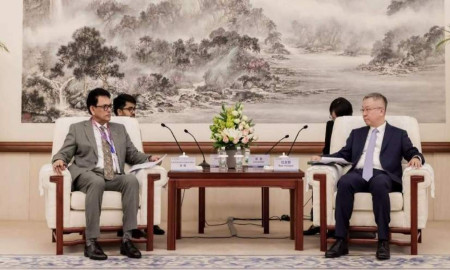
The event was attended by Zhao Junmin, member of the Standing Committee of the CPC Yunnan Provincial Committee, as the chief guest. Chinese Ambassador to Bangladesh Yao Wen, CU Vice-Chancellor Prof Dr Mohammad Al-Forkan, Yunnan Minzu University Party Committee Secretary Ruan Zhaoqi and Bangladesh Krira Shikkha Pratisthan Director General Brigadier General Mohammad Saif Ullah were also present, along with teachers, students and other stakeholders.
 Follow The Daily Campus on Google News