Shoes hurled at 'Razakar-Al-Badr-Al-Shams' effigies at RU on Victory Day
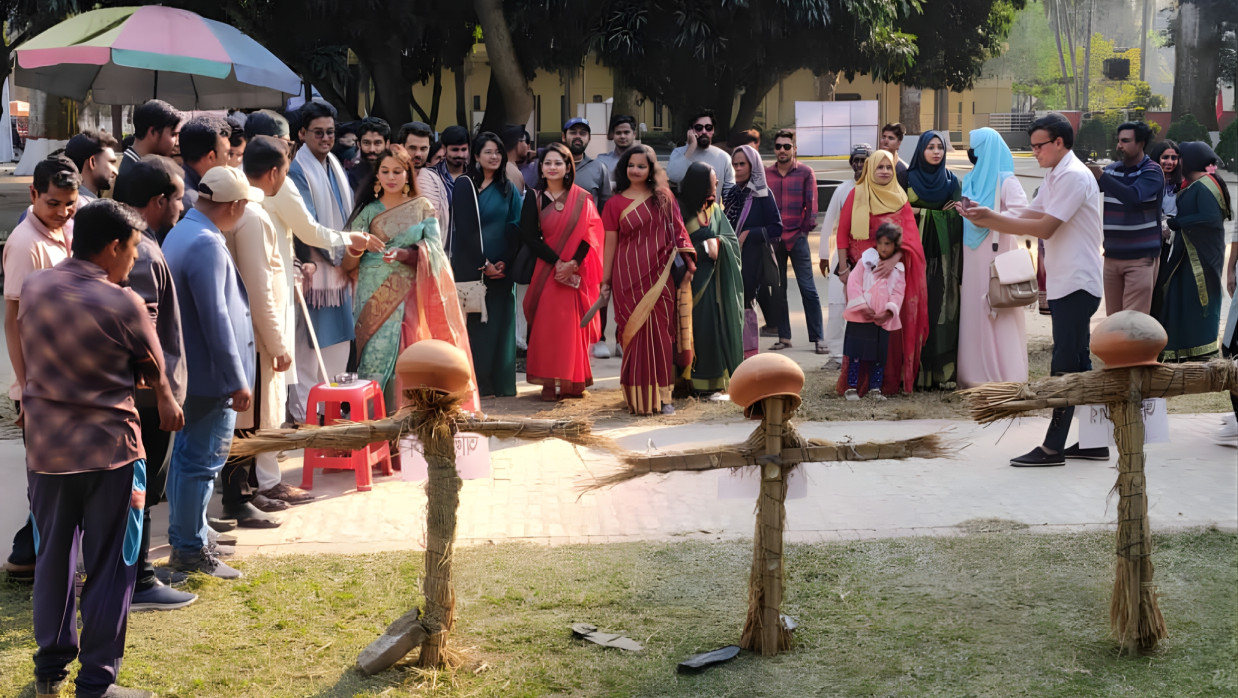
A shoe-throwing programme targeting symbolic representations of "Razakar, Al-Badr, Al-Shams" was observed at Rajshahi University (RU) on the occasion of the great Victory Day. The programme, titled "Hanadar Hunt" (Invader Hunt), was organised by the university's Chhatra Dal at the Buddhijibi Chattar around 3pm on Tuesday (16 December).
On-site observation revealed that they were throwing shoes at three earthen pots labelled "Razakar, Al-Badr, Al-Shams". Participants who successfully hit the pots with their shoes were being rewarded with chocolates.
Speaking about the programme, Rajshahi University Chhatra Dal President Sultan Ahmed Rahi said Pakistani forces' collaborators (Razakar, Al-Badr, Al-Shams) raped hundreds of thousands of women and killed them brutally against the people of Bangladesh in 1971. At the same time, these pro-Pakistan collaborators also brutally killed the heroic freedom fighters who fought and sacrificed their lives for the red-green flag. On the great Victory Day today, the programme was organised to express hatred and protest against these despicable crimes.
He said through this programme, hatred has been expressed towards those who do not believe in Bangladesh's sovereignty, deny the red-green flag, still hold pro-Pakistan sentiments, and are involved in conspiracies against Bangladesh.
Organisational Secretary Mahmudul Mithu said today's initiative aims to express hatred towards those who were killers and collaborators in the history of 1971, who helped the invading Pakistani forces kill the people of this country and pulled the strings behind the killings, and to identify Razakars.
He said if Mir Jafar had not been forgiven in this land in 1757, perhaps we would not have had to endure two hundred years under British rule. Similarly, forgiving the treacherous Razakars of 1971 was a grave mistake. We are still paying the price for that mistake, because since the uprising, they have been trying to tarnish the Liberation War in various ways and creating different narratives to question the history of the Liberation War.
Mithu further said those who openly took positions against independence in broad daylight and organisationally opposed the Liberation War are now making grand proclamations. They are conducting negative campaigns by calling the Liberation War an Indian conspiracy. Although the Razakars of 1971 are not directly present today, their ideological followers and descendants are still engaged in anti-state conspiracies.
 Follow The Daily Campus on Google News