The Resurrected House: Return of Chowdhury, Nizami, and Sayeedi families
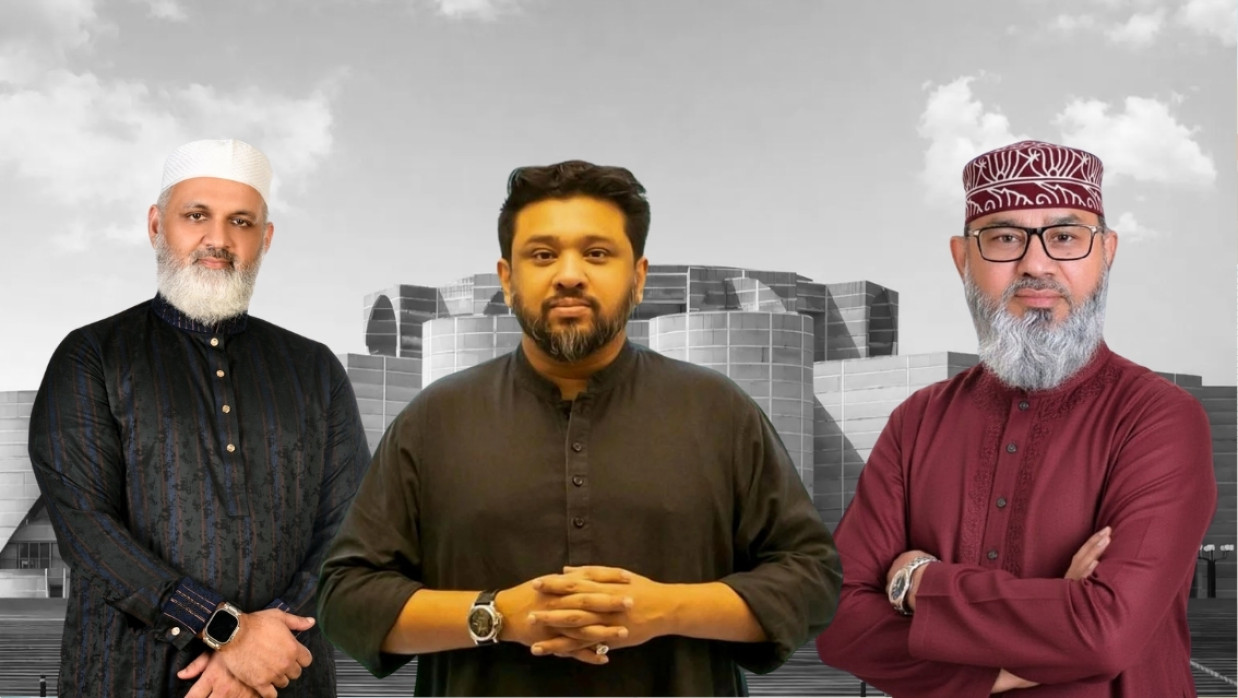
The 13th Jatiya Sangsad, which convened following the February 12 general election, represents a profound rupture in the historical narrative of Bangladesh. The assembly has welcomed back the sons of men once condemned as the ultimate enemies of the state by the previous regime. Their presence in the chamber where their fathers were once influential leaders signifies a remarkable reversal of the political order established over the last decade.
Hummam Quader Chowdhury, the son of the late Salauddin Quader Chowdhury, secured a significant victory in the Chittagong-7 constituency. His father was a veteran six-term lawmaker who was executed in 2015 following a conviction for crimes against humanity. The return of the younger Chowdhury to his father's seat suggests a public rejection of the judicial process that ended his father's life.
Similarly, Mohammad Nazibur Rahman has entered parliament to represent the Pabna-1 constituency. This seat was long held by his father, the former Jamaat-e-Islami Ameer Motiur Rahman Nizami. Nizami was executed in 2016 after a trial that drew intense international scrutiny for its significant procedural gaps and legal inconsistencies.
Masood Sayeedi has also reclaimed his family's political ground by winning the Pirojpur-1 seat. He follows the legacy of his father, Delwar Hossain Sayeedi, who died while serving a life sentence in custody. While his brother Shameem Sayeedi narrowly lost his own contest, the family's political brand remains a potent force in the Barishal division.
The presence of these individuals in the house of the nation forces a critical re-examination of the International Crimes Tribunal (ICT). For years, this tribunal was the centerpiece of a state project intended to provide closure for the 1971 war through a series of controversial trials. However, the return of these dynasties suggests that the project may have achieved the opposite of its intended goal by turning the accused into political martyrs.
Many legal observers and human rights organizations have long criticized the tribunal for failing to meet international fair trial standards. Groups such as Human Rights Watch and Amnesty International highlighted systemic failures in the judicial process throughout the last decade. They argued that the trials were often used as a tool for political vengeance rather than genuine historical accountability.
One of the most damaging episodes for the tribunal's legitimacy was the 2012 Skype scandal. Leaked conversations suggested that the presiding judge was taking instructions from external consultants and government officials behind closed doors. Justice Mohammed Nizamul Huq eventually resigned following the leak, but the government refused to grant retrials to the accused individuals.
This controversy fueled the narrative that the trials were "judicial murders" rather than impartial legal proceedings. The term "judicial murder" has since become an industry standard word in the Bangladeshi political lexicon to describe these executions. it encapsulates the belief that the state used the cover of law to systematically eliminate its most vocal political opponents.
Furthermore, the legal framework of the tribunal was built on constitutional exceptions that stripped the accused of their fundamental rights. Article 47(3) and Article 47A of the Constitution prevented defendants from seeking remedies for the violation of their fair trial rights in the Supreme Court. These provisions effectively created a parallel legal system where the presumption of innocence was often discarded in favor of predetermined outcomes.
The families of the accused frequently pointed out that the tribunal restricted the number of defense witnesses while allowing the prosecution unlimited scope. In the case of Salauddin Quader Chowdhury, the court famously refused to hear testimony from high-profile international witnesses who could have provided alibis. These individuals were prepared to testify that Chowdhury was in Pakistan during the period of the alleged crimes.
The recent July uprising has further complicated the historical memory of the 1971 trials and the previous government's narrative. During the anti-discrimination movement, the use of the term "Razakar" by the state backfired spectacularly against the ruling party. Protesters re-appropriated the label to mock the regime's attempts to delegitimize modern democratic demands through historical slurs.
This linguistic shift indicates that the historical trauma of 1971 can no longer be used as a shield for contemporary authoritarianism. The people of Bangladesh have signaled that they value the rule of law over the selective and biased application of history. The electoral success of the heirs is a direct manifestation of this public sentiment regarding the previous regime.
It is a critical irony that the leaders of the previous regime now face the same tribunal they once championed to silence others. Former Prime Minister Sheikh Hasina and her home minister were found guilty of crimes against humanity in November 2025. They were convicted in absentia for their roles in the "July Massacre" that preceded the collapse of their government.
However, human rights groups caution that these new trials must not repeat the procedural errors of the previous era. Amnesty International has noted that the speed of the current proceedings and the lack of a robust defense for the accused are concerning. Justice for the victims of the July uprising should not be served through the same flawed mechanisms once used against the opposition.
The return of the Chowdhury, Nizami, and Sayeedi families to parliament is not merely a political comeback for their respective parties. It is a repudiation of an era marked by "enforced disappearances" and secret detentions targeting political lineages. Hummam Quader Chowdhury himself was a victim of this system, having been abducted and held for seven months in secret.
His testimony at the tribunal in early 2026 provided a chilling look into the "Aynaghor," the notorious House of Mirrors. He recounted being subjected to torture and chemical injections in a secret facility run by security forces. Such extrajudicial practices were the inevitable consequence of a system that first eroded the integrity of the judiciary.
When the state is allowed to bypass the rule of law in the name of historical justice, it eventually bypasses it for all political purposes. The "judicial killings" of the previous decade created a culture of impunity that infected all law enforcement agencies. This culture led to the widespread use of "crossfire" and custodial deaths as standard tools of governance.
The 13th parliament now has the daunting task of dismantling this culture and restoring faith in the national judiciary. This cannot be achieved through a simple reversal of roles or the pursuit of a new round of political revenge. It requires a fundamental reform of the International Crimes Tribunal Act to align it with modern international standards.
The new administration must also address the constitutional barriers that currently prevent the protection of fundamental rights for all citizens. Repealing the 15th amendment and restoring the neutrality of the state are essential steps for true national reconciliation. Without these reforms, the cycle of political victimization will continue to haunt the future of the nation.
Critics argue that the return of these dynasties might lead to a new form of political polarization centered on the past. They worry that the heirs may focus more on vindicating their fathers than on the pressing needs of the youth who led the 2024 uprising. The Gen Z-inspired electorate expects governance that is transparent and free from the heavy baggage of history.
The heirs themselves have a unique responsibility to prove their commitment to the goals of the July Charter. This document calls for an end to all forms of fascism and the establishment of a pluralistic democracy. Their leadership will be judged by whether they can rise above their personal grievances to serve the entire population.
Bangladesh stands at a crossroads where the ghosts of the past have become the legislators of the present. The fate of the 13th parliament depends on its ability to learn from the failures of the International Crimes Tribunal. It must ensure that justice is never again used as a weapon of the ruling class against the marginalized.
The international community is watching to see if this transition will lead to a genuine restoration of the rule of law. If the current trials of former leaders remain as flawed as the ones that came before, the country risks further instability. True justice requires an impartiality that has been absent from the Bangladeshi courtroom for too long.
The stories of the Chowdhury, Nizami, and Sayeedi families are inextricably linked to the struggle for institutional integrity in Bangladesh. Their return to power is a testament to the fact that you cannot bury political influence through the misuse of the law. It is a reminder that the only lasting foundation for a state is a justice system that is scrupulously fair.
As the new lawmakers take their seats, the nation remains deeply divided by the events of 1971 and 2024. The challenge is to find a path toward reconciliation that honors the victims of both eras without compromise. This will require a political courage that goes beyond winning elections or securing new convictions.
It will require the humility to admit that the state's previous attempts at justice were tainted by narrow political ambition. Only by acknowledging the "judicial killings" and "enforced disappearances" of the past can the nation begin to heal. The 13th Jatiya Sangsad has the unique opportunity to lead this essential healing process.
The landslide victory of the BNP and its allies provides a mandate for deep-seated transformation across all institutions. This transformation must begin with the restoration of the judiciary as an independent and neutral branch of government. The heirs of the displaced dynasties are now in a position to ensure that no other family suffers the fate of their own.
In the end, the legitimacy of a democracy is measured by how it treats its most vocal and difficult critics. The failure of the previous regime lay in its belief that it could eliminate dissent through a tribunal of its own making. The new parliament must be careful not to make the same mistake in its pursuit of accountability.
The presence of the heirs in parliament is a signal that the era of selective justice may finally be over. Whether it will be replaced by a truly impartial system remains the defining question of this new era. The eyes of the nation are on those who have returned from the political wilderness to lead.
They carry with them the names of their fathers and the expectations of a generation that will no longer accept a "culture of silence". Their success or failure will determine the future of democracy in Bangladesh for decades to come. The 13th Jatiya Sangsad must now decide if it will be a house of reconciliation or a house of repeats.
 Follow The Daily Campus on Google News