Bangladesh not ready for theocracy, yet
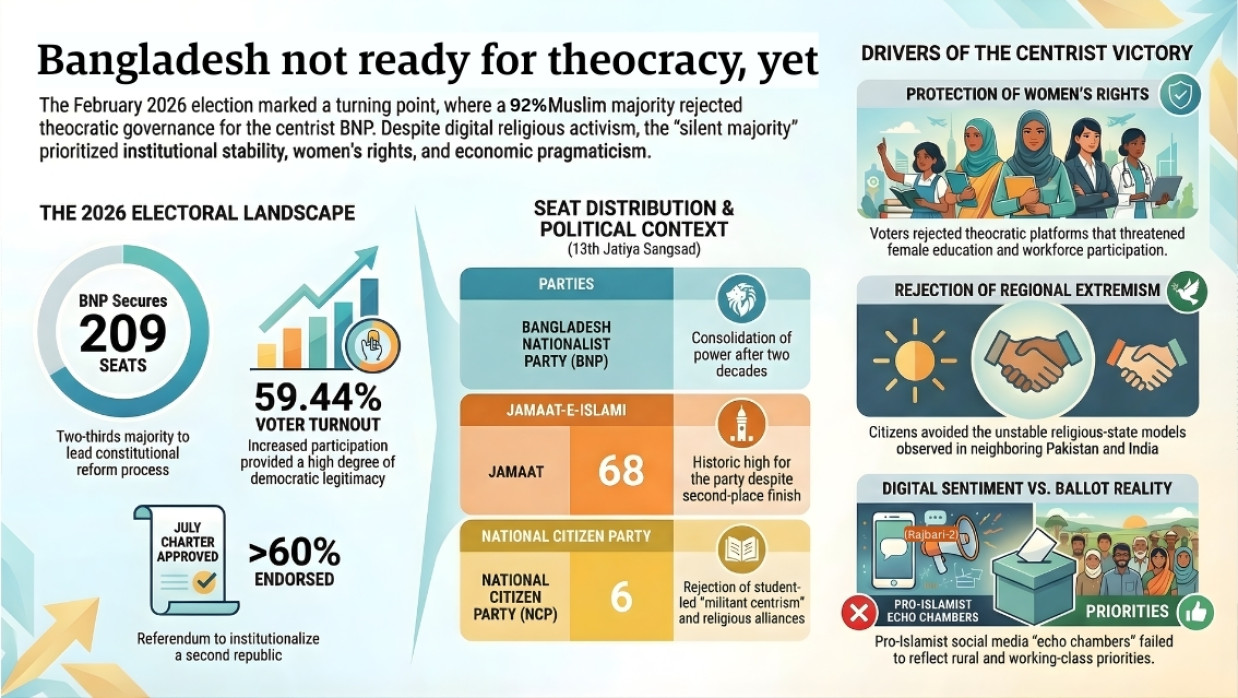
The conclusion of the 13th national election on February 12, 2026, marks a definitive moment in the history of Naya Bangladesh. For months, international observers and digital activists speculated that a wave of religious fundamentalism could fill the vacuum left by the fallen autocracy. Instead, the electorate delivered a resounding mandate to the centrist Bangladesh Nationalist Party (BNP), led by Tarique Rahman.
The BNP secured 209 of the 300 directly elected seats, effectively consolidating power for the first time in two decades. This result serves as a stark reminder that while Bangladesh is a nation with over 90 percent Muslim majority, its voters distinguish between personal faith and the requirements of statecraft. The preference for a centrist alternative over a theocratic model highlights a deep-seated resistance to ideological absolutism.
This outcome was far from certain during the high-octane campaign season that followed the July Revolution of 2024. Social media platforms and several pre-election surveys, including those from Chatham House, suggested a much tighter race between the BNP and the Jamaat-e-Islami led alliance. However, the silent majority of Bangladeshis opted for political familiarity and institutional stability over the promise of a religious state.
The sheer scale of the BNP victory is best understood through the official tallies released by the Election Commission. The party and its allies secured a two-thirds majority in the Jatiya Sangsad, granting them a mandate to lead the constitutional reform process. While the Jamaat-e-Islami achieved its best-ever historical showing with 68 seats, it remained a distant second in terms of seat count.
Voter turnout reached 59.44 percent, a significant increase from the previous boycotted elections. This high participation rate lends a high degree of democratic legitimacy to the results. It demonstrates that the public was eager to participate in the restoration of a representative government after years of autocratic rule.
The discrepancy between digital sentiment and the actual ballot box performance is a significant takeaway of this election. In the months leading up to the vote, social media was dominated by pro-Jamaat influencers and bot-generated campaigns. These digital efforts created an echo chamber that amplified the perceived strength of the religious right.
Pre-election field research indicated that many young voters were initially seen as gravitating toward the disciplined integrity of the Islamist camp. This demographic makes up 44 percent of the total electorate, making their preferences a critical variable in any forecast. However, the final result suggests that social media algorithms do not always reflect the priorities of the rural or working-class voter.
The election was heavily shaped by what experts called an intensified information war. This included the use of AI-generated deepfakes and misinformation campaigns targeting both domestic and foreign audiences. Chief Adviser Muhammad Yunus even called for international support to counter the surge of fake news before the polls.
To understand why a 92 percent Muslim nation rejected a theocratic mandate, one must look at specific sociological barriers. The most prominent factor was the concern over women's rights and economic participation. Jamaat-e-Islami’s campaign was marred by regressive comments from its leadership regarding the status of women in leadership roles.
Shafiqur Rahman, the head of the party, faced significant backlash for statements suggesting a woman could never lead the party because it is un-Islamic. These comments had a chilling effect on the millions of women who form the backbone of the garment industry. For many female voters, the rise of a theocratic party represented a direct threat to their hard-won social freedoms.
Bangladesh’s social transformation over the last three decades has been largely driven by women’s education and employment. Any political party that cannot articulate a credible vision for gender equality is destined to struggle at the national level. The Islamist platform’s failure to field female candidates alienated a critical voting bloc.
The Bangladeshi electorate did not cast their votes in a regional vacuum. They have witnessed the consequences of mixing religion and state in neighboring countries like Pakistan and India. These examples serve as cautionary tales that inform the political choices of the Bangladeshi public.
Pakistan provides a direct example of the economic and institutional costs associated with state-sponsored Islamization. Since the 1970s, Pakistan's focus on religious identity has often come at the expense of industrial growth and judicial independence. The result is a nation plagued by instability and a recurring need for international bailouts.
In India, the rise of Hindutva and religious majoritarianism has created a different kind of instability. The exclusionary politics of the neighboring state have actually hardened the resolve of many Bangladeshis to protect their own pluralism. They see majoritarianism as a political pandemic that eventually erodes the rights of all citizens.
There is a concern that radical elements in India and Bangladesh reinforce each other's extremes. The saffron in Delhi often feeds the green in Dhaka, creating a dangerous cycle of identity-based politics. This symmetry of extremes is viewed as a threat to regional peace and economic cooperation.
By choosing the BNP, the Bangladeshi people opted for a path that avoids this reactive trap. They demonstrated a preference for a centrist government that can engage with the world on pragmatic terms. This choice is a vital safeguard against the partition of the mind that religious majoritarianism requires.
The 13th election was unique because it was held alongside a referendum on the July Charter. This document represents a political covenant aimed at dismantling the autocratic structures of the past. Its approval by over 60 percent of voters marks a significant step toward institutionalizing the centrist mandate.
The charter introduces reforms that act as barriers to any future theocratic or autocratic takeover. These include the introduction of a bicameral parliament and strict term limits for the Prime Minister. The public has demanded a system of governance based on rules and shared power.
A theocratic model, which relies on absolute authority of religious interpretations, is fundamentally at odds with this new constitutional architecture. The referendum result shows that the desire for a second republic is rooted in democratic values rather than religious law. The mandate of 2026 is a mandate for a balanced state where religion stays in the private sphere.
The election also proved to be a humbling experience for the National Citizen Party (NCP), which emerged from the 2024 student uprising. Despite its revolutionary credentials, the party won only six seats. The verdict suggests that voters were wary of the party’s militant centrism and its strategic alliance with the religious right.
Many student leaders who had joined the interim government faced allegations of corruption and mismanagement. This tarnished the NCP’s image as a clean alternative to the traditional parties. The results indicate that the electorate is not yet ready to trust the management of a complex state to a new force.
Furthermore, the NCP’s attempt to bridge the gap between progressive values and the religious right was seen as a betrayal. Several high-profile female members resigned in protest of the alliance with Jamaat-e-Islami. This loss of internal cohesion made the party vulnerable to the more established grassroots machinery of the BNP.
The country’s future depends on a public that can recognize the difference between moral persuasion and moral coercion. The 13th election proved that the majority recognizes that moral coercion is bad for business and democracy. This economic rationality is perhaps the strongest safeguard against theocracy in the long run.
While the results are a clear victory for centrism, it would be a mistake to assume that the challenge of Islamism has vanished. The 68 seats won by Jamaat-e-Islami represent a historic high for the party and an expansion of its influence. This means that Islamist ideas will continue to shape the political discourse in the coming years.
The BNP's victory was aided by the exclusion of the Awami League and the unique circumstances of the post-uprising period. If the new government fails to deliver on its promises of clean governance, the frustration could once again push voters toward the right. The theocratic trap is not gone; it is merely waiting for the center to fail.
The BNP now has a commanding majority that allows it to govern without the support of the religious right. This is a rare opportunity to solidify a centrist, democratic future for the country. However, it also means that the party bears full responsibility for the country's trajectory.
The implementation of the July Charter will be the first test of this new mandate. If the party attempts to sidestep the reforms, it will lose the trust of the youth who spearheaded the revolution. The mandate of 2026 is a mandate for change, not just a change of faces.
Bangladesh is not ready for theocracy, and perhaps it never will be. The 90 percent Muslim majority has spoken in favor of a state that is modern, inclusive, and democratic. They have rejected the mirage of the social media wave in favor of political stability.
The path forward for the 14th Jatiya Sangsad is clear. It must honor the sacrifices of the July Revolution by building a state where faith is respected but power is shared. It must focus on the economic and social aspirations of its citizens, particularly women and the youth.
By choosing the ballot over the pulpit, the people of Bangladesh have reaffirmed their unique identity. This is a triumph of the center that offers hope for the entire region. The message to the world is that the soul of Bangladesh belongs to its people, and they have chosen moderation.
 Follow The Daily Campus on Google News