The Last Firefly Generation
Witnessing the Silent Extinction of Nature's Bioluminescence
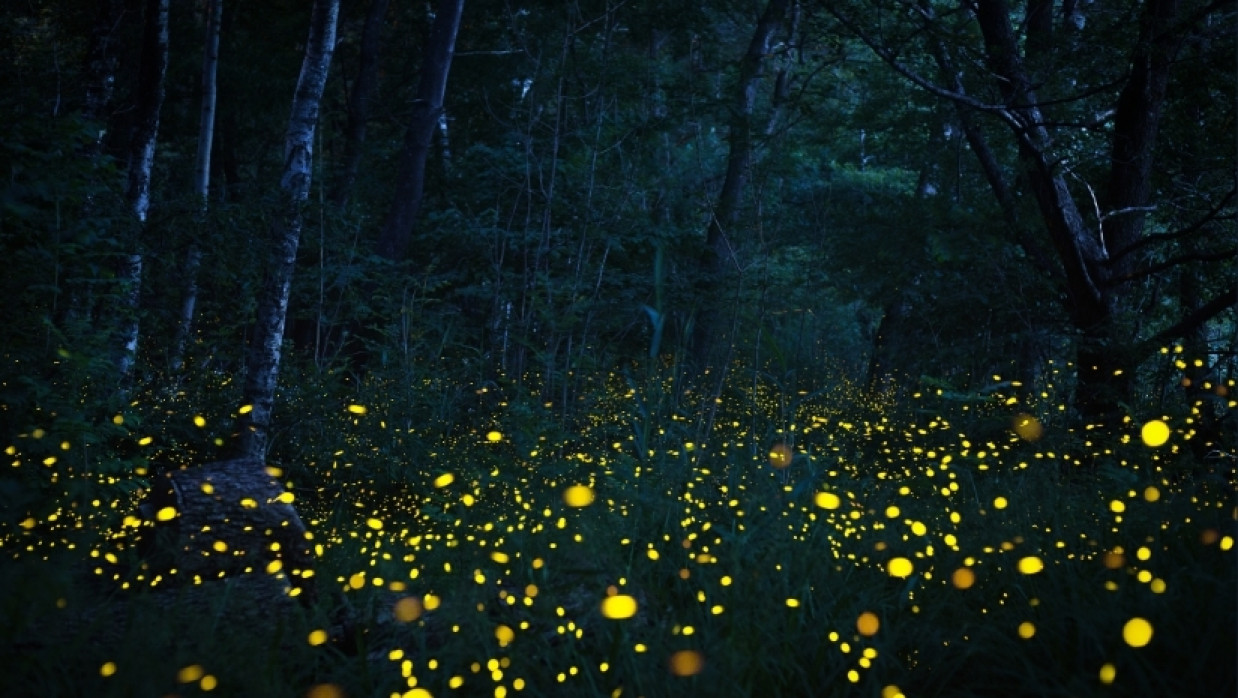
Rokeya Begum is 68 years old and lives in Manikganj. She remembers the nights of her childhood the way people remember music: not exactly, but in feeling. The ponds behind her house, the darkness between the bamboo groves, the air in June that hung heavy and warm before the rains arrived. And above everything, the lights. Thousands of tiny, cold, blinking lights drifting through the dark like sparks that refused to die.
"We called them jonaki pora," she says, using the old village pronunciation. "The children would chase them. You could fill a jar and the jar would glow."
Her grandchildren have never filled a jar. They have barely seen a firefly.
A Light Going Out
Across Bangladesh and the wider region, firefly sightings that were once ordinary have become remarkable. In Dhaka, they are essentially gone. In Sylhet's tea gardens, where dense canopy once shielded them from the city's reach, populations are shrinking. Even in the haors of Sunamganj, where wetland conditions should still suit them, villagers report fewer every year.
This is not nostalgia inventing a better past. The numbers confirm what older Bangladeshis already sense.
A 2021 study published in Science of the Total Environment found that firefly populations in parts of Asia have fallen by up to 70 percent over two decades. The Fireflyers International Network and the IUCN Firefly Specialist Group estimate that roughly 35 percent of firefly species worldwide now face extinction risk. Of the approximately 2,600 known firefly species, fewer than 150 have been formally assessed for conservation status. Among those assessed, nearly one in five is already threatened. Bangladesh has no comprehensive national firefly survey. The absence of data is itself a kind of answer.
Professor Kabirul Bashar of the Department of Zoology at Jahangirnagar University stated that the primary reason behind the declining population of fireflies is the uncontrolled use of pesticides. He explained that a massive amount of chemicals is used to protect fruits and crops, and in some instances, farmers apply an overdose of these pesticides. The application of these toxic substances kills not only fireflies but also numerous other beneficial insects.
Regarding the prevention of extinction and the active conservation of fireflies, Professor Bashar emphasized that the uncontrolled application of any chemical pesticide must be stopped completely. He advised that pesticides should only be used in strictly required quantities and that halting unregulated chemical use could successfully aid the partial conservation of these creatures.
What Fireflies Actually Are
To understand why their disappearance matters, it helps to understand what fireflies actually are, beyond the childhood wonder.
Fireflies are beetles, not flies. They belong to the family Lampyridae, a group with more than 2,200 described species distributed across every continent except Antarctica. They are drawn to moist habitats: forests, paddy fields, riverbanks, marshes. In Bangladesh, the species Photinus pyralis traces a distinctive J-shaped arc of light in flight. Other species glow without flashing. Some, like glow-worms, produce no adult light at all and rely on chemical signals instead.
Their bioluminescence works through a reaction between a compound called luciferin and an enzyme called luciferase. When oxygen enters the firefly's light organ, luciferase triggers a reaction that converts nearly 100 percent of the energy into light, producing almost no heat. Nitric oxide gas regulates the flash by controlling oxygen flow. The result is what scientists call "cold light," and it is one of the most efficient light-producing systems in nature.
Fireflies spend most of their lives as larvae, living underground or underwater for one to two years, feeding on snails, worms, and other soft-bodied invertebrates. The adult stage lasts only a few weeks. During that brief window, they must find mates, reproduce, and die. Everything depends on their ability to see and respond to each other's signals in the dark.
Take away the darkness, and that entire system collapses.
Four Threats, One Trajectory
Light Pollution: Dhaka is one of the most light-polluted cities in South Asia. Streetlamps, billboards, construction lights, and the diffuse orange glow of millions of households combine to make genuine darkness almost impossible to find within the city limits or close to it. Distant districts are getting no better in terms of avoiding light pollution.
For fireflies, this is a reproductive catastrophe. Males fly and emit species-specific flash patterns. Females respond from the ground or from vegetation. When background light is too bright, neither can detect the other's signal. They never mate. The next generation never happens.
Research from the Anamalai Tiger Reserve in Tamil Nadu found that the species Abscondita perplexa actively avoids illuminated environments, abandoning habitats where artificial light is present even at low intensity. Blue and green wavelengths are particularly disruptive. A study in BioScience confirmed that artificial light at night ranks among the most significant threats to firefly reproduction globally. Satellite data shows that nighttime light pollution is expanding worldwide, and Bangladesh, with its rapid urban growth, is accelerating along that curve.
Habitat Destruction: Firefly larvae need moist, undisturbed soil. They need leaf litter, wetland edges, and the slow, shaded margins of rivers and ponds. Urban expansion across the Dhaka metropolitan area has consumed tens of thousands of hectares of wetland since the 1980s. In the char lands of the north, agricultural intensification has replaced complex, mossy wetland edges with bare banks and monoculture fields.
In India’s Andhra Pradesh, researchers documented an Abscondita chinensis population that numbered over 500 individuals per 10 square metres in 1996. By 2019, fewer than 20 remained in the same area. Paddy field conversion and riverbank clearance drove most of that collapse.
The pattern repeats across South Asia. When mangroves are cleared, when marshes are drained, when river edges are concreted over, fireflies lose the only environments in which they can complete their life cycle.
Pesticides: Bangladesh uses some of the highest volumes of agricultural pesticide per hectare in the region. Organophosphates and neonicotinoids, the dominant chemical families in use, are acutely toxic to insects and persist in soil and water long after application.
Firefly larvae feed on soil invertebrates, which means they sit in the middle of the food chain in agricultural land. They absorb pesticide residues both through direct contact and through their prey. Indian research on firefly habitats near paddy fields found significant reductions in larval survival and adult emergence in chemically treated areas. Sublethal doses produce malformed adults and reduce reproductive capacity even in survivors.
Household mosquito fogging, common across Dhaka's residential neighbourhoods during summer months, adds another layer. The chemicals used in urban fogging kill fireflies and their larval food sources without discrimination.
Climate Change: The monsoon governs firefly biology in Bangladesh. Larvae depend on soil moisture to develop. Adults emerge in coordination with temperature and humidity cues that have stayed relatively consistent for thousands of years. Climate change is disrupting that consistency.
Extended pre-monsoon droughts dry out the soil before larvae can complete development. Erratic rainfall floods larval habitats at the wrong time. Temperature shifts alter luciferase activity in adults, reducing flash intensity and disrupting mating synchrony. Researchers tracking populations in the Gangetic and Godavari basins found that delayed or irregular monsoons consistently reduced adult emergence and firefly visibility in the following season.
Bangladesh, with its position at the confluence of three major river systems and its extreme sensitivity to both drought and flood, faces compounded pressure from all of these patterns.
What Disappears With Them
The ecological consequences of firefly loss extend beyond the insects themselves.
In their larval stage, fireflies are active predators of snails, worms, and other soil invertebrates. Their removal reduces a natural check on those populations. The U.S. Fish and Wildlife Service estimates that beneficial insects collectively contribute around $34 billion annually to pest control in the United States alone. Fireflies are part of that system.
Their biochemistry has direct applications in medicine and food safety. The luciferase enzyme extracted from fireflies is used in laboratories to detect bacterial contamination in food products and to track cancer cell behaviour in medical research. Losing firefly diversity narrows the gene pool from which those compounds can be drawn.
Most significantly, fireflies function as environmental indicators. They are sensitive to water quality, soil contamination, light levels, and habitat integrity. When populations collapse, they signal conditions that harm far more than fireflies.
What Would Actually Help
Conservation frameworks for fireflies have been proposed across the region. Several have produced results where implemented.
Reducing light pollution is the most immediate intervention available to individuals and municipalities. Switching off unnecessary outdoor lights between 9 pm and dawn, particularly during the monsoon months from June through August when fireflies breed, costs nothing. Replacing white or blue-spectrum outdoor lights with warm amber tones reduces disruption to bioluminescent signalling. In Taiwan, designated firefly viewing sites replaced flashlights with white-painted path markers, allowing visitors to walk through habitats without light sources.
Protecting wetlands and riverbanks requires policy enforcement. Bangladesh's wetland protection laws exist on paper; their application remains uneven. The Hakaluki Haor, the Tanguar Haor, and the riparian edges of major river systems are firefly habitats. Treating them as such in land-use planning would require no new legislation, only enforcement of what is already written.
Regulating pesticide use near sensitive habitats is standard practice in pest-integrated management programmes elsewhere in Asia. Buffer zones around wetlands, seasonal restrictions on fogging near natural areas, and support for organic alternatives in agriculture adjacent to forests and riverbanks would reduce larval mortality.
Citizen monitoring has produced usable conservation data in India, where community volunteers mapped species distribution across multiple states through the Firefly Survey programme. A similar initiative in Bangladesh, coordinated through universities or environmental organisations, would generate the baseline data the country currently lacks.
Dark-sky designations for rural protected areas and forests would allow firefly populations to persist beyond city limits. Sundarbans buffer zones, the Chittagong Hill Tracts, and protected haor areas are candidates.
The Night Is Quieter Now
Rokeya Begum's grandchildren know fireflies exist. They have seen them in photographs and in the cartoons their parents show them on phones. One of them, a girl of nine, told her grandmother she had seen "maybe three or four" in the village during last year's monsoon.
Three or four.
Rokeya filled a jar.
The science on firefly extinction is contested at the margins and uncertain in its details. What is not contested is the trajectory. Populations are down. Habitats are shrinking. The insects are retreating from the places where humans live, and in some regions they are not retreating, they are disappearing outright.
Bangladesh has no firefly survey, no dark-sky policy, no specific conservation framework for Lampyridae. What it does have is a generation of older people who remember the lights clearly and younger people who have mostly stopped expecting to see them. The gap between those two groups has opened in less than forty years.
The jonaki poka lit up the subcontinent for millions of years before the first city rose on the banks of the Buriganga. Whether they survive the next fifty depends less on their resilience than on decisions being made right now, in offices and fields and neighbourhoods, by people who probably are not thinking about fireflies at all.
That is, perhaps, the most urgent part of the story.
This article draws on research from the University of Gerogia, Journal of Diversity Studies, Science of the Total Environment, IUCN Firefly Specialist Group, and field studies conducted across USA, India, and Southeast Asia.
 Follow The Daily Campus on Google News