
Why Fighter Jets Train Over Dhaka, How They Become Trainer Aircraft
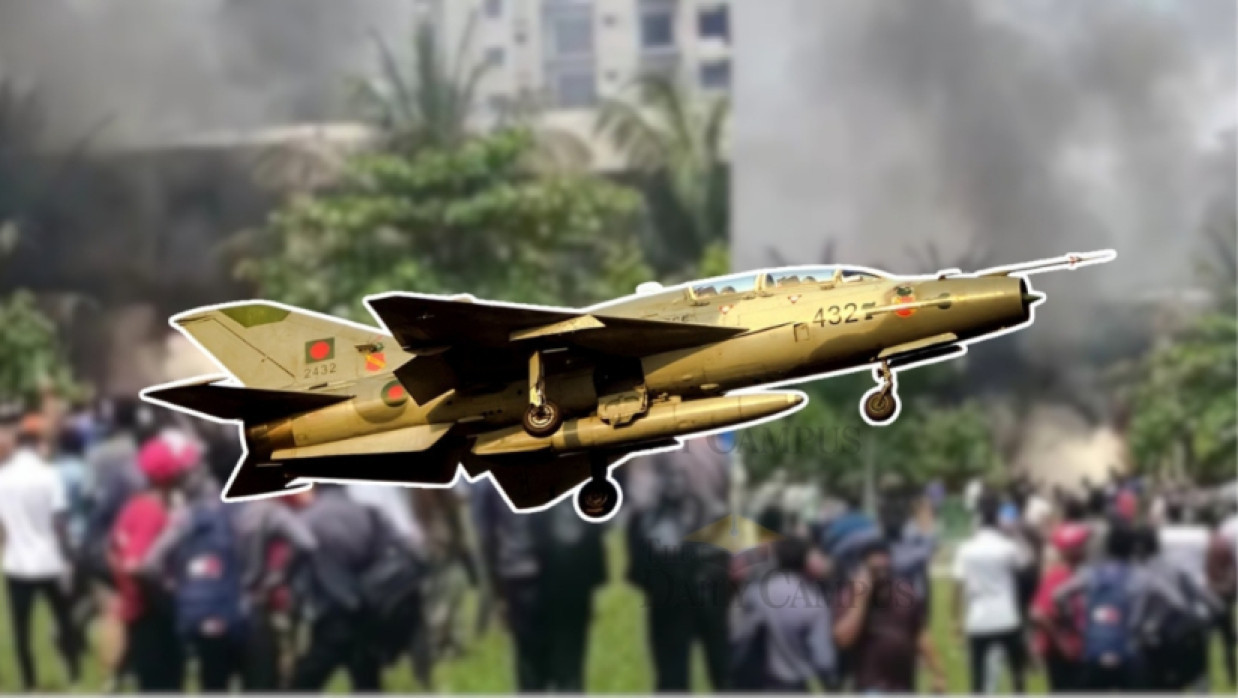
Following the tragic crash of a Bangladesh Air Force F-7BGI aircraft into a two-story building at Milestone School and College in Diabari, Uttara, a wave of critical questions has surfaced across public and digital platforms. The crash resulted in the tragic loss of 22 lives, including pilot Flight Lieutenant Md. Towkir Islam Sagar, a schoolteacher, and several young students.
As citizens and civil society leaders express grave concerns regarding military flight paths over densely populated urban zones, citizens have raised three core questions: Why are fighter jets stationed and flown over Dhaka? Is the F-7BGI purely a trainer or a combat interceptor? How are training missions classified?
"Why are fighter jet training operations conducted over heavily populated urban areas? The individuals or authorities responsible must be brought under strict accountability, and an accurate, transparent accounting of all casualties must be presented to the nation."
— Dr. Anu Muhammad, Former Professor, Jahangirnagar University
Key Point Installations and the 5-Minute Intercept Radius
Addressing why supersonic fighter jets operate out of the capital, high-level Bangladesh Air Force sources explained to The Daily Campus that aircraft departing from Hazrat Shahjalal International Airport (HSIA) or BAF Base AK Khandoker in Kurmitola quickly transition to designated, restricted military airspace for maneuvers.
The primary strategic rationale for maintaining a permanent fighter fleet in Dhaka centers on national defense architecture and Key Point Installations (KPIs). Capital city KPIs encompass vital economic, administrative, legislative, and strategic infrastructure, alongside power grids and central government installations. In the event of foreign aerial aggression or airspace violations, these KPIs represent primary strategic targets.
Military strategy dictates a crucial response window in this defense posture. Fighter jets stationed directly at BAF Base AK Khandoker in Dhaka can get airborne and intercept incoming threats over the capital's airspace within approximately 5 to 6 minutes. In stark contrast, fighter jets launched from BAF Base Zahurul Haque in Chattogram require more than 20 minutes to reach and intercept hostile assets over the capital. A senior commercial pilot corroborated this strategic positioning, noting that the physical presence of quick-reaction jets in the capital serves as a vital deterrence posture, signaling the nation's readiness to execute rapid airspace defense.
Dual Role: Advanced Combat Trainer and Daylight Interceptor
Public debate has also centered on whether the crashed aircraft was a training jet or an active warplane. According to Air Force sources, the Bangladesh Air Force relies primarily on two main combat operational fleets: the Mikoyan MiG-29 and the Chengdu F-7BGI. While the all-weather MiG-29 fleet currently operates with 2 active units out of a total fleet of 8, the F-7BGI represents the backbone of the daylight interceptor force, with 32 operational units out of a total fleet of 35.
The F-7BGI functions under a dual-use procurement protocol. While procured primarily as an advanced conversion trainer for fighter pilots, it is structured to immediately serve as the country’s primary frontline daylight interceptor during wartime. Every non-combat sortie flown by operational pilots on these jets is classified under military doctrine as a training mission to maintain high-G maneuver proficiency, combat readiness, and navigational flight hours.
ISPR Statement and Emergency Protocols
In an official press release issued by Inter-Services Public Relations (ISPR), the military confirmed that the F-7BGI combat trainer took off from BAF Base AK Khandoker in Kurmitola at 1:06 PM on a routine training mission before experiencing critical mechanical failure mid-flight.
ISPR highlighted that the pilot, Flight Lieutenant Md. Towkir Islam, made every heroic attempt to steer the malfunctioning aircraft away from high-density residential sectors toward open terrain to minimize civilian casualties. However, despite emergency maneuvers, the jet tragically crashed into a building at the Milestone School and College campus in Diabari. A high-level military board of inquiry has been instituted to determine the exact mechanical root cause of the crash.
 Follow The Daily Campus on Google News