Bangladesh’s Strategic Rise in the Bay of Bengal and Its Relations with India, China and the USA
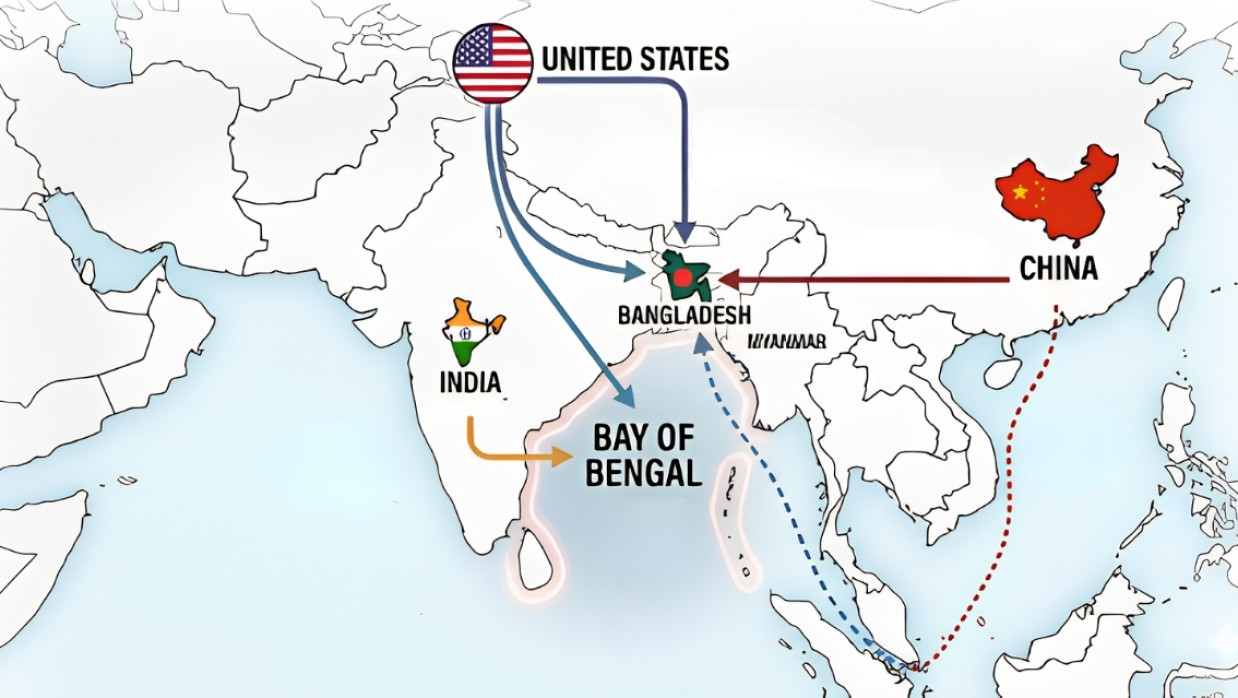
Bangladesh is no longer a country that can be viewed only through the old ideas of poverty, natural disaster or foreign aid. It is an independent and capable nation with a growing economy, a large and talented population, an important maritime territory and a highly valuable geographical position. Situated between South Asia and Southeast Asia, Bangladesh has become an important country in the emerging Indo-Pacific region.
The growing interest of India, China, the United States and other international powers in Bangladesh proves the country’s strategic importance. Bangladesh should welcome cooperation with all nations, but every relationship must protect its sovereignty, dignity, resources, security and economic interests. The central principle of foreign policy must therefore be clear: Bangladesh First.
Bangladesh stands at the northern point of the Bay of Bengal. It shares borders with India and Myanmar and has direct maritime access to the Indian Ocean. This position makes Bangladesh a natural bridge between South Asia and Southeast Asia. The Bay of Bengal is increasingly important for global trade, energy transport, maritime security, and regional connectivity. Bangladesh’s ports can serve not only its own economy but also Nepal, Bhutan, India’s northeastern states, and other nearby regions.
The development of Chattogram, Mongla, Payra, and Matarbari can turn Bangladesh into a major centre of regional trade and transportation. Bangladesh should use this connectivity as an economic asset. Transit and port facilities should be provided only through fair agreements that bring clear financial, commercial, and strategic benefits to the people of Bangladesh.
Cooperation must always be based on reciprocity. Bangladesh should never provide valuable facilities without receiving appropriate benefits in return. Its location must not make Bangladesh an area of competition controlled by foreign powers. Rather, Bangladesh should use its geographical position to negotiate confidently with all sides.
Since achieving independence in 1971, Bangladesh has faced political crises, military rule, natural disasters, poverty, and international pressure. Despite these difficulties, the country has made remarkable progress in agriculture, education, health, industry, women’s participation, infrastructure, and human development. Bangladesh’s early foreign policy was shaped by the Liberation War and close relations with India and the Soviet Union.
Later, the country expanded its relations with China, the United States, Europe, the Middle East, and the Muslim world. This diplomatic diversification was necessary for protecting national independence. Over the years, however, foreign relations have sometimes become too closely connected with individual governments or political parties. This has created mistrust and weakened Bangladesh’s ability to negotiate as a united nation.
Bangladesh’s relationship with another country should never depend on which political party is in power. Foreign policy must be conducted between sovereign states. National institutions, Parliament, professional diplomats, experts, and the public interest should guide every important decision. No foreign country should be allowed to influence Bangladesh’s elections, political leadership, administration, or domestic policies. The people of Bangladesh alone have the right to determine the country’s political future.
The settlement of maritime boundary disputes with Myanmar in 2012 and India in 2014 established Bangladesh’s rights over a vast area of the Bay of Bengal. The country gained recognized sovereign rights over approximately 118,813 square kilometres of maritime territory. This maritime achievement opened the door to a new economic future. The sea may provide fish, natural gas, minerals, renewable energy, shipping opportunities, tourism, and scientific knowledge.
Bangladesh’s blue economy can create employment, strengthen food and energy security, and support long-term national development. Coastal and marine areas may contain strategically important minerals such as zircon, rutile, ilmenite, and monazite. Offshore areas may also contain natural gas and other energy resources. However, proper scientific surveys are necessary before the extent of these resources can be confirmed. Foreign companies may possess technology and investment, but Bangladesh must retain ownership and effective control over its natural wealth.
Exploration and extraction contracts must be transparent, competitive, environmentally responsible, and financially beneficial to the country. No single foreign power should receive exclusive control over Bangladesh’s gas fields, mineral resources, deep-sea facilities, ports, or strategic infrastructure. These resources belong to the people of Bangladesh and must be used for their welfare.
The United States is an important economic and diplomatic partner of Bangladesh. It is a major market for Bangladeshi products, particularly ready-made garments. Cooperation in education, technology, health, energy, development, and maritime security can bring significant benefits. The United States also views Bangladesh as important to its Indo-Pacific strategy. Washington is interested in secure sea routes, diversified supply chains, democratic institutions, and limiting the strategic expansion of China.
Bangladesh may cooperate with the United States wherever the relationship serves its national interests. However, it should not become an instrument in a strategy directed against China, India, Russia, or any other country. Political or economic pressure should not be used to interfere in Bangladesh’s internal affairs. Issues concerning democracy, human rights, and governance should primarily be resolved by the people and institutions of Bangladesh. International partnership should be based on mutual respect rather than unequal pressure. The United States should recognize Bangladesh as a sovereign partner, not merely as a location in its wider geopolitical plans.
China is one of Bangladesh’s major trading, development, and defence partners. Chinese companies have contributed to bridges, roads, railways, tunnels, power plants, and other infrastructure projects. Such cooperation has helped Bangladesh address important development needs. China sees Bangladesh as an important part of the Belt and Road Initiative and the Maritime Silk Road. Access to the Bay of Bengal can also support China’s wider commercial and strategic interests.
Bangladesh should accept Chinese investment when it supports national development. At the same time, every project must be examined carefully. Its financial conditions, environmental effects, technological dependence, security implications, and long-term economic value must be considered.
Bangladesh must not become dependent on Chinese loans, military equipment, technology, or infrastructure. Cooperation should not give China control over Bangladeshi ports, communication systems, energy networks, or strategic decisions. The relationship should serve both countries equally. China’s interest in Bangladesh must never take priority over Bangladesh’s national interest.
India is Bangladesh’s closest and most influential neighbour. The two countries share rivers, borders, language, culture, history, trade, and many security concerns. India’s assistance during the 1971 Liberation War will always remain an important part of Bangladesh’s national memory. However, historical friendship cannot justify permanent inequality. Modern relations must be based on sovereign equality, mutual respect, and fair exchange. Bangladesh has provided India with valuable transit, transport, port, security, and connectivity facilities.
These have particularly benefited India’s northeastern states. Bangladesh must receive fair economic and strategic benefits in return. The Teesta agreement and the sharing of other common rivers remain major concerns for Bangladesh. As a lower-riparian country, Bangladesh needs a fair share of river water for agriculture, fisheries, the environment, and human life. Water cannot be treated as a favour from one country to another. It is a shared natural resource that must be managed according to fairness and international principles.
Border killings must also end. No unarmed Bangladeshi citizen should lose his or her life at the border. Smuggling and other border crimes should be addressed through arrest and legal procedure, not through unnecessary deadly force. India should also remove unfair trade barriers and help create a more balanced economic relationship. Bangladesh respects India’s security concerns, but India must equally respect Bangladesh’s sovereignty, political independence, and public opinion. A strong India–Bangladesh relationship is necessary, but it must be a partnership between equals—not a relationship of dominance and dependence.
Bangladesh has shown extraordinary humanity by sheltering a large number of Rohingya people who fled violence and persecution in Myanmar. Although Bangladesh did not create this crisis, it has carried a large part of its human, economic, social, and environmental burden. The presence of the refugees has placed serious pressure on Cox’s Bazar, local communities, forests, public services, employment, and national security. Declining international assistance has made the situation more difficult. Bangladesh cannot be expected to carry this responsibility forever.
The Rohingya must be able to return to Myanmar voluntarily, safely, and with dignity, citizenship rights, and international protection. China, India, the United States, ASEAN, the United Nations and other international actors must place effective pressure on Myanmar and help create suitable conditions for repatriation. Humanitarian aid alone is not a permanent solution. Bangladesh’s generosity should not be exploited as an excuse for international inaction.
Wars in Ukraine, Gaza, and other parts of the Middle East affect Bangladesh through rising fuel prices, food insecurity, expensive shipping, inflation and disruption of international trade. Bangladesh should continue to support peace, justice, national self-determination, and respect for international law. It should stand with oppressed people, including the Palestinian people, while avoiding involvement in military rivalry.
These conflicts also show why Bangladesh must diversify its sources of food, fuel, fertilizer, technology, defence equipment and investment. Excessive dependence on any one country may become dangerous during an international crisis. National food security, energy security, cybersecurity, and supply-chain security must therefore become central parts of Bangladesh’s foreign policy.
Bangladesh does not need to choose one power against another. It can work with the United States, China, India, Japan, Russia, the European Union, South Korea, the Gulf states, and Southeast Asian countries according to its own needs. This approach can be called active non-alignment. It does not mean remaining silent or inactive. It means making independent decisions without joining hostile military or ideological blocs.
Bangladesh can cooperate with the United States in trade, technology, education, and maritime safety. It can work with China in infrastructure and industrial development. It can cooperate with India in connectivity, energy, water management, security, and regional trade. Yet every agreement must produce visible and measurable benefits for Bangladesh.
The country should say “yes” when cooperation advances the national interest and “no” when a proposal threatens its sovereignty, resources, economy, or security. Bangladesh should also strengthen BIMSTEC, the Indian Ocean Rim Association, and other multilateral institutions. Working through regional organizations can prevent powerful states from placing unfair pressure on smaller countries.
A successful foreign policy begins with national unity. Political division, weak institutions, corruption, and secret agreements make a country vulnerable to foreign influence. Bangladesh needs democratic stability, accountable government, an independent administration, professional diplomacy, and public confidence. Major agreements involving ports, transit, energy, defence, minerals, water, or maritime resources should be transparent and subject to proper national review. Foreign policy should not protect a party, government, family, or individual. It must protect the state and its citizens.
Governments may change, but Bangladesh’s sovereignty and long-term interests must remain permanent. Universities and research institutions should contribute to national strategy. Bangladesh needs more experts in international relations, maritime law, oceanography, geology, energy policy, cybersecurity, defence studies, and environmental science. Without its own knowledge and technology, the country will remain dependent on foreign assessments of its resources and security needs.
Bangladesh stands at an important moment. Its geographical position, maritime territory, economy, human resources, and diplomatic importance give it the opportunity to become a powerful regional voice. The country must not allow itself to become a battleground for competition among India, China, and the United States. Instead, it should use their competing interests to gain better trade, investment, technology, infrastructure, and international support. Bangladesh is willing to be a friend to all, but friendship must never mean submission.
Cooperation must never mean the loss of sovereignty. Connectivity must never become one-sided dependence. Investment must never result in foreign control over national resources. The principle of “friendship to all, malice towards none” should therefore be renewed for the present century. Its modern meaning must be: friendship with dignity, cooperation with reciprocity, and diplomacy based on national interest.
Bangladesh earned its independence through immense sacrifice. Its sovereignty, territory, resources, and political freedom cannot be compromised for the interests of any foreign power. India is an important neighbour, China is an important development partner, and the United States is an important economic and diplomatic partner. But Bangladesh must remain above the rivalries among them.
None should be allowed to dominate its decisions. The future policy of the country must be firm and clear: Bangladesh will cooperate with everyone, oppose no nation without reason, and surrender its national interests to no one. With internal unity, transparent governance, strategic diplomacy, and control over its resources, Bangladesh can turn its geographical position into lasting strength.
It can emerge not as a field of great-power rivalry, but as a confident, peaceful, and sovereign nation shaping the future of the Bay of Bengal and the wider Indo-Pacific. Bangladesh first- not against any country, but in defence of its people, sovereignty, dignity and future.
Disclaimer: Written by Dr. Saiful Islam, Political Analyst and Professor at the University of Dhaka. The views and opinions expressed in this op-ed are solely those of the author and do not necessarily reflect the views, policies, or editorial position of The Daily Campus.
 Follow The Daily Campus on Google News