Awami League Following Muslim League’s Path Amid Leadership Crisis
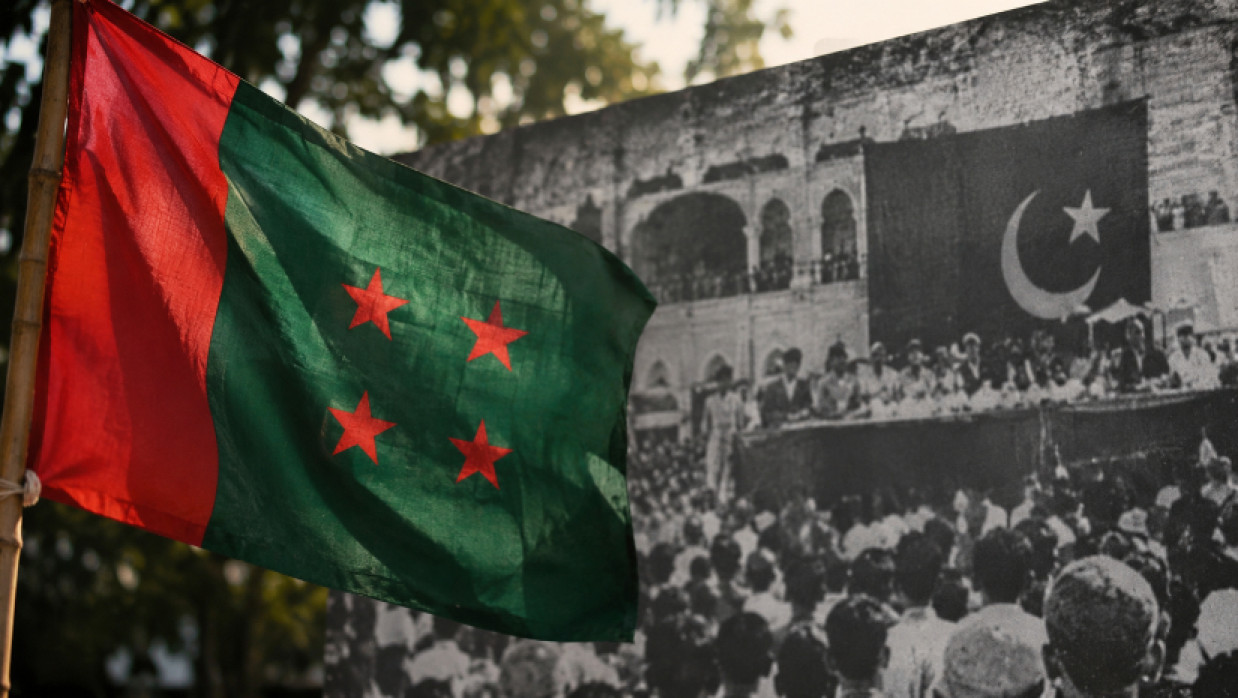
The Muslim League was once one of the most influential political parties in the Indian subcontinent. After leading the movement for the establishment of Pakistan, it enjoyed widespread popularity. But within a few years, the party became increasingly disconnected from the people of East Bengal. Its failure to address public concerns over language, rights, democratic aspirations and economic disparities led to a political crisis that culminated in its crushing defeat to the United Front in the 1954 provincial election.
The once-powerful Muslim League subsequently weakened amid leadership divisions, organisational failures and the erosion of its popular base. Although several political groups still operate under the party's name, it no longer commands the influence it once held in national politics. In practice, the once-powerful political force built around nationalist aspirations has been reduced to a fragmented collection of groups.
Political analysts say the Awami League, whose activities are currently banned, is now facing a similar trajectory in Bangladesh. The party, founded through movements for democratic rights, political freedom and the interests of the Bengali people, also carries the historical legacy of leading the country's independence struggle. Yet centralised leadership, a lack of internal democracy, power-centric politics and disregard for public opinion have pushed it into an existential crisis.
During Sheikh Hasina's prolonged rule, party leadership and state power became increasingly intertwined. This, analysts say, severely weakened the Awami League's organisational strength, public engagement and process of developing new leadership.
The rise and fall of the Muslim League
After the end of British colonial rule and the establishment of Pakistan in 1947, the Muslim League became part of the governing structure in what was then East Bengal. Its sweeping victory in the 1946 election had made it the most powerful political organisation in the region.
However, after coming to power, the party failed to meet public expectations. Internal leadership rivalries, corruption, allegiance to a West Pakistan-centred governing system and its negative position on the Bengali language and demands for autonomy fuelled public resentment.
Disputes over language in 1948, the Language Movement of 1952 and growing opposition to political and economic discrimination against East Bengal gradually consolidated public resistance. Against this backdrop, opposition groups united to form the United Front for the 1954 election. Led by influential politicians including AK Fazlul Huq, Maulana Abdul Hamid Khan Bhashani and Huseyn Shaheed Suhrawardy, the alliance contested the election with a 21-point programme.
The result was a major political disaster for the Muslim League. Of the 237 Muslim seats in East Bengal, the party won only nine, while the United Front secured 223. Within just seven years of leading the movement for Pakistan, the Muslim League had been overwhelmingly rejected by voters.
The defeat was more than an electoral setback. It was a clear public verdict against a politics that ignored people's views on language, rights and democratic aspirations while seeking to retain power.
The Muslim League's organisational strength continued to decline amid political tensions at the centre of Pakistan, military rule, party divisions and leadership crises. Having lost its influence across the subcontinent, the party eventually fragmented into political groups operating under different names and leadership.
Awami League emerged from opposition to the Muslim League
One of the significant ironies of history is that the Awami League rose politically in East Bengal amid the Muslim League's growing isolation.
On June 23, 1949, the East Pakistan Awami Muslim League was established at the Rose Garden in Dhaka's KM Das Lane, with Maulana Abdul Hamid Khan Bhashani as president and Shamsul Haque as general secretary. Leaders associated with the political traditions of Huseyn Shaheed Suhrawardy and Abul Hashim also played important roles in its formation. In 1955, the party dropped the word 'Muslim' from its name and adopted a new political identity.
From its inception, the Awami League played a major role in movements for democratic rights, recognition of Bangla as a state language, provincial autonomy and an end to economic disparities between East and West Pakistan. Through the Six-Point Movement, the 1969 mass uprising and its landslide victory in the 1970 election, it became the principal political force in the Bengali people's struggle for national liberation. Its role remains closely associated with the 1971 Liberation War and the achievement of independence.
However, the party failed to preserve that democratic political tradition after independence. During its rule from 1972 to 1975, economic crises, the 1974 famine, widespread corruption, a severe deterioration in law and order and confrontations with opposition political forces eroded the government's popularity.
In January 1975, the Fourth Amendment to the Constitution replaced the parliamentary system with a presidential form of government. In June of the same year, the establishment of BAKSAL brought an end to multiparty politics and introduced a one-party state political structure. Press freedom was also curtailed.
These political decisions raised serious questions about the Awami League's democratic legacy and popular support. Following the assassination of Sheikh Mujibur Rahman on August 15, 1975, the party faced a leadership crisis, internal divisions and organisational collapse.
Although Sheikh Hasina later took over the party's leadership, the Awami League had to wait until 1996 to return to state power. It remained out of government for nearly 21 years, from 1975 to 1996.
After returning to power in 1996, the party lost the 2001 election. It came back with a landslide victory in 2008 and, after forming the government under Sheikh Hasina in 2009, remained in power for nearly 15 consecutive years.
Prolonged rule, democratic crisis and growing public isolation
Political analysts identify the party's decision to make state power the principal foundation of its political existence as one of the key reasons behind its current crisis.
During its years in government, the Awami League's organisational activities increasingly came to depend on the state administration, law enforcement agencies and networks of influence surrounding the centres of power. Democratic processes for selecting party leadership weakened, while decisions made by the central leadership took precedence over the views of grassroots members.
The national elections held on January 5, 2014, December 30, 2018, and January 7, 2024, faced political controversy, with allegations that opportunities for opposition participation had been restricted. These controversies further undermined questions about the party's democratic legitimacy.
Allegations of suppressing opposition movements, filing cases against political leaders and activists, arrests, enforced disappearances, extrajudicial killings and restrictions on media freedom also featured in reports by domestic and international human rights organisations.
Various reports by Human Rights Watch documented allegations of enforced disappearances, extrajudicial killings, arbitrary arrests and repression of political opponents during Sheikh Hasina's rule. As a result, opposition to the Awami League extended beyond the BNP and Jamaat-e-Islami, with dissatisfaction also growing among civil society members, students, professionals and ordinary citizens.
Meanwhile, power-centric politics increasingly spread within the party. Allegations emerged that controversial individuals were given important party and state positions alongside long-serving and tested leaders. Allegations of political influence over businesses, tenders, recruitment, the banking sector and the administration also became prominent in political discourse.
Investigations into corruption and money laundering were subsequently launched against several individuals linked to such allegations. This created a significant gap between the party's historical image as the force that led the independence struggle and the realities of its time in government.
Fall in mass uprising, Hasina flees to India
In July 2024, protests by students began over reforms to quotas in government jobs. The use of force by law enforcement agencies, deaths, arbitrary arrests and the government's hardline response rapidly transformed the demonstrations into a broader anti-government movement.
The movement gained wider public participation with the involvement of the BNP and other political parties. Eventually, it evolved into a one-point demand for the government's resignation.
On August 5, Sheikh Hasina resigned as prime minister and left for India amid the mass uprising. An investigative report published by the Office of the UN High Commissioner for Human Rights in 2025 estimated that up to approximately 1,400 people may have been killed in violence between July 1 and August 15, 2024. The report also raised serious allegations of the involvement of the then government and security forces.
Following the change of power, many Awami League leaders went into hiding, while others left the country. Cases were filed against party leaders and activists at different levels over allegations including murder, corruption, money laundering and crimes against humanity.
However, not all party members face the same allegations. Ensuring impartial trials based on specific allegations, rather than treating individuals as criminals solely because of their political affiliation, is also essential.
Hasina announces return as grassroots activists face risks
After losing power, Sheikh Hasina and part of the Awami League's senior leadership remained abroad, while some ordinary party activists in Bangladesh initially stayed largely silent. Apart from a few isolated incidents, there was little visible large-scale organisational activity among the party's grassroots members.
However, renewed activity among the party's supporters has been observed following Sheikh Hasina's announcement that she would return to Bangladesh in December.
In an interview with Reuters last July, Hasina said she planned to return to Bangladesh in December and surrender before the court. She reiterated the announcement later. However, the process and practical prospects of her return remain uncertain.
Meanwhile, incidents of clashes, bomb explosions, arson and sabotage have been reported in different parts of the country in connection with Awami League programmes announced around her planned return in November 2026. Violence in several areas, particularly Gopalganj, has renewed concerns over the law and order situation.
Ordinary party activists inside Bangladesh are bearing much of the risk. In attempting to implement political announcements and programmes made by senior leaders living abroad, many are facing fresh cases, arrests and legal complications.
At the same time, attacks on the homes and properties of absconding leaders have taken place in different areas amid public anger over violent incidents. These developments are deepening the crisis facing the party's grassroots organisation.
The party's future or one leader's political return?
Political analysts say the question of leadership lies at the centre of the Awami League's current crisis. If the party gives greater importance to Sheikh Hasina's personal political return than to rebuilding its organisation and political future, its internal crisis could deepen further.
A political party's existence cannot depend solely on the presence or absence of a single leader. To survive as a democratic political organisation, it needs accountable leadership, internal democracy, the willingness to acknowledge mistakes, public accountability and the ability to develop new leaders.
In particular, public questions over the political and moral responsibility of the party's senior leadership for the violence and deaths in 2024 require answers. Since losing power, neither Sheikh Hasina nor the party's top leadership has visibly accepted clear political responsibility for those events, offered a sincere apology to the families of those killed or made a credible commitment to prevent a recurrence. Instead, critics say, the party's political statements have placed greater emphasis on trying to justify its own position.
In May 2025, the interim government banned the activities of the Awami League and its affiliated organisations, while the Election Commission suspended the party's registration. On April 9, 2026, Parliament approved amendments to the Anti-Terrorism Act, providing a legal basis for keeping the party's activities banned.
The question of the party's political return is therefore no longer limited to decisions by its leadership. It is also tied to judicial proceedings, legal barriers and a crisis of public trust.
The history of the Muslim League offers an important political lesson for the Awami League. The Muslim League led the movement for the establishment of Pakistan but lost its popular base because it failed to address the people's aspirations concerning language, rights and democracy.
The Awami League, too, carries the historical distinction of leading the independence struggle, but later faced serious controversies over democracy, human rights and people's voting rights.
However, the historical contexts of the two parties are not identical. The Muslim League declined amid internal power struggles within Pakistan and the movement for autonomy in East Bengal. The Awami League's current crisis, by contrast, has emerged in the context of democratic governance, voting rights, human rights and the 2024 mass uprising in independent Bangladesh.
It is therefore too early to say with certainty whether the Awami League will ultimately become politically marginalised like the Muslim League. But history offers a clear lesson: a party's past glory, contribution to independence or state formation, and long years in power cannot replace public support.
No political party can survive in the long term by ignoring the people, concealing leadership failures and clinging to personality-centred power politics. If the Awami League fails to recognise this reality, the possibility of it turning from a once-dominant political force into a fragmented party existing largely in name, much like the Muslim League, cannot be ruled out.
 Follow The Daily Campus on Google News