Jamaat’s Scales Symbol in Class Six ICT Textbook Triggers Correction of 2 Million Copies
Nearly two million copies of the Class Six Information and Communication Technology (ICT) textbook for the 2027 academic year are facing corrections after an illustration of a pair of scales used to represent wisdom sparked controversy because it resembles the political and electoral symbol of Bangladesh Jamaat-e-Islami.
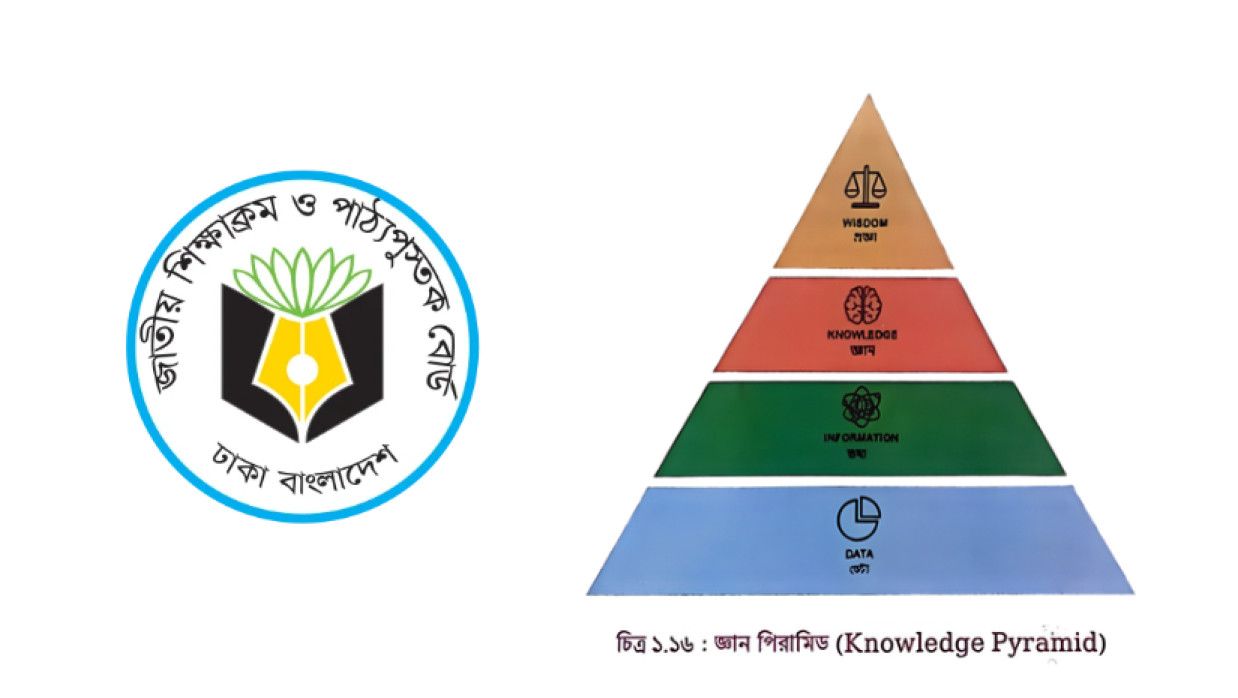
The illustration appears in the chapter titled “Data and Information” as part of a pyramid depicting levels of knowledge. The National Curriculum and Textbook Board (NCTB) has halted printing and initiated steps to retrieve and correct copies already distributed to the field. The move has raised concerns over additional costs, time pressure and the timely delivery of textbooks to students.
How the four levels of knowledge are arranged
The NCTB intended to explain the progression from data to information, from information to knowledge, and from knowledge to the highest level, wisdom, using a pyramid-shaped illustration. A diagram was therefore included in the Class Six ICT textbook for the 2027 academic year, with four levels arranged from bottom to top in the “Data and Information” lesson.
To make the concept easier for students to understand, each level was assigned a separate symbol. The data level features a round, clock-like symbol, while the information level has a symbol resembling an atom or network. The knowledge level is represented by a human brain, while a pair of scales appears at the wisdom level.
How the scales became the symbol of wisdom
The English word “wisdom” means “প্রজ্ঞা” in Bengali. However, the Class Six ICT textbook for the 2025 academic year used “বুদ্ধি” as the Bengali equivalent of wisdom, with a pair of scales as its symbol.
The NCTB changed the symbol in the 2026 edition, replacing the scales with a brain. During revisions for the 2027 edition, the committee recommended replacing “বুদ্ধি” with “প্রজ্ঞা” while retaining the brain symbol.
However, the symbol was changed again. Although the Bengali term was revised from “বুদ্ধি” to “প্রজ্ঞা”, the brain symbol was not retained. Instead, the scales reappeared, making them the symbol for wisdom in the 2027 textbook.
NCTB blames graphic designers for the error
The NCTB has attributed the use of the scales symbol at the wisdom level to an error by those involved in graphic design.
Professor Dr AKM Shawkat Ali Khan, NCTB member for curriculum, told The Daily Campus that “বুদ্ধি” was not the correct Bengali equivalent of “wisdom”. The term had been used in both the 2025 and 2026 editions, prompting the revision committee to replace it with “প্রজ্ঞা” in the 2027 edition.
“The graphic designers also replaced ‘বুদ্ধি’ with ‘প্রজ্ঞা’. But they changed the symbol. The revision committee had recommended correcting only the Bengali word to ‘প্রজ্ঞা’, not changing the symbol,” he said.
He added that the graphic designers may have searched for an image on Google and found the symbol used in the 2025 edition, leading them to reuse the old illustration. They may not have understood the implications of the symbol, he said.
The official declined to comment on how the scales symbol was originally introduced in the 2025 edition. “I took charge on August 20 this year. I do not know about this,” he said.
Following the political change in 2024, the interim government led by Dr Muhammad Yunus scrapped the new curriculum introduced under the Awami League government and returned to the previous 2012 curriculum. As the political transition took place in August 2024, the textbooks for the 2025 academic year were revised during that period.
Correction of printed textbooks raises cost concerns
Around 3.8 million copies of the Class Six ICT textbook are planned for printing for the 2027 academic year. Of these, nearly two million copies have already been printed and sent to the field. Those copies will have to be collected and corrected, creating a significant logistical challenge.
Retrieving, correcting and redistributing the books to change a single symbol could incur additional transportation, labour and management costs.
NCTB member Abu Naser Tuku told The Daily Campus that the scales symbol had appeared in the 2027 textbooks. After learning about the issue, the board decided to retrieve copies already sent to the field and correct them.
“Approximately 1.5 million to two million books have already gone to the field. We are bringing them back. They will then be corrected and supplied again,” he said, adding that the board also had to consider the additional costs.
Printing industry owners said recalling textbooks at this stage, after printing, binding and distribution work had been completed, would require additional time and money. However, the total additional cost of the correction process remains unknown.
Who is responsible?
The NCTB has described the change in the symbol as unintentional. However, retrieving, correcting and redistributing the books already sent to the field could make it more difficult to deliver all textbooks to students on schedule.
The incident has raised questions about how an error involving a single symbol passed through multiple review stages before the textbooks reached final printing. Although the revision committee had recommended changing the Bengali word while retaining the existing symbol, it remains unclear who was responsible for ensuring that the symbol stayed unchanged. NCTB officials have pointed to different areas of responsibility.
NCTB member Abu Naser Tuku said textbook content and symbols were determined by curriculum specialists, while his own responsibilities primarily involved printing-related work.
NCTB chief editor Professor Md Riazul Islam said he was not authorised to comment on the matter. He referred questions to his superiors, including the chairman, the member for textbooks and the member for curriculum.
Professor Dr AKM Shawkat Ali Khan said he was responsible for overseeing the overall textbook content in his capacity as the curriculum member. Although the books went through several stages of verification and review, the error was not detected.
“The books go through validation, review, the English version and several other stages. Despite being present at all these stages, no one noticed the mistake,” he said.
He added that those involved may have focused primarily on whether the word “প্রজ্ঞা” had been corrected, overlooking the symbol. The errors identified in the digital copies have now been corrected, and the revised files have been sent to the relevant parties.
 Follow The Daily Campus on Google News