14,000 primary teachers to be appointed as transfers suspended indefinitely
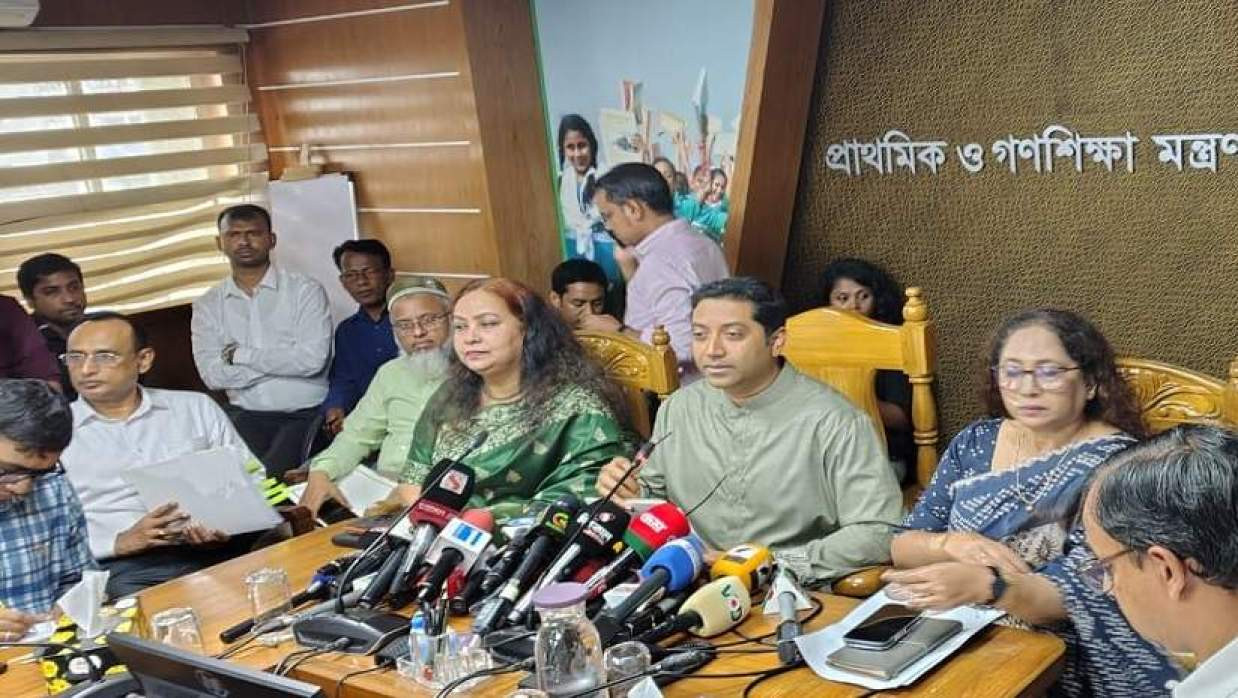
The government has suspended teacher transfers at government primary schools indefinitely to facilitate the posting of more than 14,000 newly recruited teachers awaiting appointment, State Minister for Primary and Mass Education Bobby Hajjaj said on Monday (September 7).
The decision was announced at a press conference at the Ministry of Primary and Mass Education.
“Transfers have now been suspended for the appointment of more than 14,000 teachers. Once the postings of the 14,000 are fixed, transfers will resume. Teachers will then be able to apply for transfers again,” Bobby Hajjaj said.
He said the government may reconsider the existing transfer system after the new teachers join their posts.
“After the new teachers are appointed, transfers will resume. Whether they will be conducted under the existing policy or a different system will be decided then. Since the policy may change, there is no need to discuss that now,” he said.
The state minister said the government is also reviewing the stipend programme and other areas of primary education. He said officials had suggested that stipends would be more effective if they were distributed based on financial need.
“Our efforts in the coming days will be to make it need-based, particularly on the basis of financial need, and to increase the number of beneficiaries,” he said.
Government plans wider focus on primary education
Bobby Hajjaj said the government is working to make primary education more effective, inclusive and quality-oriented while strengthening non-formal education to bring out-of-school children and adolescents into the education system.
He said the government's education approach gives importance to linking education with skills, using technology and ensuring the inclusion of marginalised communities.
Referring to Article 17 of the Constitution, the state minister said ensuring universal, free and compulsory education and eliminating illiteracy are among the state's fundamental responsibilities.
He said the government is working through primary education, non-formal education, adult education, life-skills programmes and employment-oriented training to bring people deprived of educational opportunities into the mainstream of development.
According to Labour Force Survey 2024 data cited by the state minister, the literacy rate among people aged seven and above stands at 78.98 percent.
He said Bangladesh has made significant progress in expanding literacy over the past several decades. However, a considerable number of people still remain outside adequate education and skills opportunities, including out-of-school and dropout children and adolescents, marginalised communities and adults deprived of education.
Skills training for out-of-school adolescents
Bobby Hajjaj said age- and need-based education, functional literacy, life skills, livelihood and pre-vocational training are being provided under the Non-Formal Education Act, 2014.
He highlighted the SKILFO (Skill Focused Literacy for Out of School Adolescent) pilot project in Cox's Bazar as an example of linking literacy with skills development.
Under the project, 6,825 adolescents received basic literacy, numeracy and pre-vocational training in 13 occupations.
The state minister said the initiative has created a model for linking literacy with employment and livelihoods.
The government is also implementing the “Effective Literacy and Practical Skills Training (Pre-Vocational Level)” programme in the sadar upazilas of all 64 districts.
In the first phase, 5,120 dropout adolescents aged 15 to 24, with 80 trainees from each district, were brought under the programme.
Each course consists of 460 hours of training, including 100 hours of functional literacy and 360 hours of skills training. The training is being conducted in line with the Bangladesh National Qualifications Framework (BNQF).
92.47% of competent trainees receive job linkages
Bobby Hajjaj said the programme is intended to create a pathway from education to employment.
Of 4,312 students registered under a special programme, 4,198 have been certified as competent. Among them, 3,882, or 92.47 percent, received some form of job linkage.
Of those receiving job linkages, 603 entered direct employment, 879 joined apprenticeships in decent work, 1,304 became entrepreneurs and 489 joined mentorship-based apprenticeships with the aim of becoming entrepreneurs.
Another 458 enrolled in BNQF Level 1 programmes, while 104 enrolled in the Bangladesh Open University’s SSC (Vocational) programme.
The state minister said the figures show that linking literacy with skills can create tangible changes in people’s lives.
 Follow The Daily Campus on Google News