Teachers demand nationalisation of 30,783 private schools, colleges and madrasas
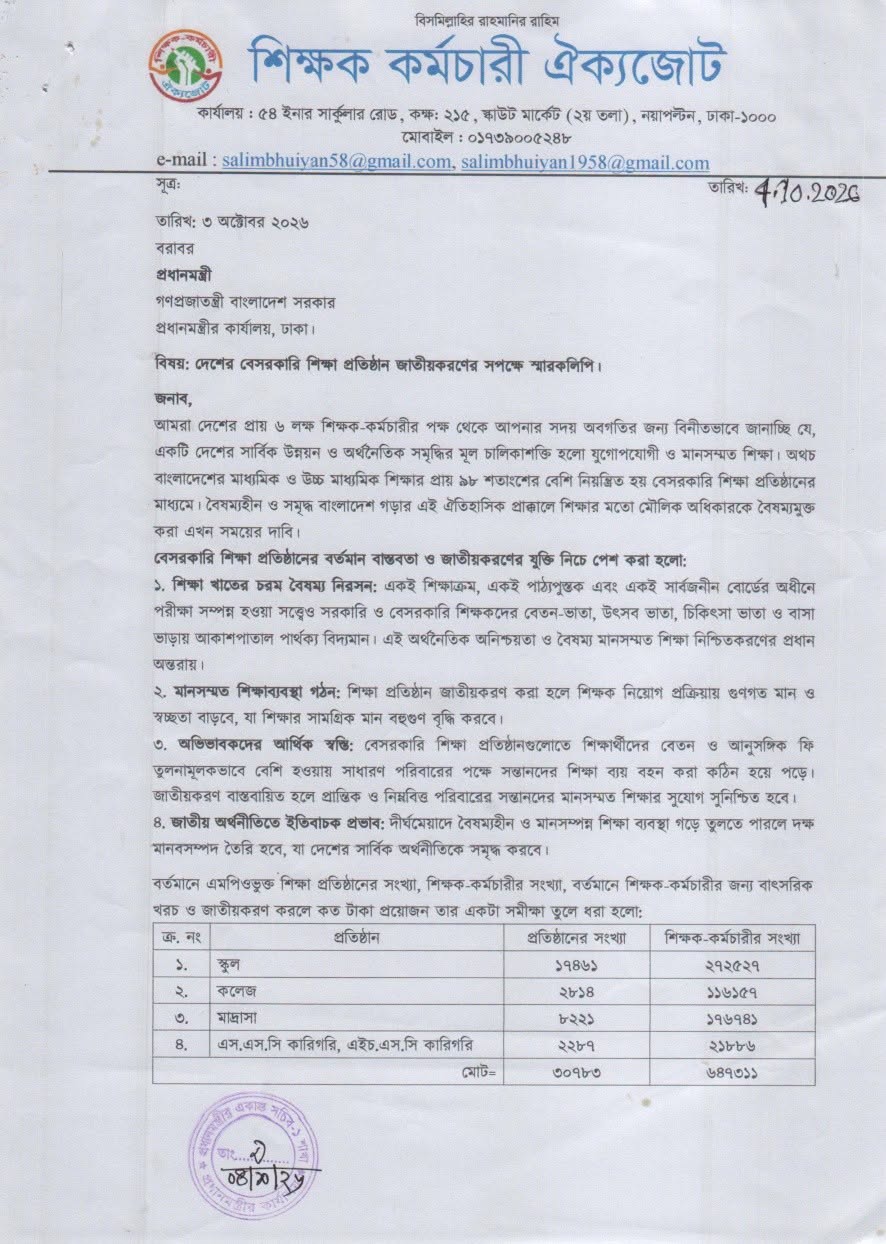
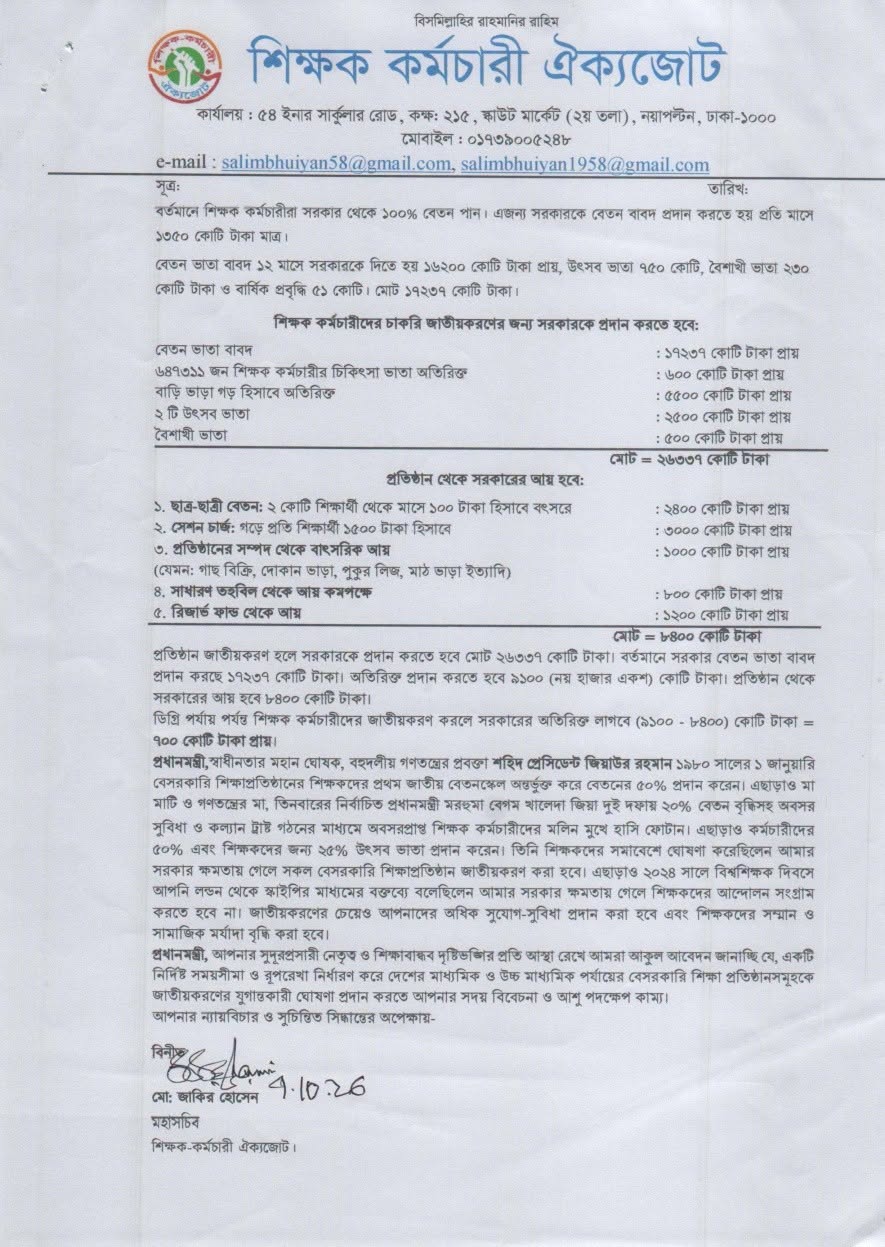
The Teachers-Employees Unity Alliance has submitted a memorandum to Prime Minister Tarique Rahman, demanding the nationalisation of 30,783 private schools, colleges, madrasas and SSC- and HSC-level technical education institutions across the country.
The memorandum, submitted to the Prime Minister’s Office on Saturday (October 3), called for an end to disparities among teachers and employees of private educational institutions, improved education quality and reduced financial pressure on parents.
According to the memorandum, more than 98 percent of secondary and higher secondary education in Bangladesh is provided through private educational institutions. It argued that despite following the same curriculum, textbooks and public examination system, teachers in government and private institutions face significant differences in salaries, festival allowances, medical allowances and housing allowances.
The alliance said such financial insecurity and disparities are among the obstacles to ensuring quality education. It argued that nationalising private educational institutions would improve transparency and quality in teacher recruitment and contribute to improving the overall standard of education.
Teachers cite financial pressure on families
The memorandum also said students at private institutions often pay comparatively higher tuition and other fees, creating additional financial pressure on ordinary families.
The teachers and employees claimed that nationalisation would help ensure access to quality education for children from marginalised and low-income families. They also argued that a more equitable education system would help develop skilled human resources and contribute positively to the national economy.
The memorandum estimated that nationalisation would require the government to spend Tk 26,337 crore, while the government currently provides Tk 17,237 crore in salaries and allowances. It said an additional Tk 9,100 crore would be required, while institutions would generate Tk 8,400 crore in government revenue.
According to the memorandum, if teachers and employees up to the degree level were nationalised, the government’s additional financial requirement would be around Tk 700 crore after accounting for the projected revenue.
Alliance cites past political commitments
The memorandum also referred to measures taken by former president Ziaur Rahman and former prime minister Khaleda Zia concerning private-sector education employees.
It claimed that Ziaur Rahman included teachers of private educational institutions in the national pay scale on January 1, 1980, and provided 50 percent of their salaries. It also credited Khaleda Zia’s governments with two 20 percent salary increases, retirement benefits and the establishment of welfare arrangements, as well as festival allowances for teachers and employees.
The alliance further referred to a statement it said Tarique Rahman made via Skype from London on World Teachers’ Day in 2024. According to the memorandum, he had said that teachers would not need to stage movements if his party came to power and that they would receive benefits beyond nationalisation, along with greater respect and social status.
The memorandum urged the prime minister to announce a specific timeframe and roadmap for nationalising private educational institutions at the secondary and higher secondary levels.
The government currently continues to operate separate policies and support mechanisms for non-government educational institutions, including MPO arrangements for private schools and colleges and separate policies for private madrasas and technical institutions.
 Follow The Daily Campus on Google News