10 government schools remain unfinished after nine years
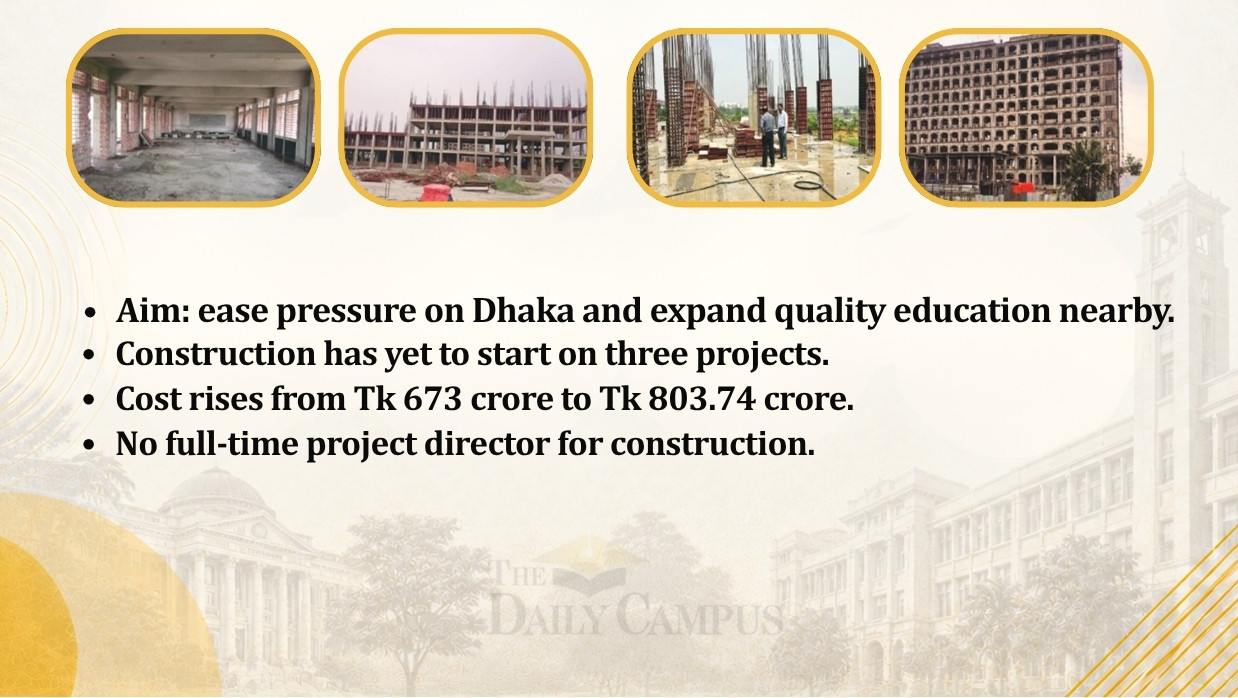
A government project to build 10 secondary schools in areas surrounding Dhaka has failed to complete construction at any of the sites even nine years after it was launched, with three schools yet to begin construction.
The project, titled “Establishment of 10 Government Secondary Schools in Areas Adjacent to Dhaka City (2nd Revised),” was approved in 2017 with an implementation deadline of June 2020. Its deadline has since been extended twice, first to December 2024 and then to June 2027, while the project cost has risen from Tk 673 crore 46 lakh 46 thousand to Tk 803 crore 74 lakh 85 thousand.
According to a 2026 intensive monitoring report by the Implementation Monitoring and Evaluation Division (IMED) of the Ministry of Planning, the project has faced delays over land acquisition, the absence of a feasibility study, limitations in project management and slow progress in infrastructure construction.
Three schools yet to start construction
The project aims to establish 10 government school and college campuses for 27,000 students in different areas of Dhaka and Narayanganj. The institutions are located in Bilamalia in Hemayetpur, Banshbari-Pathalia in Nabinagar, Lakuriapara in Dhamrai, Paschimdi in Keraniganj, Purba-Narsinghpur in Ashulia, Khordd Ghoshpara and Jalkuri in Narayanganj, Purbachal in Rupganj, and Satarak and Khilkhet in Dhaka.
Each institution is planned to have a 10-storey academic building, gymnasium, Shaheed Minar, internal roads, boundary walls and other infrastructure. The project also includes furniture, computers and internet facilities, laboratories, sports and cultural equipment, and books.
However, none of the 10 academic buildings had been completed by April 2026. Four buildings had reached 88 to 93 percent completion, two were at 30 and 33 percent, and another was only 10 percent complete.
Construction had not started at the remaining three sites. At one site, land had been handed over and tender evaluation was underway for awarding the construction contract. At the other two, land handover had not yet been completed.
The project's financial progress stood at 55.45 percent as of April 2026. Against the total allocation of Tk 803 crore 74 lakh 85 thousand, Tk 528 crore 31 lakh 31 thousand had been released, while actual expenditure stood at Tk 443 crore 86 lakh 54 thousand.
As construction has not been completed, none of the schools has started academic activities under the project. The procurement of furniture, computers and related equipment, laboratory, gymnasium and cultural equipment, sports materials and books has also not begun.
The project also envisaged creating 210 posts in various positions before the schools opened. The project office sent a letter to the Ministry of Education on August 12, 2025, seeking the creation of posts for Bangladesh Civil Service General Education cadre personnel, including principals, for the Bilamalia, Banshbari-Pathalia and Lakuriapara schools. No final decision has yet been received.
Land disputes and site changes delayed work
Project Director (additional charge) Professor Dr Mir Jahida Naznin said several sites faced complications that delayed construction.
“Now three to four sites are almost complete. Four of them will be handed over within two months. Work orders have been issued for three others. All three had different problems. One site was changed three times. Another faced a lawsuit. We finally found a new site there. Another site is in Purbachal, where there were many complications over a cemetery,” she said.
She said the project involved the Housing and Public Works Ministry, the Public Works Department and Rajdhani Unnayan Kartripakkha (RAJUK), making it impossible for the project authorities to take decisions independently in some cases.
“The work on these three sites has not started anew yet, but work orders have been issued. Four sites will be completed within two months. Of the remaining three, the 10-storey structure of one has been completed, another has reached eight storeys and the 10-storey structure of the third has also been completed. We are trying to hand over one around February or March and the other two by December,” she said.
The IMED report identified the absence of a feasibility study before the project was taken up as one of the key reasons for the prolonged implementation.
According to the monitoring team, a feasibility study could have identified problems involving land selection, ownership, lawsuits and acquisition before the project began. This could have made the implementation plan more realistic and helped control both time and cost.
The report said some identified plots had to be cancelled because of lawsuits and ownership complications, after which new sites were selected through fresh field inspections. This delayed construction even before it could begin.
The project had a target of acquiring 20 acres of land, and most of that target had been achieved. However, at Purba-Narsinghpur, the land had not been handed over even after acquisition money was paid. Road and boundary wall-related complications were also reported in Bilamalia, Paschimdi and Khordd Ghoshpara.
The monitoring report also identified delays in obtaining approval from the Executive Committee of the National Economic Council (ECNEC), issuing administrative orders and appointing officials. These caused project activities to begin nearly 11 months late.
The Covid-19 pandemic subsequently disrupted field-level activities, while lawsuits and ownership disputes over land further slowed acquisition. Changes to building designs and the introduction of a new rate schedule also required additional time for revision and approval of the Development Project Proposal (DPP).
The report also pointed to a lack of coordination among government agencies as a factor behind delays in tender evaluation and project implementation.
It mentioned an Anti-Corruption Commission (ACC) investigation following allegations of irregularities in land purchases against the first project director. The report said the ACC investigation did not find the allegations to be true.
Project director cites Covid, land acquisition delays
Professor Dr Mir Jahida Naznin said the project effectively began in 2018, although it was formally scheduled to start in 2017, because the first project director joined in December that year.
“The project was supposed to start in 2017. The first project director joined in December 2017. So ultimately it started from 2018. Then Covid came. In this type of construction project, the first task is land acquisition, and before land acquisition, land has to be selected,” she said.
She said a designated high-profile committee of the ministry visits potential sites before proposals are sent to the deputy commissioner's office.
“Because of Covid, activities including land inspections were disrupted. In 2020 and 2021, we could not go outside normally. So these activities also did not progress. After I joined in January 2021, when the situation improved somewhat, we inspected the lands and completed the acquisition process. Basically, the land acquisition activities started from January 2021,” she said.
Asked why no feasibility study had been conducted, she said, “The rule is that a feasibility study has to be conducted before starting a project. I was not involved with this project at that time. So I cannot say why the feasibility study was not conducted.”
Explaining delays linked to allegations against the first project director, she said, “My predecessor, who was the project director, had some cases against him. There were many reports and articles about him in print media, television and other media. So from 2018 to 2019, besides working on the project, time was also spent dealing with these matters. Even after I came, I had to provide many documents on these issues.”
Project cost rises by nearly Tk 130 crore
The project cost has increased significantly alongside the extension of its implementation period.
The original project was approved at Tk 673 crore 46 lakh 46 thousand. Under the first revision, the cost rose to Tk 750 crore 40 lakh 10 thousand. The second revision increased it further to Tk 803 crore 74 lakh 85 thousand.
The current cost is therefore about Tk 130 crore 28 lakh 39 thousand higher than the original estimate, an increase of approximately 19.35 percent.
The original implementation period, from July 1, 2017 to June 30, 2020, was first extended to December 2024 and later to June 2027. This represents an increase of 84 months, or 233.33 percent, compared with the original timeframe.
Explaining the rise in cost, Naznin said the original DPP had been prepared based on the 2014 rate schedule.
“Costs will increase. The DPP was prepared based on the 2014 rate schedule. The buildings are also very large. Each academic building is 10 storeys. Along with this, there are approach roads, boundary walls, gymnasiums, guardian sheds, substations and many other construction works,” she said.
She added, “The DPP was prepared according to the 2014 rate schedule. By the time land was acquired and construction work was about to begin, the 2022 rate schedule had come into effect. As a result, construction costs increased. At the same time, the Bangladesh National Building Code was revised in 2020. There are differences between the previous code and the current code. Overall, the cost of construction has increased.”
Full-time project director still unavailable
The project has had three project directors since its launch up to April 2026.
The first project director, Dr Amirul Islam, served from December 20, 2017 to October 12, 2020. Dr Harun-or-Rashid subsequently served as project director in additional charge for around three months.
Professor Dr Mir Jahida Naznin served as the full-time project director from January 12, 2021 to January 7, 2026. After being posted as director of Planning and Development at the Directorate of Secondary and Higher Education, she has continued to perform the project director's duties as an additional responsibility.
The IMED report warned that the absence of a full-time project director could constrain close supervision, prompt decision-making, inter-departmental coordination and timely completion of the project.
Naznin said she had repeatedly sought the appointment of a full-time project director.
“I have repeatedly applied and sent letters for a full-time project director, but one has not yet been appointed. There should be a full-time person. The project is now going through a very important period, its peak time. A full-time project director is very necessary at this time,” she said.
The IMED report also noted that even after construction is completed, several steps will remain before the schools can begin operations, including creating posts, recruiting teachers and staff, and supplying furniture and educational materials.
Original objective remains unfulfilled
The project was intended to expand access to government secondary education around Dhaka, reduce pressure on renowned educational institutions in the capital and make quality education more accessible to ordinary people.
Most parents surveyed for the monitoring study said they expected the new schools to improve education quality, provide modern infrastructure, reduce travel time and costs, increase girls' participation and reduce student dropout.
Some 80.50 percent of parents expected improvements in the quality of education. Another 78.25 percent expected access to modern educational materials and infrastructure, while 74.75 percent expected reduced travel time and costs.
However, nine years after the project was launched with a target of completion within three years, none of the 10 schools has been fully completed.
Speaking to The Daily Campus, Dr Rubaiya Murshed, a teacher at the Department of Economics at the University of Dhaka, said the need for schools and the feasibility of the project should have been established before it was undertaken.
“The question is how many schools are needed in an area relative to its population. Why are children in that area not going to school? Is it because there are not enough schools, or are there other reasons despite schools being available? These issues need to be assessed first. In other words, before undertaking the project, it was necessary to determine the actual need and feasibility through a feasibility study,” she said.
She also pointed to a political economy dimension to the project.
“There is certainly a political economy issue here. Economic and financial matters are also involved because a lot of money and the interests of many stakeholders are connected to the project. Therefore, if implementation is delayed, accountability must be established and ensured,” she said.
On the failure to complete the project on time, she said, “A project is supposed to be completed within a certain period, but in reality it is not happening. Various aspects of implementation management, starting from the absence of a feasibility study, need to be examined. At the same time, there needs to be an institutional mechanism through which those responsible can be held accountable if a project is not completed within the stipulated time.”
She said the existing system does not provide sufficient incentives for completing projects on schedule.
“Our system does not have enough incentives to complete projects on time. If failure to complete work within the stipulated time has no negative impact on someone's job or responsibilities, and an extension of the project instead creates an opportunity for additional funding, then the incentive to complete the work on time decreases. This becomes easy to understand when we consider human behaviour and incentives,” she said.
Murshed also said simply increasing the number of schools would not necessarily guarantee better access to or quality of education.
“Simply increasing the number of schools does not necessarily ensure the quality or availability of education. Many of our existing schools have teacher shortages, and in many cases a teacher has to teach multiple subjects. Teachers also lack sufficient incentives. Therefore, simply increasing the number of new schools without addressing the problems in the existing education system will not produce the desired results,” she said.
“Alongside building new schools, it is also very important to invest in teachers, academic preparation, teaching resources and necessary facilities.”
 Follow The Daily Campus on Google News