80.6% of Primary Teachers Lack Digital Skills, Yet Over 300,000 Will Receive Tablets
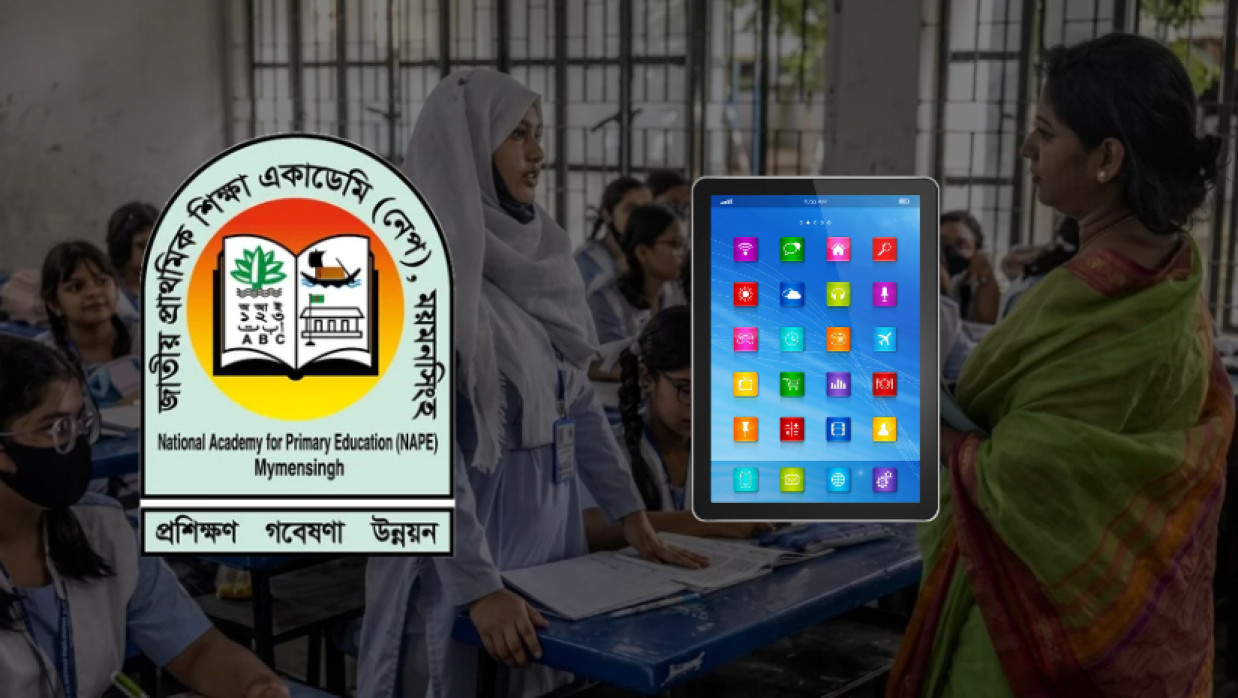
More than 300,000 government primary school teachers are set to receive tablets under a Tk 41,090 crore education programme. However, a National Academy for Primary Education study found that 80.6% of teachers lack the skills to effectively apply digital learning in classrooms, raising questions about training, age-related challenges and inadequate school infrastructure.
The government has taken an initiative to provide a tablet to each of more than 300,000 government primary school teachers as part of efforts to modernise primary education. However, the findings of a study by the National Academy for Primary Education (NAPE) suggest that many teachers may not yet be adequately prepared to use the devices effectively.
The study found that 80.6% of teachers had not developed the skills required to properly apply digital education in classrooms. Meanwhile, more than 134,000 government primary school teachers are aged 46 or above, potentially making adaptation to new technology an additional challenge for some. Shortages of computers, multimedia equipment and internet facilities in schools also raise questions about whether distributing tablets alone will ensure technology-based teaching.
The NAPE study, titled ‘Exploring Teacher Understanding About Twenty First Century Skills Among the Government Primary Schools of Bangladesh’, identified a significant gap between teachers' understanding of digital education and their ability to apply it in classrooms.
While 2.7% of teachers rated their understanding of digital education as ‘excellent’, 9.1% described it as ‘very good’ and 23.9% as ‘good’. However, only 19.4% demonstrated the ability to apply digital education effectively in classrooms, meaning 80.6% did not meet the required standard of practical skills.
Conducted under NAPE's research activities for the 2024-25 fiscal year, the study examined government primary school teachers' understanding of 21st-century skills and their application in classrooms. More than 691 teachers from 16 upazilas across the country's eight divisions were included.
Our teachers are not adequately prepared. They have skill gaps. They are given training, but concerns have long been raised that the quality of training is poor, it is not useful, and it is not conducted properly.
- Professor Emeritus Dr Manzoor Ahmed, BRAC University
The study also identified gaps in teachers' understanding of various 21st-century skills. Some 35.2% of teachers said they needed support in global citizenship, while 29.5% and 29.8% reported needing assistance with digital literacy and self-management, respectively.
The findings indicate that teachers face challenges not only in delivering textbook lessons but also in helping students develop skills needed for modern life and the workplace. Rural teachers were also found to lag behind their urban counterparts in areas such as digital literacy, global citizenship and problem-solving.
The study therefore emphasised the need for training tailored to teachers' individual requirements and the realities of their schools, rather than providing the same training to everyone.
More than 300,000 teachers to receive tablets
The Executive Committee of the National Economic Council (ECNEC) has approved the Fifth Primary Education Development Programme (PEDP-5), involving an expenditure of Tk 41,090 crore, to improve the quality of primary education.
The five-year programme is scheduled to run from July this year to June 2031. Alongside infrastructure development, it includes an initiative to provide one tablet to each primary school teacher.
According to the Directorate of Primary Education (DPE), Bangladesh has 65,569 government primary schools, with 372,632 teachers and more than one crore students. However, a source at the DPE involved with PEDP-5 put the number of teachers at 383,624. Under the programme, more than 300,000 teachers are expected to receive individual tablets.
Rather than giving each teacher a tablet, it is more important to strengthen school-based ICT activities, training and the capacity to develop content.
- A teacher who requested anonymity
The project was approved at an ECNEC meeting held at the Secretariat on Wednesday (November 4), chaired by Prime Minister Tarique Rahman.
After the meeting, Planning State Minister Zunaid Saki said Tk 33,203.48 crore of the project's total cost would come from government funds. The remaining Tk 7,887.25 crore is expected to be arranged through foreign loans and grants.
He said the programme includes establishing new schools, renovating old ones, training teachers, providing one tablet to each teacher, setting up multimedia classrooms and distributing shoes, school uniforms and educational materials to students.
However, observations were made regarding the rationalisation of expenditure in several areas, including consultancy costs, and the transfer of some expenses to the revenue budget. The authorities instructed that the project be resubmitted within two weeks after incorporating the observations.
Higher academic qualifications, but gaps in practical skills
Statistics on the academic qualifications of government primary school teachers show that a large proportion have higher education degrees. However, the NAPE study indicates that these qualifications do not necessarily translate into the ability to use modern technology and 21st-century skills effectively in classrooms.
According to the latest Annual Primary School Census report of the DPE, 163,080 government primary school teachers hold master's degrees. The second-largest group, comprising 99,991 teachers, have bachelor's pass degrees.
Another 42,304 teachers have completed higher secondary education, while 20,984 hold bachelor's honours degrees.
Among other qualifications, 13,119 teachers hold BSS degrees, 8,579 have passed the SSC examination and 7,710 hold MBA degrees.
More than 134,000 teachers aged 46 or above
The age profile of government primary school teachers also raises questions about their preparedness to use tablets.
According to the latest Annual Primary School Census report, 109,263 teachers are aged between 46 and 55, while 24,777 are aged 56 or above. This means 134,040 teachers are at least 46 years old.
Another 155,663 teachers are aged between 36 and 45, while 82,835 are between 26 and 35. Alongside distributing tablets to such a large workforce, ensuring that teachers have the necessary technological skills and training has therefore become an important consideration.
A government primary school teacher said the authorities had informed teachers that each of them would receive a tablet, but questions remained about the quality and practical usefulness of the devices.
“We know that every teacher will be given a tablet. But the question is, what will be the quality of the tablets? Computers were previously provided to our school. We have two computers, but both are out of order. I use my personal computer for school work. If tablets are distributed now, their effectiveness also needs to be considered,” he said.
“I think the necessary infrastructure must be ensured in schools first. Good-quality devices need to be provided. Many schools still do not have internet connections. Even in schools where internet is available, it is necessary to examine how effectively it is being used.”
He said around 50% of people in Bangladesh could operate digital devices, while many others still needed training. In particular, he said, some older teachers did not even have Android phones and continued to use feature phones.
“Based on my experience around me, I would say that the number of such teachers is not small,” he added.
Government primary schools have 109,263 teachers aged between 46 and 55 and 24,777 teachers aged 56 or above. This means the number of teachers aged 46 or above is 134,040. Another 155,663 teachers are aged between 36 and 45, while 82,835 are between 26 and 35.
- Annual Primary School Census report
The teacher said he received ICT training at the primary level in 2011 and later gained experience working with ICT alongside his academic activities in Bangla. He said he regularly used computers himself and believed school-based ICT activities could be strengthened instead of providing a separate tablet to every teacher.
“I do not think every teacher needs a tablet. It is not possible to conduct every class using ICT. Multimedia equipment has been provided to our schools, but not all schools have it. Some have it, while others do not. More attention should be given to ensuring that lessons are delivered using multimedia and appropriate content,” he said.
Emphasising the need to develop quality educational content, he said, “At the primary level, importance should be given to content development. Everyone knows that it is now impossible to do without ICT. Many of the new teachers joining the profession are skilled in computers. Those who can operate computers generally have their own personal computers. Almost every school also has some computers. School activities can be carried out using those devices.”
On training, he said 10 days of training could be sufficient for teachers who already knew how to operate computers and needed to learn content development. However, the same duration would not be enough for teachers who lacked basic computer skills.
“In other words, training must be based on teachers' skills and needs. Every school has one teacher who has received ICT training. They can be utilised. Rather than giving each teacher a tablet, it is more important to strengthen school-based ICT activities, training and the capacity to develop content,” he said.
Questioning the effectiveness of the tablet distribution initiative, the teacher said he did not personally believe it would be particularly effective without proper monitoring.
“If every teacher is given a tablet, it is also important to see how much they will actually use it. In many cases, the tablet may remain at a teacher's home but be used by their son or daughter. Without proper monitoring, the actual objectives of the initiative will not be achieved,” he said.
He added that teachers who could operate computers already had access to devices for school-related work. The government should therefore consider whether the money could be spent on other essential areas instead of providing a separate tablet to every teacher.
Teachers need better skills and training alongside tablets
Professor Emeritus Dr Manzoor Ahmed of BRAC University said the gaps in teachers' skills and preparedness were not new. He said concerns had long persisted over the quality and effectiveness of the training provided to teachers.
Referring to the issue, he said, “Our teachers are not adequately prepared. They have skill gaps. They are given training, but the quality of training is poor, it is not useful, and it is not conducted properly. Such concerns have been raised for a long time.”
Describing the NAPE research as a good initiative, he said identifying problems through research alone would not be enough. Long-term thinking was needed to find solutions, and discussions should be held to determine the necessary steps. He said responsibility for addressing the problems also needed to accompany research.
Professor Manzoor Ahmed said efforts to address teachers' skill gaps must focus not only on training after they enter the profession but also on their initial preparation. He said many people entering teaching lacked the necessary aptitude and skills, while the training they received after joining the profession was also insufficient.
Instead of arranging isolated training programmes, he said, a coordinated plan was needed to improve teacher preparation and professional skills.
He also stressed the importance of practical teaching and guidance from experienced teachers to make training more effective. Although opportunities for practice teaching are included in training, he said, they are often not implemented properly. Experienced professionals should be involved in observing new teachers' lessons and providing them with necessary guidance.
According to Professor Manzoor Ahmed, weaknesses in school management and supervision must also be addressed alongside teacher preparation and training. He said these issues should be brought under a comprehensive and coordinated
 Follow The Daily Campus on Google News