Government plans university focused on blue economy, education minister says
The government is planning to establish a university focused on the blue economy, or ocean economy, Education Minister Dr ANM Ehsanul Haque Milon has said. He said there is an opportunity for Bangladesh and China to work together on the initiative, particularly in research and education related to the blue economy.
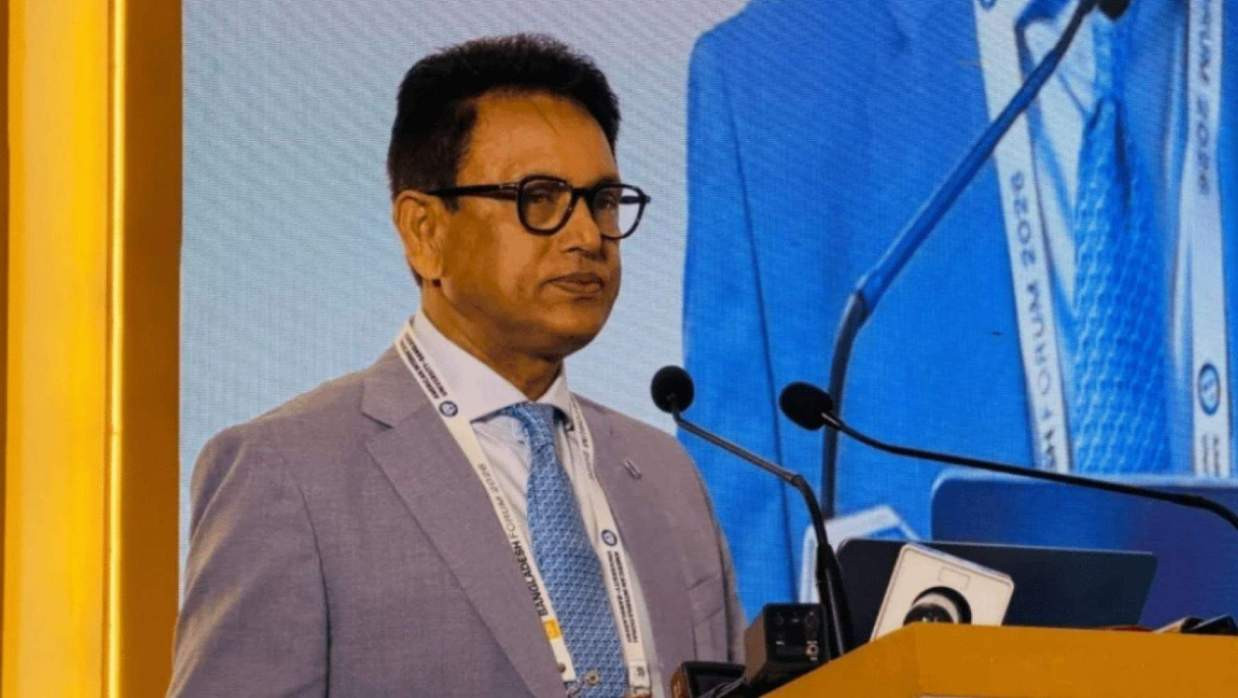
Milon made the remarks on Monday (September 21) morning at the second China-Bangladesh Administrative Experience Exchange Roundtable at Hotel InterContinental Dhaka. The event was jointly organised by the University of Dhaka’s Centre for China Studies, the Shanghai Institutes for International Studies and the University of Dhaka.
“Our second major resource is the blue economy, or ocean economy,” the education minister said.
Recalling a visit to the Bay of Bengal on January 17, 1981, with former president Ziaur Rahman, Milon said he had accompanied the former president along with teachers, artists, professors and students from different fields.
“I was also present on that trip, which was organised on a ship called Hijbul Bahar. At the time, he showed us how the resources beneath the sea could be explored and made suitable for use. We stayed there for two nights and three days,” he said.
Highlighting the potential of the blue economy, Milon said Bangladesh has a 200-nautical-mile Exclusive Economic Zone covering more than 100,000 square kilometres.
“This vast sea holds enormous economic potential. Chinese researchers, experts and academics are currently working on this issue,” he said.
He described the ocean economy as an important area for academic research and said the government is prioritising specialised research focused on the blue economy and circular economy.
Addressing Li Kaishi, a parliamentarian from Bangladesh and China, a senior research fellow in international studies, other guests and participants, Milon described the event as a “very excellent” initiative.
He said the first roundtable was held at the University of Dhaka and expressed his satisfaction with attending the second one and with the issues discussed there.
On Bangladesh-China relations, Milon said the relationship between the two countries has continued for many years.
“Whatever the weather, whether the sky is sunny or cloudy, or there is a storm or rain, Bangladesh’s friendly relationship with China has always remained intact and continued,” he said.
Turning to population and human resources, the education minister said China had once also been a highly populated country but later transformed its population into a national resource and established a strong position in the global economy.
Bangladesh, he said, should draw lessons from China’s experience and use proper planning to turn its large population into a major national asset.
“The time has come to make proper use of our demographic dividend,” he said.
Milon described human resources as Bangladesh’s biggest strength, saying around 65% of the country’s population consists of working-age young people.
He said the country’s population of around 180 million represents a major demographic opportunity at a time when many developed countries are experiencing population decline and an increase in their elderly populations.
The minister said he recently visited China to see how the country had used technology to transform its population into a skilled workforce. He praised China’s coordination between industries and educational institutions.
He also said the government plans to gradually increase budget allocations for education and stressed greater investment in technical and vocational education for sustainable social and economic development.
As remittances are one of the major drivers of Bangladesh’s economy, the government is focusing on improving technical and vocational education to produce skilled workers, Milon said.
He added that the government is signing various memorandums of understanding and modernising technical institutions as part of the initiative.
 Follow The Daily Campus on Google News