CUET remains shut 56 days after VC change as government looks to DUET experience
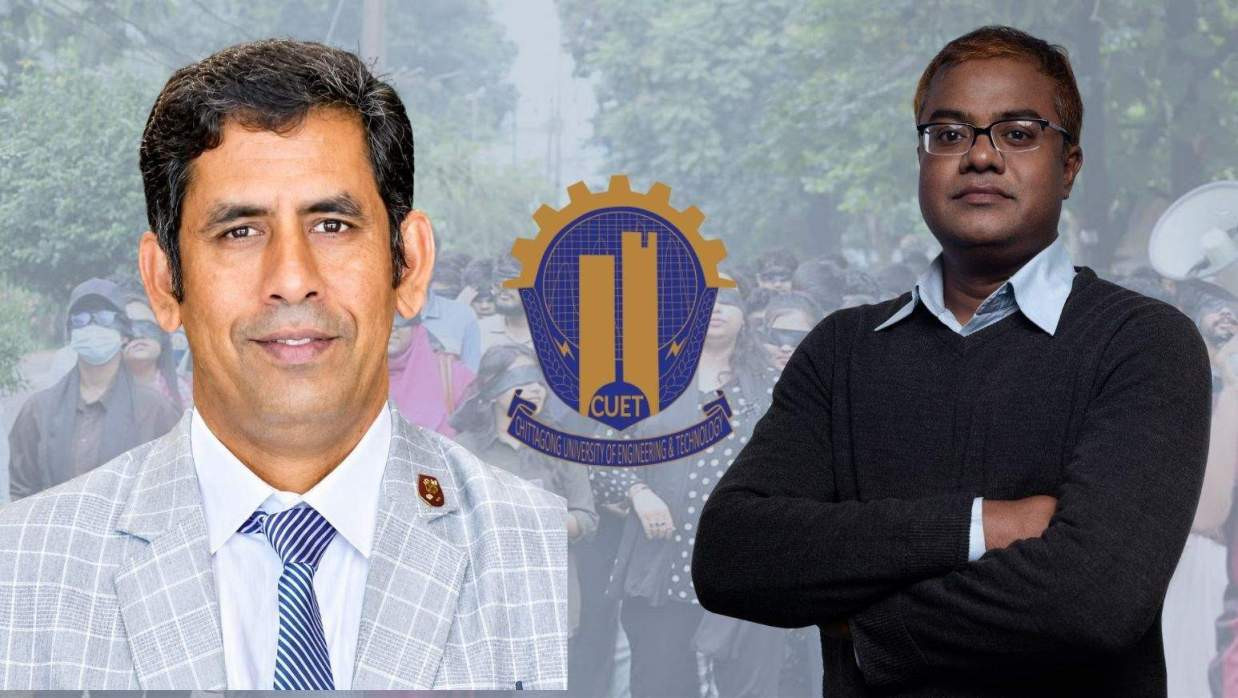
Chittagong University of Engineering and Technology (CUET) has remained effectively shut for more than two weeks following the replacement of its vice-chancellor just 56 days after his appointment.
Classes and examinations remain suspended, while classrooms and laboratories lie empty. There is still no clear indication of when normal academic activities will resume, leaving more than 5,000 students from 12 departments at risk of session delays.
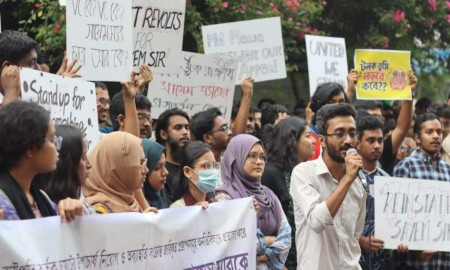
The movement that began on campus has also spread to Chattogram city. Students held a human chain in front of Chattogram Press Club on Tuesday, demanding the reinstatement of former VC Professor Abu Sadat Muhammad Sayem. No students from the 2023 batch are taking part in the movement as they have returned home after completing their examinations, while some students from the 2024 batch are participating.
The government has not publicly provided a detailed explanation for removing Sayem just 56 days after he took office. The protesters, meanwhile, have refused to withdraw their demand.
The government is maintaining its decision and is looking at the experience of Dhaka University of Engineering and Technology (DUET) as an example in dealing with the CUET deadlock.
According to information available, DUET faced a similar stalemate from May 14 following protests against its vice-chancellor. Although academic activities had already stopped after term-final examinations, office activities were supposed to continue until May 22.
The situation turned into a confrontation on May 17. Students then announced a “complete shutdown” on May 19. After the campus was closed indefinitely, newly appointed VC Professor Dr Engineer Mohammad Iqbal quietly returned to the campus. The situation gradually returned to normal.
The Education Ministry and officials involved in VC appointments now want to observe the CUET situation in light of that experience.
Students, teachers remain firm on VC Sayem’s reinstatement
Students have been observing an all-out shutdown at CUET since September 22, demanding the reinstatement of former VC Professor Abu Sadat Muhammad Sayem. A lock was placed on the VC’s residence on the night of September 21, after which protesters also closed the university’s main gate.
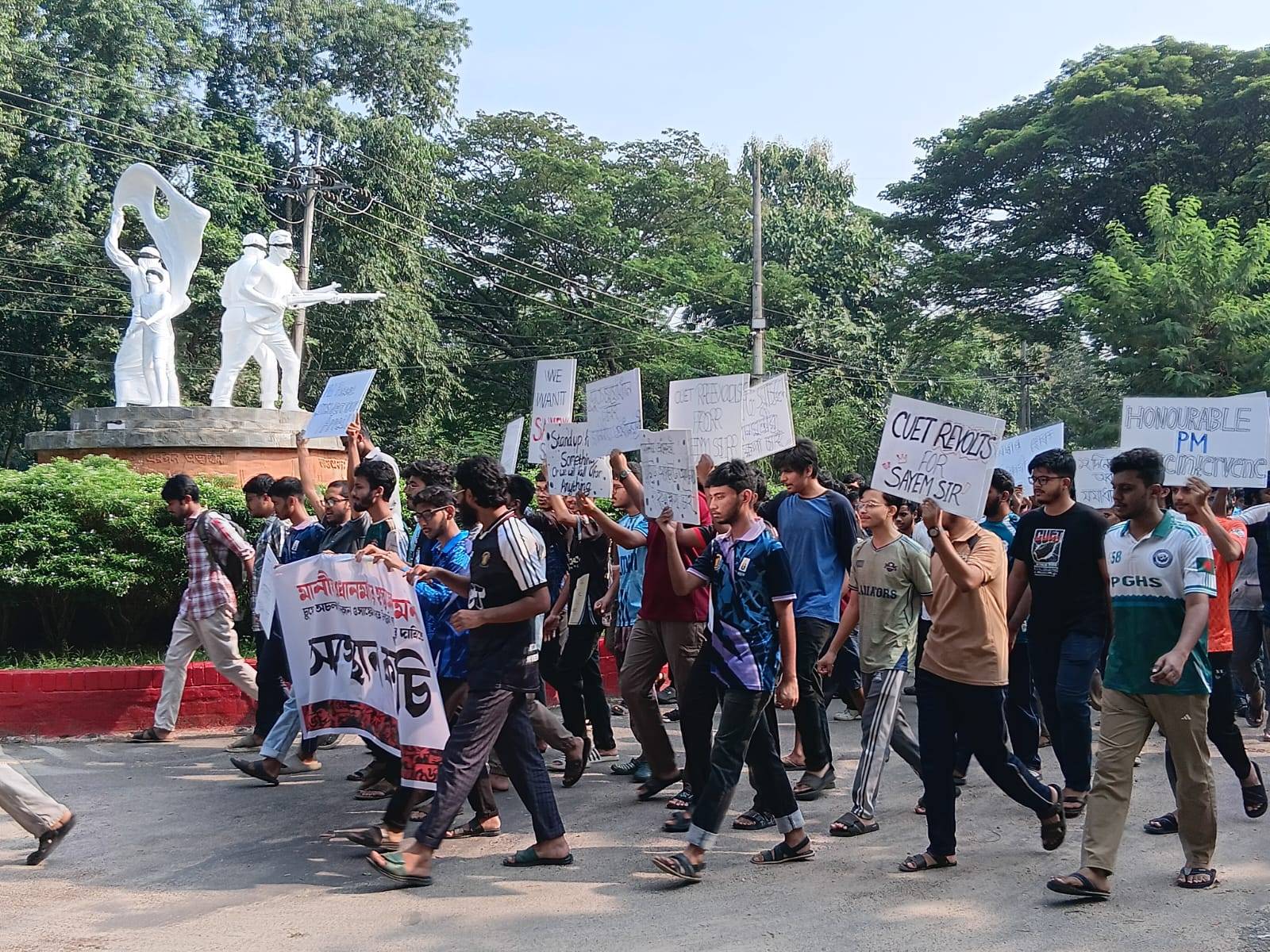
A section of teachers, officers and employees has expressed solidarity with the movement, bringing normal university activities to a virtual standstill.
The university authorities said the students of the 2021-22 academic session began classes on January 1, 2023. Under the four-year course structure, they were expected to complete their undergraduate studies by January 2027.
However, academic activities had already fallen behind schedule because of the July 2024 movement and an earlier movement at CUET demanding road safety.
The ongoing shutdown has now resulted in the cancellation of two to three examinations of different departments from the first term of the fourth year. Final examinations of different years and semesters in six departments have also been postponed indefinitely.
According to CUET’s academic calendar, each term provides 65 working days, or 13 weeks, for classes. The university will have a two-week winter vacation from December 22 this year.
The university also remains closed for around a month each year during Ramadan and Eid-ul-Fitr.
If the current deadlock continues, examinations for the outgoing batch’s second term could stretch until the middle of May next year. As the period would coincide with the Eid-ul-Adha holiday, some examinations could be pushed to after the Eid vacation.
As a result, fourth-year students may need until July 2027 to complete all their academic activities, meaning the four-year degree programme could take more than four and a half years to complete.
CUET is currently running academic activities for five batches at the same time instead of the usual four. The ongoing movement could further deepen the backlog, creating the possibility of six batches being caught in an academic jam.
Several examinations of students from the 2022 academic session are also pending. An examination in the Mechanical and Manufacturing Engineering (MME) Department was scheduled for October 15.
Four examinations in the Electrical and Electronic Engineering (EEE) and Biomedical Engineering (BME) departments were also scheduled before the Puja vacation, but there are doubts over whether they will be held as scheduled.
CUET Controller of Examinations Professor Moinul Islam said examinations in six departments have been suspended, but the disruption to the academic calendar can still be overcome.
“There is some vacation after the final examinations of each batch. The delayed academic activities can be made up by continuing academic activities during that period,” he said.
Why was VC Sayem removed after 56 days?
Professor Abu Sadat Muhammad Sayem, a professor of CUET’s Mechanical Engineering Department, was appointed vice-chancellor on July 27 and took charge the following day.
Soon after his appointment, allegations of links with the Awami League surfaced. He had participated in various programmes during the Awami League government and photographs of him with leaders, MPs and ministers from the Sheikh Hasina era emerged. He had also served as president of the teachers’ association during that period.
Amid discussions over those issues, Sayem was removed from office on September 21, just 56 days after taking charge. Professor Sheikh Shariful Alam of Khulna University of Engineering and Technology (KUET) was appointed as the new VC.
Sayem, however, denied both allegations of links with the Awami League and claims that he had instigated the ongoing movement.
Speaking to The Daily Campus, Professor Sayem said he had never asked any teacher, officer or employee to join a movement or any programme.
“I never asked any teacher, officer or employee to join any movement or programme. I enjoy teaching. I want to continue working to build the younger generation as responsible citizens,” he said.
The protesters, meanwhile, allege that the VC was changed within such a short period without any visible reason. They want to know the rationale behind the decision and have also objected to the appointment of a VC from outside CUET.
CUET has appointed VCs from outside before
According to the list of CUET vice-chancellors, nine teachers have so far served as VC. Two of them were teaching at other universities when they were appointed.
Professor Sheikh Shariful Alam is the second such appointment. The first was Professor Mir Shahidul Islam of the Department of Urban and Regional Planning at Bangladesh University of Engineering and Technology (BUET).
After CUET was transformed from an institute of technology into a university, Professor Mohammad Mozammel Haque served as its first vice-chancellor. Professor Mir Shahidul Islam took charge on July 25, 2004.
Professor Sheikh Shariful Alam is a former CUET student. However, he was teaching at KUET when he was appointed VC.
The appointment of a VC from another university has become a source of anger among a section of CUET teachers and students. However, there is no legal restriction on appointing a teacher from another university as vice-chancellor.
Under the CUET Act, 2003, the president has the authority to appoint the vice-chancellor. Section 10(2) of the law also gives the chancellor the power to remove a VC at any time without assigning a reason if deemed necessary.

Teachers demand Sayem’s reinstatement
Professor Syed Masrur Ahmad, a teacher leading the movement, told The Daily Campus that the situation at CUET was extremely unfortunate and that the university remained paralysed.
He said students remained firm in their position and that the teachers’ association had also made its position clear that it did not want Sayem as VC.
“First, the government changed. The interim government appointed someone. Professor Abdul Matin was there. Then elections were held and an elected government came to power. When the government appointed Abu Sayem as VC, we naturally accepted it,” he said.
“CUET has its own dynamism. Most teachers, officers and employees here are apolitical. They do not engage in politics. As a result, CUET has been able to continue its activities even amid political instability.”
He said the university had been functioning normally after Sayem’s appointment.
“The government appointed Professor Sayem. We were doing our work. Classes were running. Everything was running. The university’s extracurricular activities were also continuing. Suddenly, the VC was changed after 56 days. We do not know why it was changed,” he said.
“A person was brought in from outside after changing the VC. CUET has 95 professors. Perhaps around 25 of them are Grade-I professors. Despite having them, a VC was brought in from outside, without any visible reason.”
He said there had been no apparent reason for removing Sayem.
“If it had been the case that he was not following the government’s instructions, or the government’s mission and vision were not being fulfilled, or instability had developed at the university, or students did not want him, then it would have been understandable. None of these things existed. A peaceful CUET suddenly became unsettled,” he said.
“Removing a VC without any reason is certainly distasteful. We, the teachers and everyone at the university, consider this an insult to us. That is why all our associations have taken the same decision. The students had already made their demand. The association’s demand is also that Professor Sayem be reinstated. The gazette should be changed and Professor Sayem should be reinstated to his position. This is our demand.”
Students say the issue goes beyond one VC
Asadullahil Galib, a fourth-year student of the Petroleum and Mining Engineering Department who is participating in the movement, said the current protest should not be viewed simply as a demand to replace one VC with another.
According to him, the issue is larger than whether a particular person remains in office.
“It is about the style of leadership at the university, institutional trust, administrative continuity and the acceptability of important administrative decisions,” he said.
Galib said Sayem’s relationship with students did not fundamentally change after he became vice-chancellor.
“After taking charge as vice-chancellor, his position changed, but the fundamental nature of his relationship with students did not. The accessibility, sincerity and direct communication that students saw in him when he was a teacher continued even after he became vice-chancellor,” he said.
He said small interactions, such as the VC stopping after seeing a student on campus, asking about their studies or classes, and listening directly to students, might not appear in administrative records but were important in building students’ trust in the university’s highest administrator.
On allegations that Sayem had instigated the movement, Galib said there was no evidence that he had directed students to participate in any programme.
“To instigate a movement means to play a direct or indirect active role in creating, directing or continuing that movement. For example, determining programmes, instructing people to continue the movement, organising protesters, exercising personal influence or controlling the direction of the movement,” he said.
“In the current movement, according to the students’ experience, Professor Sayem did not give any such instruction. He did not call students and tell them to announce any programme. He did not instruct them to start the movement. He did not instruct them to continue the movement. He did not set any specific programme. Similarly, he did not instruct students to abandon their position.”
Galib said describing the students’ position as instigation would raise a serious question about whether university students were being considered capable of making decisions themselves.
“If this position is identified as instigation, it creates a serious logical problem. Because then it has to be assumed that students are not capable of making decisions based on their own judgment and that behind every position they take there must be instructions from a person or group,” he said.
“Such an assumption cannot be acceptable in the case of university students. Students are adult citizens. When an administrative decision affects their university, education and institutional environment, forming their own opinion about that decision, organising themselves and making demands peacefully are matters of their own decision.”
Teachers, officers and employees also join movement
Alongside the students’ shutdown, a section of teachers, officers and employees has also been observing a work abstention over the same demand.
Last Sunday, they held a sit-in in front of the VC building from 11am to 1pm. Students also held a protest march on the previous Saturday, which was a holiday.
Teachers have been communicating with different levels of the government to resolve the crisis and have put forward arguments in favour of reinstating Professor Sayem. However, no visible discussion on a solution has yet begun.
Professor Dr Sheikh Mohammad Humayun Kabir, registrar of CUET, said the sudden removal of one person and appointment of another as VC was not appropriate.
“Speaking as Professor Humayun as an individual, in the culture of Bangladesh, suddenly removing someone officially and suddenly appointing another person is not appropriate. As a result, everything on campus has now effectively stopped. There is a work abstention in the teachers’ association in particular. Students are also observing a shutdown. Overall, campus activities have stopped,” he said.
Regarding his own resignation, Professor Humayun said he had submitted it on September 1 and it was supposed to become effective on September 22.
“I actually submitted my resignation on the first of last month. It was supposed to take effect from the 22nd. However, I do not know whether it became effective. I submitted the resignation on the first, giving sufficient time. It was supposed to take effect from the 22nd. There were 21 days in between. But the situation suddenly developed on the night of the 21st. The gazette was issued on the 21st and everything on campus was shut down from the 22nd. Because of this, I do not know what the subsequent status of the matter is,” he said.
Professor Arafat Rana of the Mechanical Engineering Department said he supported whoever the government appointed as VC.
“I am in favour of whoever the government appoints as vice-chancellor. I do not support any movement against the government’s decision. If the teachers’ association’s decision goes against the government’s decision, I do not agree with it either,” he said.
No formal handover took place
Regarding the transfer of responsibilities between the two VCs, Professor Humayun said a formal handover was not legally necessary because it was a government matter.
“Actually, there is no need for a formal handover. Because this is a government matter. The government removed one person and appointed another. So formally, there is no need for a handover,” he said.
However, he said discussing the transfer would have been more appropriate.
“It would have been better and more appropriate in the normal sense if it had been done through discussion. There are many documents in any government office. There are confidential documents here. There are financial matters. There are issues related to the careers of various students and teachers. It would have been better to hand these over to someone. It is a decent way of doing things,” he said.
He said there had been no opportunity to complete the process.
“There was suddenly a gazette on the 21st. Everything was shut down from the 22nd. Many officers, teachers and employees went on work abstention. Students also shut down the campus. Because of that, this process could not take place,” he said.
Regarding the teachers’ association’s work abstention, he said the decision had been taken at a general meeting.
“I do not know exactly about that. It is actually a decision of the general meeting. The work abstention is now continuing based on that decision. Since I am also a member of the association, I am a teacher. My first identity is that I am a teacher. I am part of the teachers’ association,” he said.
New VC takes charge online, faces rejection
On September 24, Professor Sheikh Shariful Alam took charge as vice-chancellor online without visiting the campus. The protesters later announced that they rejected him.
The new VC said he wanted to visit the campus soon and resolve the situation after discussions with all sides. However, he could not visit the campus in the following days because of the ongoing movement.
In an earlier statement, he said his first responsibility after reaching the campus would be to arrange salaries for teachers, officers and employees.
“My first responsibility after setting foot on the campus is to arrange the salaries of teachers, officers and employees. On September 28, I called 12 officials, including the comptroller, to a meeting. I had called the concerned people for the meeting. But none of them came. Later, I emailed the bank manager,” Professor Sheikh Shariful Alam said.
Students take protest to Chattogram city
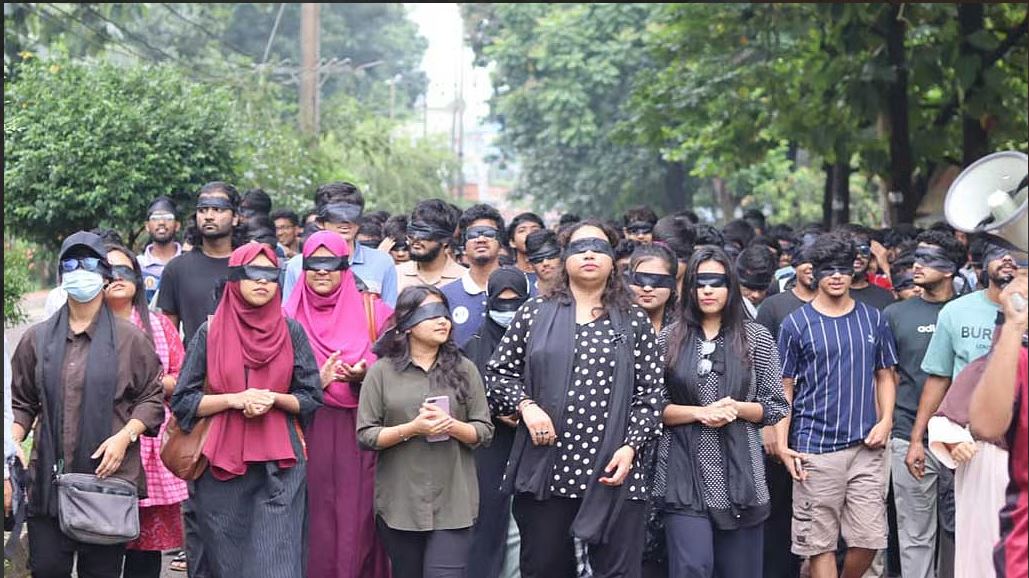
On the 15th day of the movement, CUET students held a human chain in front of Chattogram Press Club at around 4pm on Tuesday.
They demanded the reinstatement of Professor Abu Sadat Muhammad Sayem and called for the prime minister’s intervention to resolve the deadlock.
Students carried various placards at the human chain, including messages such as “Professor Sayem must be reinstated,” “We want a solution to the CUET deadlock,” “When will you wake up?” and “We want the prime minister’s intervention.”
A section of teachers, however, has not joined the ongoing movement or the programmes organised by the teachers’ association.
Professor Arafat Rana of the Mechanical Engineering Department is among them.
“I am in favour of whoever the government appoints as vice-chancellor. I do not support any movement against the government’s decision. If the teachers’ association’s decision goes against the government’s decision, I do not agree with it either,” he said.
Another teacher, speaking on condition of anonymity, accused some of those demanding Sayem’s reinstatement of seeking VC appointments for themselves.
“Those who have been protesting all this time only demanding ‘Sayem Sir’ be reinstated as VC are now going to the higher authorities and arranging to become vice-chancellor themselves. What great hypocrisy! If they had said on the first day that instead of a VC from KUET, someone from CUET should be made VC, then a decision could have been changed and an arrangement made within one or two days,” the teacher said.
September salaries and festival allowances held up
CUET currently has 367 teachers, 208 officers and 512 employees.
A section of the teachers, officers and employees has been observing a work abstention in solidarity with the ongoing movement demanding the reinstatement of former VC Professor Dr Abu Sadat Muhammad Sayem.
Amid the deadlock, the September salaries and festival allowances of 1,087 teachers, officers and employees have been held up.
According to CUET’s usual practice, the VC’s signature is not required to release salaries and bonuses. Salaries and bonuses are released from the bank with the signatures of the comptroller and deputy comptroller.
The September salary and allowance sheets were also signed by them and submitted to the bank. However, the salaries and allowances were subsequently held up following a letter from the new VC, according to allegations.
In an email sent to the bank, Professor Sheikh Shariful Alam referred to Section 13(7) of the CUET Act, 2003, and said any financial transaction without the VC’s explicit approval was legally invalid.
He said that if any financial irregularity, unwanted situation or legal complication arose from an unauthorised transaction, neither the VC nor the university authorities would bear any legal, administrative or financial liability.
He also said the concerned two officials would bear sole and complete responsibility for any violation caused by preparing and sending documents without authorisation. The Sonali Bank authorities would also be held responsible, according to the email.
Professor Sheikh Shariful Alam told The Daily Campus that arranging salaries was his first priority after reaching the campus.
“My first responsibility after setting foot on the campus is to arrange the salaries of teachers, officers and employees. On September 28, I called 12 officials, including the comptroller, to a meeting. I called the concerned people for the meeting. But none of them came. Later, I emailed the bank manager,” he said.
He said the bank held the salaries after seeing his email.
“The email stated that if any financial irregularity, unwanted situation or legal complication arose from the transaction, neither the vice-chancellor nor the university authorities would bear any legal, administrative or financial liability. The bank authorities kept the salaries suspended after seeing this email. They did not respond to my call. They did not reply to the email,” he said.
The new VC also referred to Article 11 of the university Act, which states that the vice-chancellor is the university’s full-time chief academic and administrative executive officer.
“According to Article 11 of the university Act, the vice-chancellor shall be the full-time chief academic and administrative executive officer of the university. So if everyone is paid without showing me the salary sheet, and if any officer, employee or teacher receives a salary while remaining absent, or if there is any problem, I would have to answer for all of this,” he said.
“That is why I wanted to call the officers and employees to a meeting and arrange the salaries. But they did not come. This is very unfortunate.”
Officials say salaries were stopped by new VC’s letter
The comptroller of the university did not answer calls seeking comment. However, Deputy Comptroller Mohammad Wahidul Islam spoke to The Daily Campus.
“There is a problem going on at our campus. That is why we are not talking to anyone over the phone. Our salaries were not stopped, they were stopped. The new VC wrote to the bank and had our salaries stopped,” he said.
Asked about the new VC’s email calling officials to a meeting over salary payments, he said they had received the email but did not respond.
“Yes, he emailed us calling a meeting to pay our salaries. It is true that we did not reply to the email. But how could we respond to the email? When someone is appointed, they have to come here and join. There has to be a handover and takeover. Aren’t these things necessary? None of these happened. Where did he join? In the sky?” he said.
He said teachers had not gone to meet the new VC because they were participating in the movement.
“We were in the movement. Why would we go there? And how would we go there? If he sends an email, can we simply go? There has to be an arrangement for us to go, right?” he said.
On the students’ demands, he said the teachers and employees agreed with them.
“We agree with the students’ demands. The students will remain. There are students in an educational institution, so it has to be student-oriented. Since the students have not agreed, we cannot go outside the students,” he said.
New VC says students are CUET’s driving force
Speaking about the overall situation, Professor Sheikh Shariful Alam said CUET should be viewed as one family, with its students at the centre.
“We are one CUET family, and the heartbeat of that family is our ordinary students. My main goal is to take CUET forward, and in this journey I want to give the highest priority to creating a student-friendly environment for my beloved students,” he said.
“I do not want to keep them at any distance. Rather, I want to work by keeping the students beside me at all times and understanding their feelings and aspirations. The students are the main driving force of an educational institution. Ensuring a safe and intellectually conducive environment for them is my first priority.”
He also stressed the role of teachers in running the university.
“At the same time, the biggest driving force in running a university is our teaching community. I deeply respect the intelligence, experience and dedication of CUET’s respected teachers,” he said.
“If we want to raise CUET to international standards, we all have to work together. Therefore, very soon I will sit separately with all the senior and young teachers of CUET and listen to their thoughtful opinions.”
CUET’s academic history
CUET began its journey as an engineering college in 1968. The institution was later transformed into Bangladesh Institute of Technology, or BIT.
It began operating as a full-fledged university on September 1, 2003.
The university currently has 18 departments and more than 6,000 students. University sources, however, said more than 5,000 students from 12 departments are directly affected by the ongoing movement.
The dispute over the appointment and removal of the vice-chancellor has now begun to affect their class and examination schedules, with the possibility of further session delays if the deadlock continues.
 Follow The Daily Campus on Google News