Errors Across English-Version Questions Spark Outcry from HSC Candidates
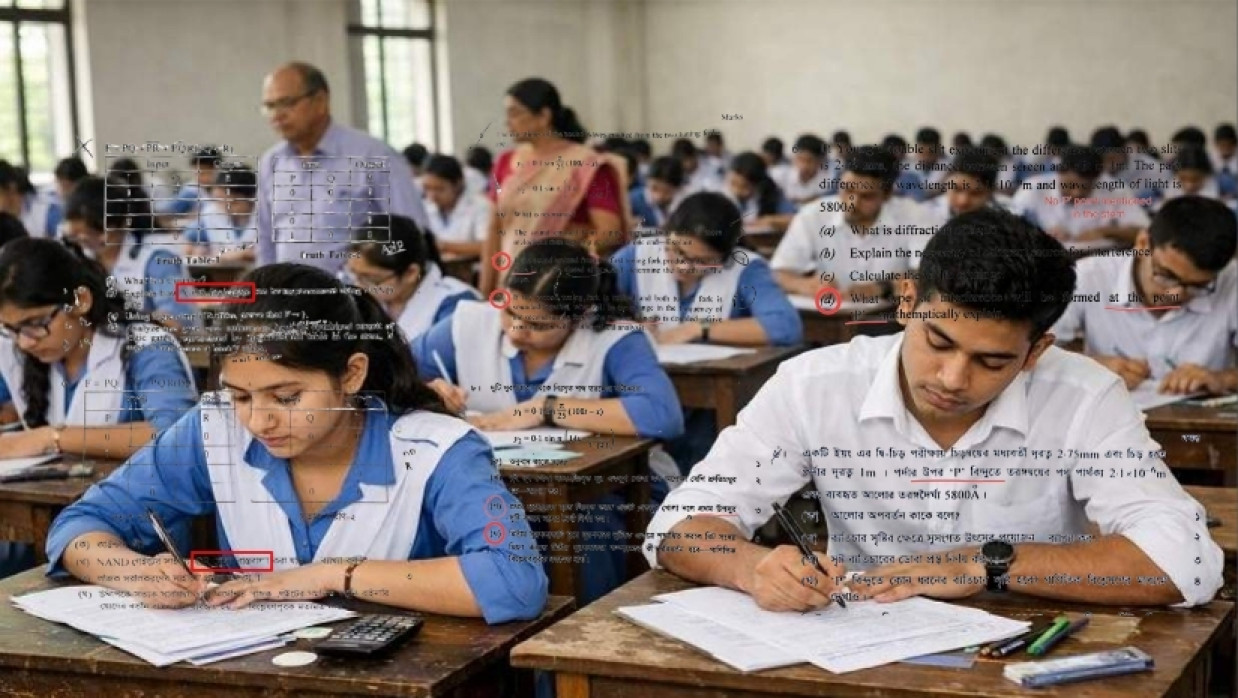
Candidates sitting for the ongoing Higher Secondary Certificate (HSC) public examinations from the English Version background have raised severe allegations against education boards, citing persistent translation blunders, omitted mathematical data, and altered scientific terminology in question papers.
Under the National Curriculum and Textbook Board (NCTB), Bangladesh officially maintains two Mediums of Instruction: Bangla Medium and English Version. However, examinees and educators allege that education board moderation committees routinely treat the English Version as an afterthought. Question papers are primarily drafted in Bangla and subsequently handed over to general translators, without mandatory moderation by subject-matter academic experts. This lack of specialized oversight has resulted in direct literal translations that distort core scientific principles and change mathematical parameters.
Examinees noted that while the initial four language papers required no translation, every subsequent science and technology examination—including Physics 1st Paper, Physics 2nd Paper, and Information and Communication Technology (ICT)—contained severe translation defects that fundamentally altered the required answers, putting English Version students at a distinct disadvantage compared to their Bangla Medium peers.
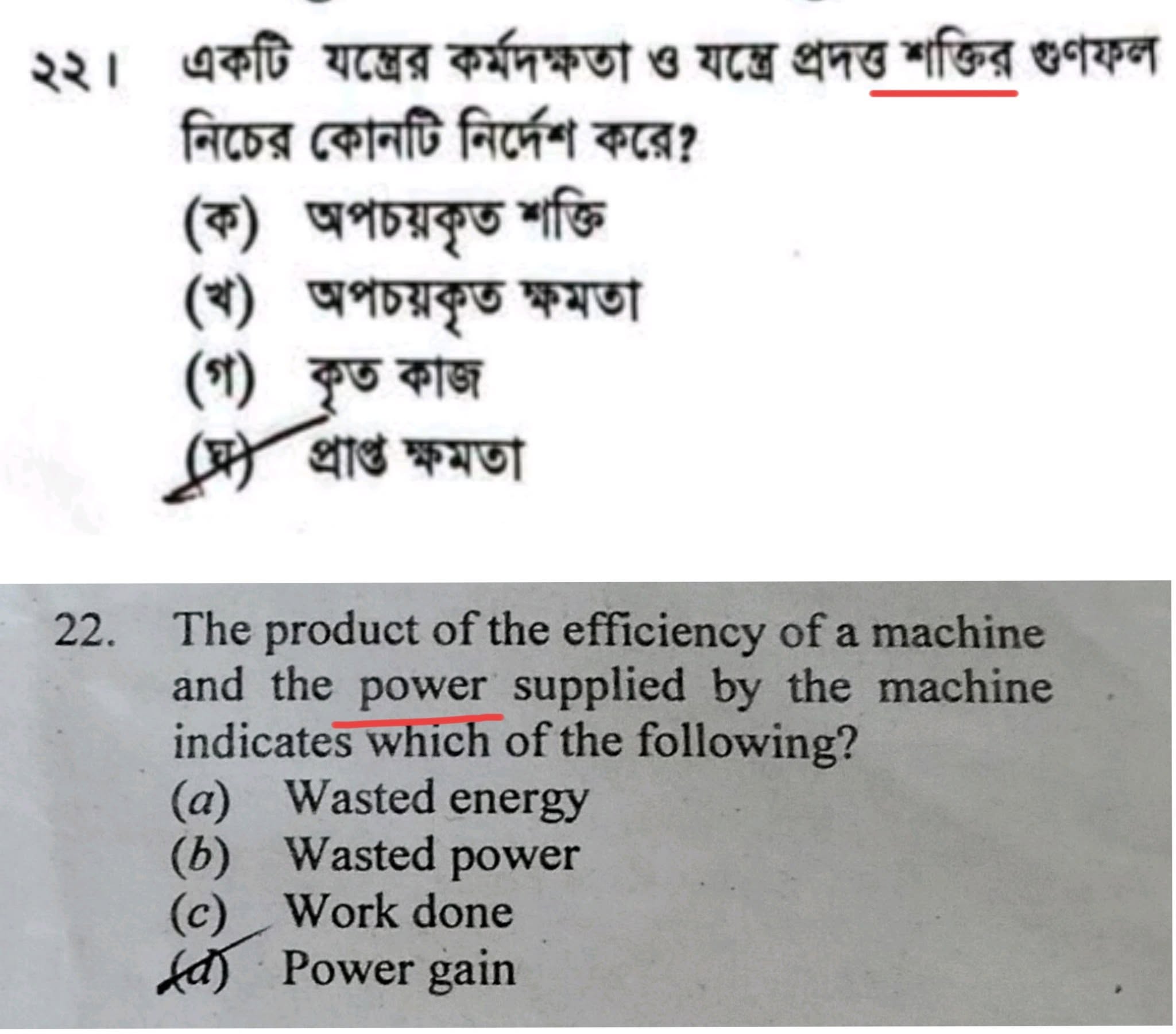
In the Physics 1st Paper examination, both multiple-choice questions and creative prompts contained terminology that differed between the Bangla and English versions. In one multiple-choice question requiring the product of efficiency and supplied energy, the English Version translated the term "energy" as "power." Consequently, candidates using the Bangla Version would derive "Work Done," whereas the English Version indicated "Power Obtained." Both options were included among the available answers.
In creative question eight, two completely different acoustic terms—'Overtone' in part C and 'Beat' in part D—were both mistranslated as 'Note', invalidating the underlying wave calculations. Furthermore, creative question six mistranslated "reduced by one-third" as "reduced to one-third," creating a complete mathematical mismatch in values between the two mediums, while creative question seven printed a vector parameter as "-120ĵ" in English compared to "+120ĵ" in Bangla.

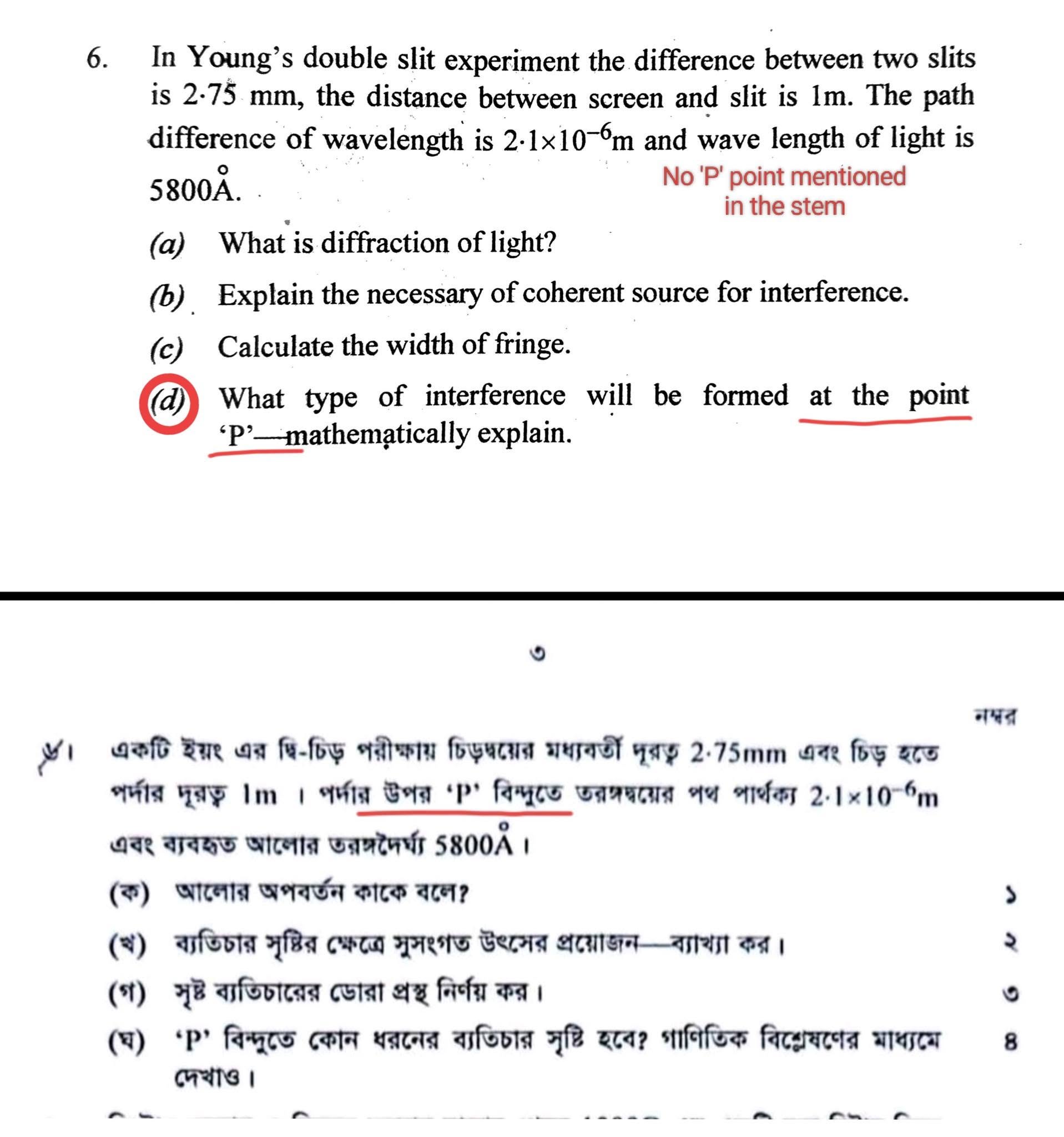
Similar discrepancies were observed in the Physics 2nd Paper and ICT examinations. In the Physics 2nd Paper, the English Version of Creative Question 4 omitted the condition of "equilibrium" that appeared in the Bangla Version, resulting in a difference in the information provided to candidates. In Creative Question 6, the English Version also omitted a reference to point "P" that was included in the Bangla paper.
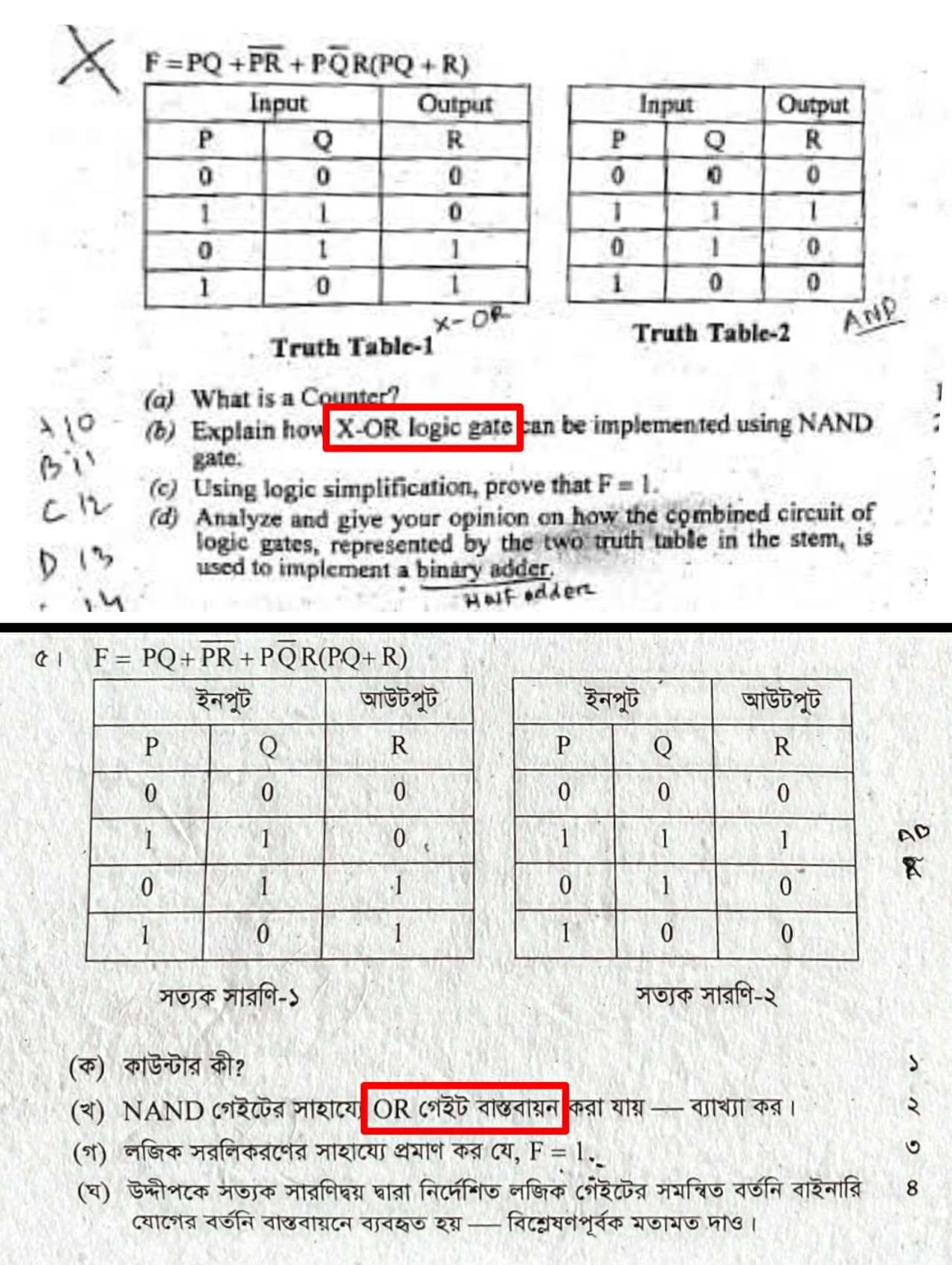
In the ICT examination, discrepancies were also identified between the Bangla and English versions of several questions. In one multiple-choice question, the English Version omitted the word "Physiological" from the term "Physiological Biometrics," resulting in a difference in the answer options. In Creative Question 5, the English Version instructed candidates to implement an X-OR gate using NAND gates, whereas the Bangla Version required the implementation of an OR gate, resulting in different logic circuits being assessed.
Education board authorities acknowledged that allegations of linguistic and translation errors in English Version question papers surface nearly every year. Taking note of this year's recurring discrepancies, the Inter-Education Board Coordination Committee has already submitted a formal report on the matter to the examination control division for appropriate administrative action.
Addressing the underlying causes of these errors, Professor Syed Akhtaruzzaman, President of the Inter-Education Board Coordination Committee and Chairman of the Dhaka Education Board, told The Daily Campus that English Version question papers are typically not drafted by teachers with specialized English-medium backgrounds. Instead, standard Bangla-medium question papers are translated into English, which frequently leads to linguistic and terminological discrepancies.
Professor Akhtaruzzaman added that the board has taken a firm decision to engage qualified, subject-matter experts to prepare and review English Version question papers in the future, expressing confidence that this measure will significantly minimize question errors in upcoming public examinations.
Answer scripts should be evaluated strictly according to the questions printed in the English Version examination paper, without cross-checking them against the Bangla Version originals. Students who sat for the English Version examination deserve the immediate publication of a dedicated Answer Scheme tailored to their question paper, ensuring that no candidate is unfairly penalised due to administrative errors in translation.
— Vincent Titas Rozario, Assistant Professor of Physics, Notre Dame College, Dhaka
Assistant Professor Rozario emphasized that education boards must move away from relying solely on general translators for public examination question papers. He called for establishing joint moderation panels where linguistic translators and subject-matter academic experts review every word, sentence, and scientific parameter together. Highlighting that scientific terms and mathematical context must never be compromised, he urged board authorities to meticulously cross-check all translated drafts against NCTB textbooks and original question papers prior to final publication.
 Follow The Daily Campus on Google News