Errors Found in 4 of 8 Creative Questions in HSC Chemistry Exam
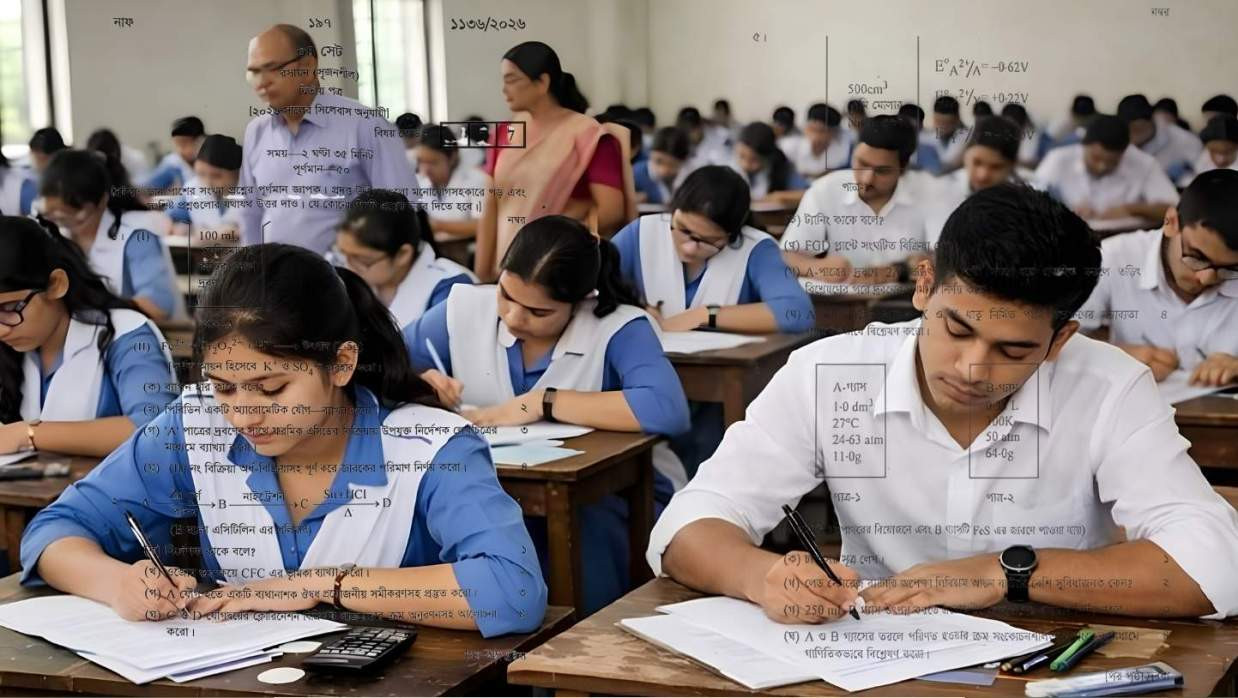
Candidates appearing for the HSC Chemistry 2nd Paper examination on Wednesday (July 22) were met with severe confusion and mental distress after encountering major factual and mathematical errors in four out of the eight creative questions (CQ) on the paper, as well as faulty multiple-choice questions (MCQ).
The development comes shortly after similar errors in the Physics 1st Paper forced education authorities to award full bonus marks for glitched items. Academic experts have warned that such persistent errors in public examinations uniquely disadvantage high-achieving students who lose critical exam time trying to reconcile flawed prompts.
Technical and Conceptual Errors Across CQs and MCQs
An analysis of the question paper alongside assessments from senior chemistry educators revealed multiple significant flaws:
In Question 1 (CQ), stimulus part (II) shows four distinct products formed from the reactants, but the prompt fails to specify which product weighs 2.5 grams. Without identifying the specific product, calculating the mass of the oxidizing agent becomes mathematically impossible.
In Question 5 (CQ), the stimulus provides data for "Beaker-1," yet sub-questions (c) and (d) abruptly ask candidates to perform calculations for "Beaker-A."
In Question 6 (CQ), sub-question (c) asks candidates to determine the amount of parent compound required to produce 250 mL of gas, but completely omits both the temperature and pressure parameters. Furthermore, data in sub-question (d) yields a compressibility factor of Z = 4.0 for CO2 gas—a value that directly contradicts real gas behavior (Z < 1) and gas liquefaction theory.
In Question 8 (CQ), sub-question (d) incorrectly describes the van der Waals equation as a modified form of the "ideal gas combination equation." According to the HSC-standard textbooks prescribed for students, this is definitionally incorrect, as the van der Waals equation is a modified form of the ideal gas law, incorporating corrections for intermolecular forces and the finite volume of gas molecules based on the equation (PV = nRT).
Additionally, in the Multiple-Choice section, Question 10 of the Yamuna (Set-D) question paper contained no correct answer among the options provided.
Candidates expressed frustration over time wasted during the examination. Imtiaz Noman, an HSC candidate, shared that he spent valuable minutes overthinking the flawed prompts believing a board question could not contain mistakes, before eventually resorting to guesswork.
Arif Hoque, President of the Bangladesh Science Council and a prominent chemistry instructor, noted that these errors create unnecessary psychological pressure.
"When error-ridden questions appear, students waste critical time second-guessing themselves during the exam. These mistakes reflect systemic flaws not just among question setters, but across curricula and textbook authors. Ultimately, it is the bright, conscientious students who suffer the most because they spend time trying to logically resolve an impossible prompt."
— Arif Hoque, President of Bangladesh Biggan Porishod
Attempts to reach Dhaka Education Board Controller of Examinations Professor Jasmin Taslima Banu and Inter-Education Board Coordination Committee President Professor Syed Akteruzzaman for official comments were unsuccessful, as both officials had their mobile phones switched off.
 Follow The Daily Campus on Google News