
Dhaka University moves to give English-medium students separate admission test questions
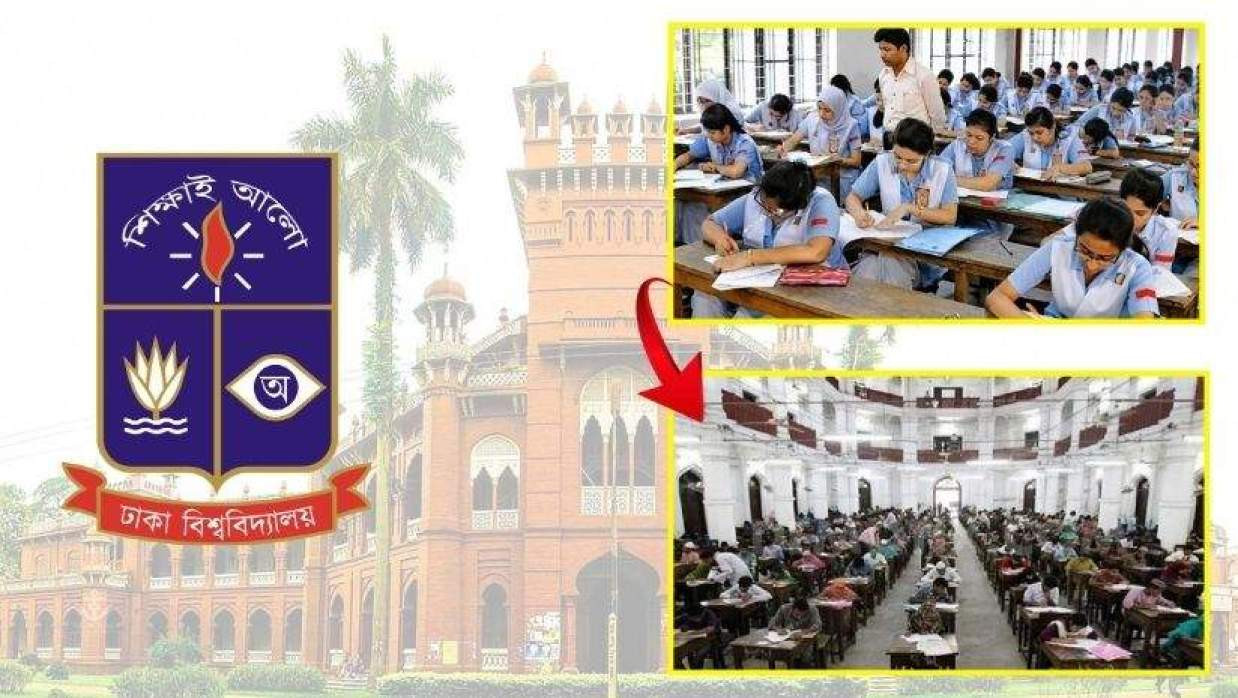
The University of Dhaka is set to finalise a proposal to prepare a separate question paper for English-medium students in the Science Unit admission test. The administration says the move is aimed at attracting more English-medium students to higher education in Bangladesh, while teachers and students warn it could create further inequality in the admission process.
The University of Dhaka (DU) may finalise the proposal at a Syndicate meeting today, Monday (August 31), to introduce a separate question paper for English-medium students in the Science Unit of the 2026-27 undergraduate admission test.
The decision was initially taken at a general admission committee meeting held on August 2 at the Nawab Nawab Ali Chowdhury Senate Bhaban auditorium. A subsequent notice from the university's Public Relations Office said a separate question paper would be prepared for English-medium students in the Science Unit based on their curriculum.
The issue was discussed in detail at a meeting of the university's Academic Council on August 23. The administration has cited two main arguments in favour of the proposal. One is that many English-medium students leave Bangladesh for higher education, contributing to what the administration describes as a "brain drain." Providing them with greater opportunities to study at institutions such as DU, officials argue, could encourage them to pursue higher education in the country.
Another argument is that a separate question paper has long been used for English-medium students in the Business Studies Unit. The administration is now considering extending a similar arrangement to the Science Unit. However, several Academic Council members reportedly opposed the proposal and questioned its rationale.
Teachers, students warn of inequality
A section of teachers and students argue that a separate test for English-medium students would effectively amount to a form of "quota" and could create an unequal competition with students from Bangla-medium, madrasa and technical education backgrounds.
They also question whether separate admission tests would then have to be introduced for students from other education streams. According to them, the admission test should use a common question paper to ensure equal opportunities for all candidates.
Professor Mojibur Rahman, chairman of DU's Institute of Education and Research (IER), said the purpose of an admission test should be to assess students' competencies rather than tailor questions to a particular curriculum.
"English-medium students may have a different curriculum, but do they study different mathematics, science or general knowledge?" he asked, arguing that concerns over brain drain or whether students remain in Bangladesh should not be used as justification for a separate test.
Professor Mojibur Rahman said, "We also need to change our question pattern. The questions should be designed in a way that gives everyone an equal opportunity. We want students from the Technical Education Board, madrasa education and all government-approved streams to have equal opportunities. There should be no discrimination. Separate questions will not achieve that; rather, discrimination will increase. And introducing separate questions carries the risk of creating a kind of instability."
He also questioned the rationale for relying heavily on curriculum differences in university admission tests, saying the assessment should focus on what students were expected to learn by the end of higher secondary education and how well they acquired those competencies.
He warned that separate question papers could also lead to disputes over whether one group received an easier test than another. If English-medium students perform poorly, there could be allegations that their separate paper was difficult; if they secure more seats, others could claim their paper was easier, he said.
Separate system already exists in Business Studies Unit
DU already has different question structures for students from different educational backgrounds in its Business Studies Unit.
For students from the business studies stream, the MCQ section includes Bangla, English, Accounting, Business Organisation and Management, and either Production Management and Marketing or Finance, Banking and Insurance, for a total of 60 marks. The written section carries another 40 marks, including translation, error correction and business-related subjects.
For science and humanities students in the same unit, the MCQ section covers Bangla, English, ICT and any one of Mathematics, Statistics or Economics for 60 marks. The written section carries the remaining 40 marks.
For A-Level and equivalent students, the MCQ section consists of English, Advanced English and two business subjects for 60 marks, while the written section includes essay writing, error correction and business subjects for 40 marks.
Several Academic Council members reportedly believe the existing arrangement in the Business Studies Unit already creates discrimination against students from Bangla-medium, madrasa and technical education backgrounds. Extending the same system to the Science Unit, they argue, could widen that disparity.
A former DU student, speaking on condition of anonymity, said, "The initiative to set separate questions is not logical; it is a form of 'quota'. The current admission-test question pattern is also not timely. It remains questionable whether it properly assesses students. The focus should be on ensuring that the question paper follows the same pattern and creates equal opportunities for everyone."
‘Seven or eight meetings held’
The university administration says the proposal was not made unilaterally and that the issue was discussed in several meetings with relevant stakeholders.
Professor Dr Abdus Salam, DU Pro-Vice-Chancellor (Education) and a member of the Academic Council, told The Daily Campus, "At least seven or eight meetings have been held on the issue. Many relevant people were present. The decision was taken based on their opinions. More details can be provided after today's Syndicate meeting."
He also said access to higher education and access to jobs are two significant issues for the current generation. According to him, however, it is not the university's responsibility to determine who stays in Bangladesh and who leaves the country.
Professor Mojibur Rahman, meanwhile, argued that the admission test should be redesigned so that students from different educational streams can demonstrate their abilities on an equal footing.
The Syndicate's decision today will determine whether English-medium students will receive a separate question paper in the Science Unit. If approved, the move is likely to intensify the debate over whether Bangladesh's largest public university is ensuring equal competition among students from different education systems.
 Follow The Daily Campus on Google News