Centuries-old Shyamsundar Temple in Satkhira set for restoration
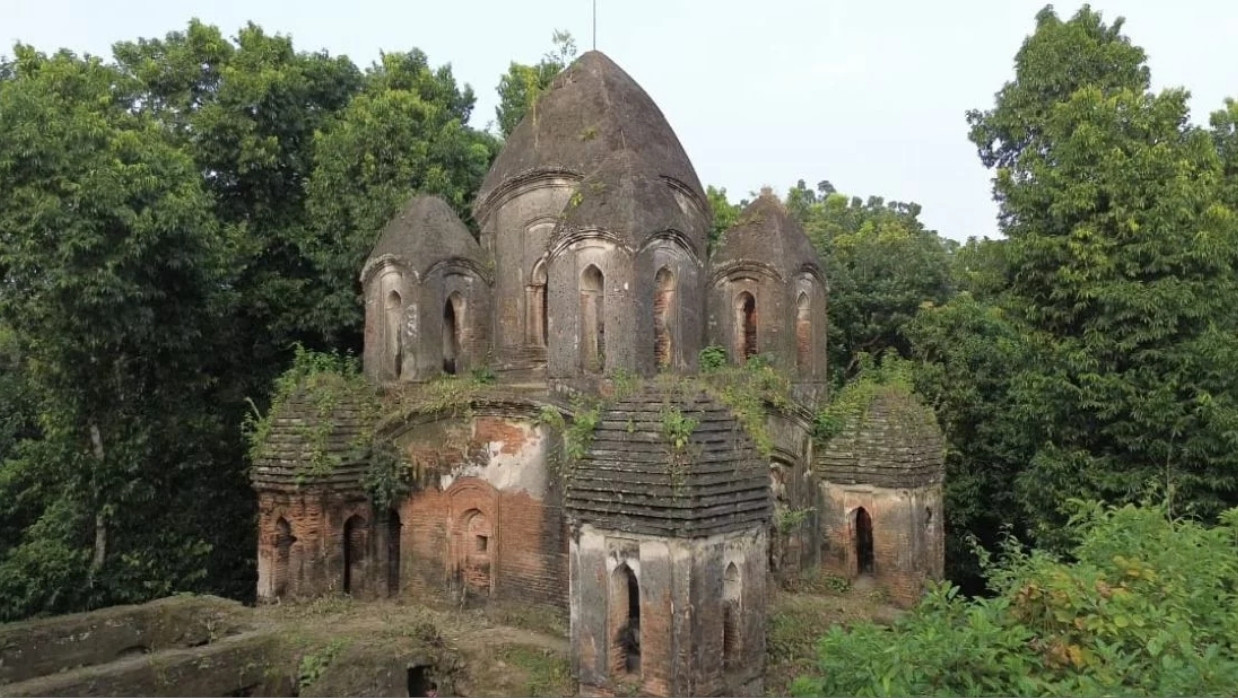
The historic Shyamsundar Temple in Sonabaria village of Kalaroa upazila, Satkhira, is set to undergo long-awaited conservation, with the Department of Archaeology preparing scientific documentation ahead of full-scale restoration.
The development comes after a series of media reports drew attention to the temple’s deteriorating condition and called for urgent measures to preserve the heritage site. A team from the department’s Khulna regional office inspected the temple on Wednesday as part of preparations for the conservation work.
During the inspection, officials and experts assessed the condition of the temple’s structure, walls, cornices, terracotta decorations and other deteriorated sections. They also discussed the technical and scientific measures required before restoration begins.
Mahidul Islam, regional director of the Department of Archaeology, said the Shyamsundar Temple is an important antiquity listed in the government gazette. “Initial cleaning has already been completed. Pre-documentation is essential before starting the main restoration work to ensure that no part of the structure’s original form or heritage value is damaged,” he said.
He said a team of experts would conduct detailed scientific documentation, including architectural drawings, measurements and other necessary data collection. Full-scale restoration will begin after the documentation is completed.
The department will seek the necessary allocation in the next fiscal year for permanent restoration and conservation of the temple, Mahidul said. He added that old trees and parasitic plants growing on the structure would be removed carefully and gradually to prevent damage to the historic fabric of the building.
Shapla Singha, an assistant professor at Khulna University, said preservation efforts should go beyond restoring the temple’s physical structure. The history and cultural practices associated with the site should also be documented and preserved, she said.
She suggested using dioramas or photographic displays to recreate the atmosphere of the site during the pre-electricity era, particularly the appearance of the temple and its surroundings at night. Such an initiative, she said, could serve as a model for preserving other historic temples and mosques in Bangladesh.
Temple president Debapriya Chowdhury and priest Subroprosad Chowdhury welcomed the initiative, saying the historic site had long suffered from neglect and disturbances caused by drug users. They urged the authorities to construct a boundary wall as soon as possible to protect the temple and preserve its sanctity.
According to historian Satish Chandra Mitra and Professor Md Abu Nasr, the nearly 60-foot-high, three-storey Shyamsundar Temple was built in 1767 by Hariram Das, although some accounts identify Durgapriya Das as its builder.
The temple complex also includes shrines dedicated to Durga and Shiva, as well as a historic pond known as “Jamir Biswaser Pukur.”
With the Department of Archaeology moving ahead with scientific pre-documentation and planning to seek restoration funding in the next fiscal year, hopes are growing that the centuries-old temple will finally be preserved as an important heritage site in southwestern Bangladesh.
 Follow The Daily Campus on Google News