Five European Countries Plan African Return Hubs for Rejected Bangladeshi Asylum Seekers
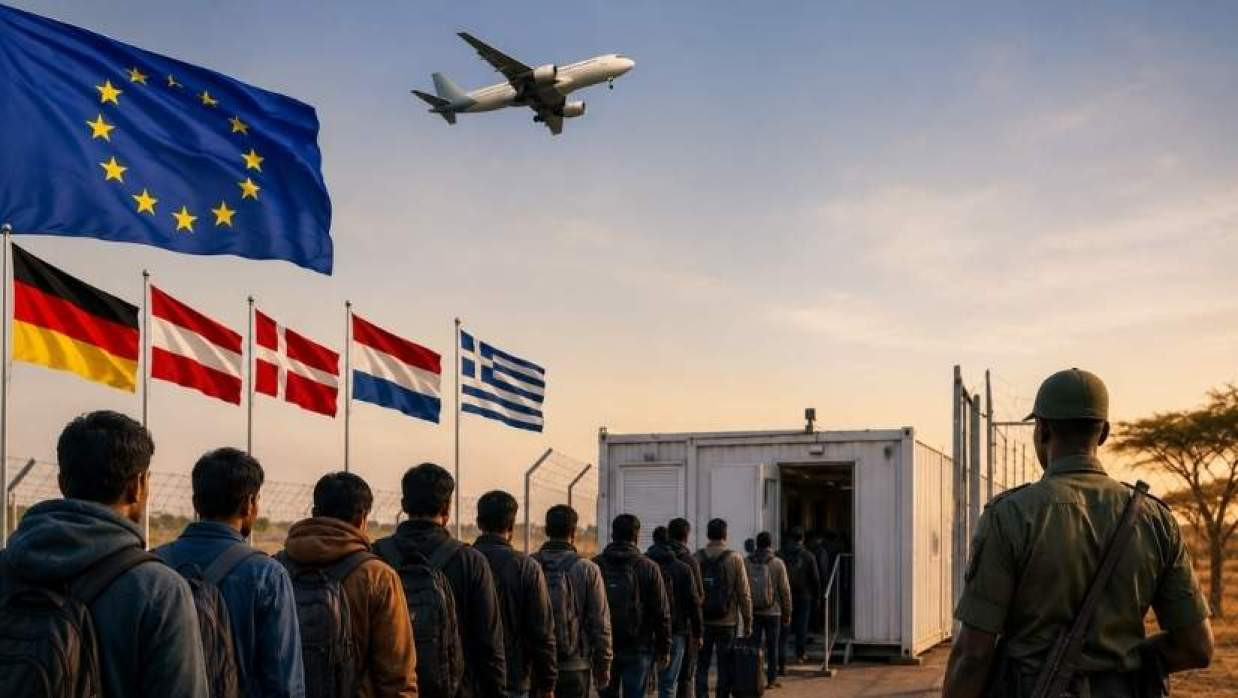
Five European Union (EU) member states—Germany, Austria, Denmark, the Netherlands, and Greece—are jointly pursuing a proposal to establish "Return Hubs" in third countries, predominantly in Africa, to temporarily house asylum seekers whose applications have been rejected before deporting them to their home countries, including Bangladesh.
The initiative leverages the European Commission’s proposed New Return Regulation framework, which permits member states to set up offshore return infrastructure under specific statutory conditions. Preliminary discussions are underway with potential host nations—including Kenya, Uganda, Ghana, Rwanda, Benin, Mauritania, and Uzbekistan—though no formal treaties have been finalized.
Greece is leading the diplomatic drive, with its Migration Ministry indicating that agreements with host nations could be concluded within 2026, potentially bringing the hubs into operation by next year. Under the proposed mechanism, individuals whose asylum claims receive final rejections and who cannot be immediately repatriated to their countries of origin will be held at these hubs until departure protocols are completed.
Government and Official Responses
Officials from Bangladesh's Ministry of Foreign Affairs stated that the government has not yet received formal diplomatic communication regarding the five-nation proposal, noting that the measure remains under debate within the European Parliament.
Senior diplomatic sources emphasized that the foreign policy tool targets all nationalities with rejected claims to accelerate deportation efficiency. European authorities note that less than one-third of individuals subject to deportation orders are currently repatriated, creating administrative backlogs across European asylum infrastructure.
A senior foreign ministry official, speaking on condition of anonymity, highlighted that European recognition rates for Bangladeshi asylum applications remain exceptionally low, averaging just 3 to 4 percent at the first-instance stage. Under the proposed framework, accelerated review cycles aim to process applications within 12 weeks, leading to immediate repatriation procedures for denied applicants.
Meanwhile, State Minister for Expatriates' Welfare and Overseas Employment Md. Nurul Huq clarified that the government has received no official notification regarding the hub system.
"There is currently no situation in Bangladesh that justifies seeking political asylum abroad. Following the election of a democratic government, the constitutional rights and dignity of citizens are fully protected. Seeking political asylum overseas lacks logical grounds. The government consistently discourages irregular migration and emphasizes lawful, formal channels."
— Md. Nurul Huq, State Minister for Expatriates' Welfare and Overseas Employment
EU Asylum Data & Recognition Metrics
According to the Latest Asylum Trends 2025 report by the European Union Agency for Asylum (EUAA), Bangladesh ranked as the fourth-largest country of origin for asylum applicants in the EU in 2025:
| Metric / Indicator | Volume / Rate |
| Total Asylum Applications (2025) | 36,901 |
| First-Time Applicants | 35,245 |
| First-Instance Decisions Rendered | 43,523 |
| Pending Claims at Year-End | 41,692 |
| First-Instance Recognition Rate | ~3% |
| Withdrawn Applications | 1,170 |
Data from European Border and Coast Guard Agency (Frontex) further indicates that Bangladeshi nationals continue to represent a notable demographic among irregular arrivals navigating the Central Mediterranean route.
Human Rights Concerns & Legal Critiques
The proposed offshore transfer mechanism has drawn criticism from human rights agencies and international law experts. The Council of Europe Commissioner for Human Rights urged the participating governments to strictly adhere to international refugee law, the European Convention on Human Rights (ECHR), and the fundamental principle of non-refoulement.
Professor Dr. Tasneem Siddiqui, Founder Chair of the Refugee and Migratory Movements Research Unit (RMMRU), warned that offshoring migration management risks violating human rights standards.
"Attempting to streamline returns by transferring asylum seekers to third countries creates serious risks of conflicting with international human rights principles. Lessons from Australia's offshore processing model demonstrate that such policies subject asylum seekers to prolonged legal uncertainty, often depriving them of effective legal counsel, mental health services, and judicial recourse."
— Prof. Dr. Tasneem Siddiqui, Founder Chair, RMMRU
 Follow The Daily Campus on Google News