August 2, 2024
Nationwide Protests and All-Out Non-Cooperation Movement Announced
August 2 marks a pivotal date in the history of the 2024 July Uprising in Bangladesh. On this day in 2024, coordinators of the Anti-Discrimination Student Movement announced nationwide protest rallies for August 3, to be followed by an indefinite "All-Out Non-Cooperation Movement" starting August 4, demanding justice for state violence, implementation of their nine-point demand, and the resignation of then-Prime Minister Sheikh Hasina.
Movement coordinator Asif Mahmud Sajib Bhuiyan announced the new action plan via social media on Friday night, calling on citizens across the country to organize locally in every neighborhood. Simultaneously, coordinator Abdul Hannan Masud urged the public to withhold taxes and utility bill payments, shut down government and private offices, and block access routes to Gono Bhaban and Bangabhaban to halt normal state operations.
The escalation followed the release of six central coordinators—including Nahid Islam, Sarjis Alam, Hasnat Abdullah, Asif Mahmud, Nusrat Tabassum, and Abu Bakar Majumdar—from Detective Branch (DB) custody on August 1. Following their release, the coordinators revealed they had been on a hunger strike since July 30 and clarified that earlier statements recorded in DB custody announcing the withdrawal of protests were made under coercion.
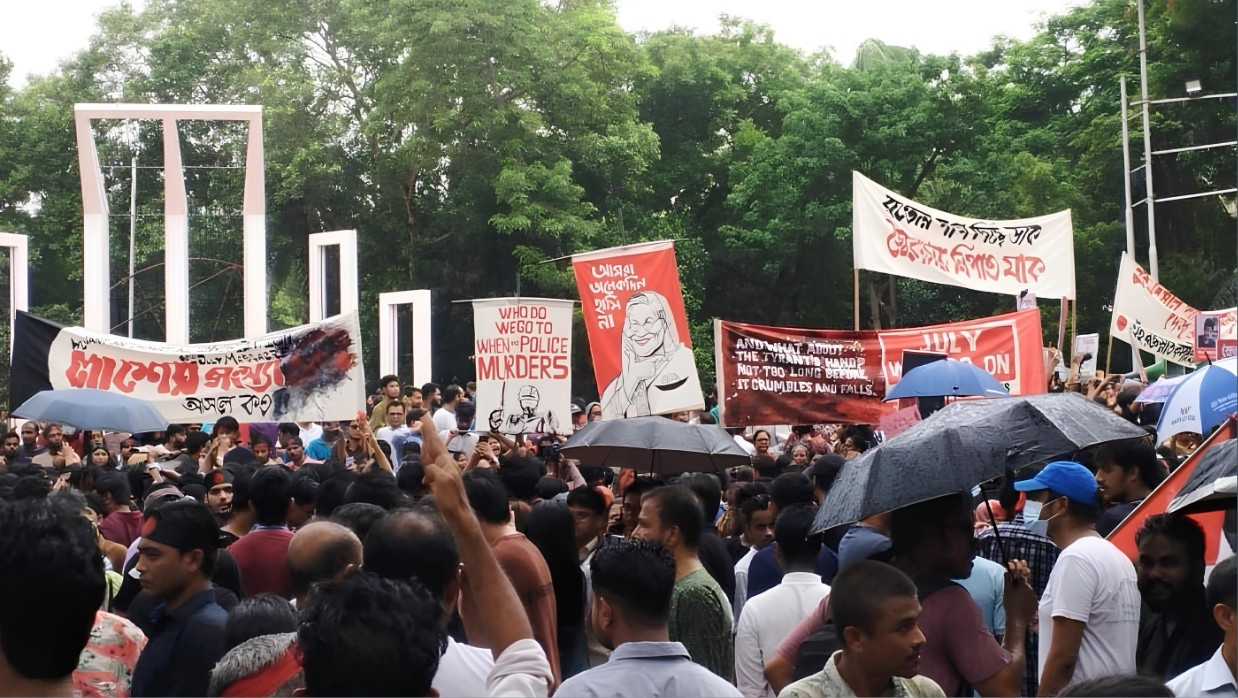
Despite heavy rainfall, thousands of citizens poured onto the streets across Dhaka and multiple districts on August 2. Major demonstrations unfolded at Science Lab, Baitul Mukarram, Shahbagh, and across several private university campuses. Additionally, teachers, writers, cultural activists, and civil society members led a mass rally titled "Droho Jatra" (Rebellion March) from the National Press Club to the Central Shaheed Minar, demanding an immediate end to mass arrests and full accountability for the July killings.
Violent clashes between security forces, ruling party activists, and protesters were reported in several districts, including Habiganj, Khulna, and Dhaka, leaving at least two people dead and over 150 injured on August 2 alone. On the same day, UNICEF Regional Director for South Asia Sanjay Wijesekera issued a statement confirming that at least 32 children were among the more than 200 people killed during the July protests, amidst a nationwide security crackdown that resulted in over 10,000 arrests.
 Follow The Daily Campus on Google News