Ventilator shortage limits benefits of new PICU at Shaheed Suhrawardy Medical College Hospital
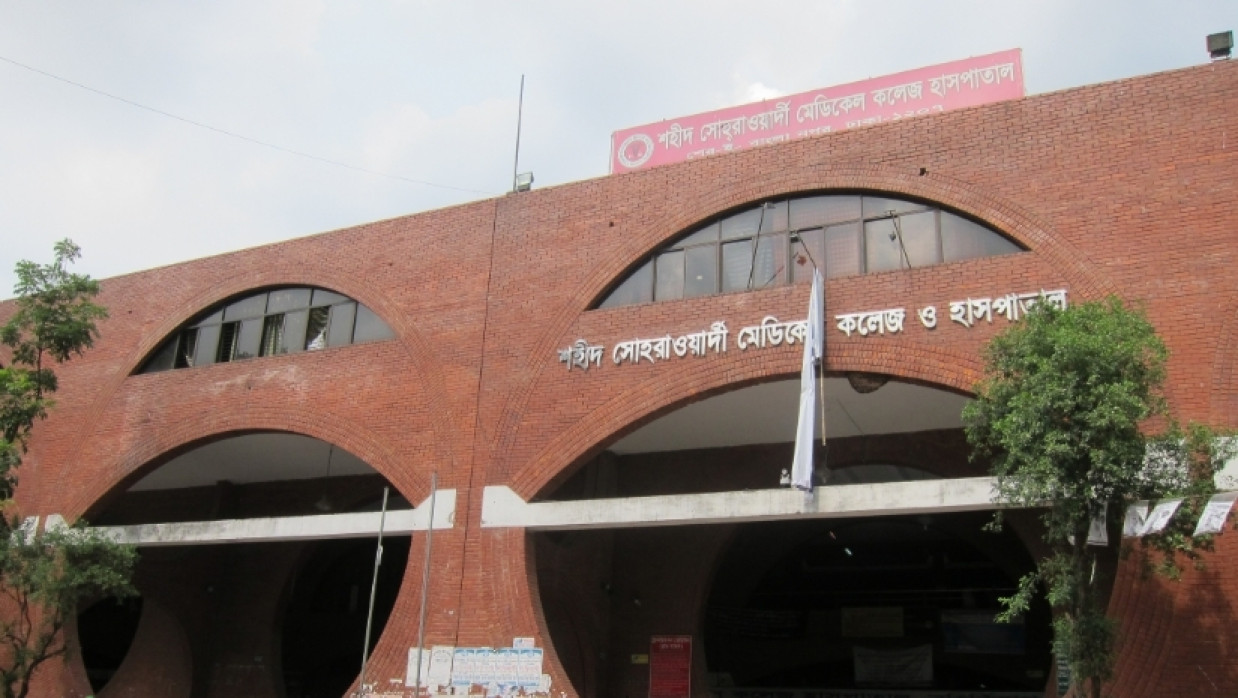
Critical care for children and newborns at Shaheed Suhrawardy Medical College Hospital in Agargaon is being provided amid severe capacity constraints, with patient numbers routinely exceeding the hospital’s available beds by two to three times.
Although a four-bed Paediatric Intensive Care Unit (PICU) has recently been launched at the hospital, only two beds are currently operational because of manpower shortages.
The situation is even more critical in neonatal care. The hospital’s neonatology department has 12 Neonatal Intensive Care Unit (NICU) beds, but only three currently have full ventilator support.
The hospital has 1,350 approved beds, yet around 2,000 patients are admitted on average each day, according to hospital officials. The paediatrics and gynaecology departments face some of the highest patient pressures.
Doctors say they are providing the best possible treatment with the resources available, noting that many patients depend on government hospitals because they offer treatment at nominal costs. A large section of the population cannot afford treatment at expensive private hospitals.
As a result, doctors and healthcare workers are attempting to manage the overwhelming patient load despite shortages of beds, equipment and manpower.
Limited NICU beds, severe ventilator shortage
The neonatology department provides treatment to newborns aged between one and 28 days. According to department sources, the unit has 36 beds in total, comprising 24 beds in the Special Care Newborn Unit (SCANU) and 12 NICU beds.
Of the 12 NICU beds, however, only three currently have ventilator support. Those three ventilators also have Continuous Positive Airway Pressure (CPAP) capability, allowing the department to provide CPAP support to a total of five beds.
Prof Dr Md Rakibul Haque Khan, head of the Department of Neonatology at Shaheed Suhrawardy Medical College Hospital, said the shortage creates serious problems when critically ill newborns require emergency respiratory support.
“There should be 12 ventilators ready for 12 patients. Any patient can develop an emergency at any moment. But because of the shortage, we sometimes have to refuse patients and refer them to other hospitals, such as Dhaka Shishu Hospital or Dhaka Medical College Hospital.”
A doctor from the department told The Daily Campus that the neonatology unit regularly operates beyond its capacity and faces severe shortages of ventilators and ICU facilities.
“On paper, there are more than 10 NICU beds, but there is no properly functioning NICU in the full sense of the term. The machines we have are mainly used for phototherapy for babies suffering from jaundice,” the doctor said.
According to the doctor, only two to three ventilators in the entire NICU are currently functional. Yet the department receives more than 50 babies on average each day who require artificial respiratory support.
“It is impossible to meet such a huge demand with only two or three ventilators. As a result, when a baby urgently requires ventilation, we have no option but to refer the patient to other facilities such as Dhaka Shishu Hospital or Dhaka Medical College Hospital,” the doctor said.
Prof Dr Md Rakibul Haque Khan also acknowledged the shortage.
“Our department officially has 36 beds. But in reality, an average of 52 to 60 patients remain admitted every day,” he told The Daily Campus.
With patient numbers consistently exceeding capacity, the department is sometimes forced to accommodate two newborns in a single bed. Regarding the shortage of ventilators and CPAP support, Prof Khan said the existing ventilators can also be used in CPAP mode.
“We can provide CPAP support to five patients and full ventilator support to three patients at the same time. Occasionally, there are mechanical problems with the machines and they need to be repaired,” he said.
“Overall, there is a crisis because ideally all 12 patients should have 12 ventilators ready. Any patient can develop an emergency at any moment. But because of the shortage, we have to refuse patients and refer them to a children’s hospital or Dhaka Medical College Hospital. If a patient needs a ventilator and one is not available, we have no choice but to send them elsewhere.”
Three children in one bed as PICU remains only partially operational
The pressure is similarly severe in the paediatrics department. According to department sources, the paediatrics department has 100 approved beds. However, between 250 and 300 children are admitted there on an average day.
To manage the pressure, younger children are sometimes placed two or three to a bed. Patients are also accommodated on floors and verandas when beds are unavailable.
A four-bed Paediatric Intensive Care Unit (PICU) was recently established in the department. However, only two of its four beds have been made operational because of a shortage of manpower.
Dr Nandadulal Saha, deputy director of Shaheed Suhrawardy Medical College Hospital, acknowledged the limitations.
“It is true that we have some limitations, particularly in terms of ventilation support and severe cases, where we have to refer patients to other hospitals. However, we are gradually trying to overcome these limitations.”
He said overcrowding has also made it necessary to place multiple children in individual beds.
“The number of patients is much higher than the number of beds, but our priority is to ensure that they receive proper treatment. If we strictly follow a one-patient-per-bed policy, it would become completely impossible to admit the large number of new patients who come to us,” he said.
A doctor, speaking on condition of anonymity, said the paediatrics department faces persistent pressure because of the large number of patients.
“There are around 150 beds across different wards, but the number of patients is so high that we often have to accommodate three children in one bed,” the doctor said.
“This is particularly common among children around one year old. Three small children may have to be placed side by side on the same bed.”
According to the doctor, older children can generally be accommodated one to a bed, but when the available beds are exhausted, patients have to be accommodated on the floor or in verandas.
The PICU is a very recent addition, the doctor said, having been inaugurated around two months ago.
Families face long waits for ICU care
The overcrowding is also creating additional difficulties for patients’ families. A relative of a child admitted to the paediatrics department said two or three children are often placed in a single bed.
“This creates difficulties for the children because they do not have enough space. It is also difficult for the mothers, because two or three mothers have to stay around a single bed,” the relative said.
Families of children requiring urgent ICU care face even greater difficulties, the relative added.
“They have to wait a long time for an ICU bed. Otherwise, they have to take the patient to another hospital.”
Prof Dr Ainul Islam, head of the Department of Paediatrics and principal of Shaheed Suhrawardy Medical College, said the hospital is struggling with an exceptionally high patient load.
“Our 1,350-bed hospital receives an average of 2,500 to 3,000 admitted patients every day. Providing space for so many patients is extremely difficult, which is why multiple patients sometimes have to receive treatment in a single bed,” he told The Daily Campus.
“The paediatrics department is also facing a much higher number of patients than its bed capacity. Against 100 beds, around 300 patients are admitted.”
He said the situation became particularly severe during a recent measles outbreak.
“When there was a measles outbreak some time ago, we had to arrange around 200 beds by combining wards from three different units. We had to take beds designated for other purposes to manage the patients, which subsequently created shortages for other types of treatment. We have now reduced that pressure,” he said.
PICU launched, but only two ventilators available
Prof Ainul Islam said the shortage of ICU and ventilation facilities in the paediatrics department is a genuine problem.
“The shortage you are referring to is absolutely true. In fact, this facility did not previously exist in our department. We launched it only last month,” he said.
“We have started at a very basic level. At present, we are somehow managing with only two ventilator machines. We have four beds prepared, but only two machines are available.”
He said the hospital has already applied for additional manpower and equipment.
“However, it is a matter of time,” he added.
According to Prof Ainul Islam, expanding the hospital’s total bed capacity is also necessary to address the problem. However, he said the existing building cannot simply be expanded further.
“We cannot suddenly increase the available space. The Public Works Department and experts have told us that the building cannot be expanded beyond six floors,” he said.
Building a new facility would also require a policy decision from the government and could take around five years, he added.
“A permanent solution could be to construct a new hospital in Gabtoli or another location, or establish an alternative facility as quickly as possible.”
Hospital seeks new complex
The hospital authorities say they have already taken steps to seek a longer-term solution.
Dr Nandadulal Saha, the hospital’s deputy director, said a proposal has been submitted to the relevant authorities for the construction of another complex or new building under the name “Shaheed Suhrawardy Hospital-2.”
“This is a long-term process. Besides, there is very limited space available for creating new facilities within our existing infrastructure,” he said.
He acknowledged that patients requiring ventilation or treatment for severe conditions sometimes have to be referred elsewhere.
“There are beds operating in the NICU. However, it is true that we have some limitations, particularly regarding ventilation support and severe cases, for which patients need to be referred to other hospitals. We are gradually trying to overcome these limitations.”
Dr Saha said the hospital continues to prioritise patient care despite the overcrowding.
“Multiple children have to be accommodated in a single bed. Although the number of patients is much higher than the number of beds, our priority is to ensure that they receive proper treatment,” he said.
“If we strictly followed the policy of one patient per bed, it would be completely impossible to admit the large number of new patients who come to the hospital.”
For now, however, the hospital continues to operate under severe pressure, with critically ill newborns competing for a limited number of ventilators and children being treated in overcrowded wards.
The newly introduced PICU and existing NICU have expanded access to critical care, but shortages of ventilators, manpower and physical space mean the facilities are yet to deliver their full potential.
 Follow The Daily Campus on Google News