Qawmi Madrasa Teachers Struggle on Tk 7,000-15,000 Salaries as Muhtamims Enjoy Comfortable Lives
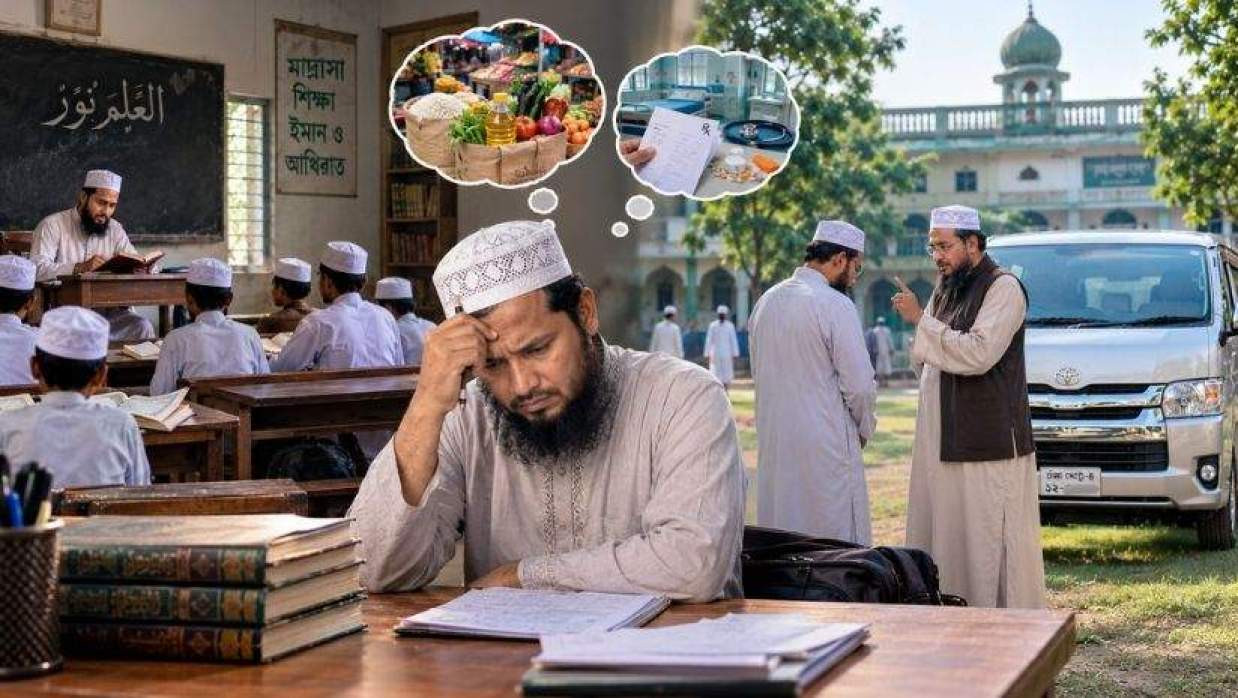
Despite more than 125 years of Qawmi madrasa education in Bangladesh, no formal salary policy has been established for teachers at these institutions. Many have spent years teaching at religious institutions but receive only nominal wages. While the salaries of muhtamims, or madrasa heads, are often kept out of public view, some reportedly lead comfortable lifestyles. Ordinary teachers, meanwhile, earn between Tk 7,000 and Tk 15,000 a month, depending on the institution. Senior teachers at a handful of well-known madrasas can earn up to Tk 35,000.
To make ends meet, some teachers take up additional small jobs alongside teaching. However, because of the limited opportunities available through this education system, such work is often restricted to serving as mosque imams or khatibs, tutoring students, or running small businesses. Even with these additional sources of income, many struggle to cover the expenses of their wives and children amid rising prices of essential goods. Despite dedicating years to religious service, ordinary Qawmi teachers often find themselves living in severe financial hardship.
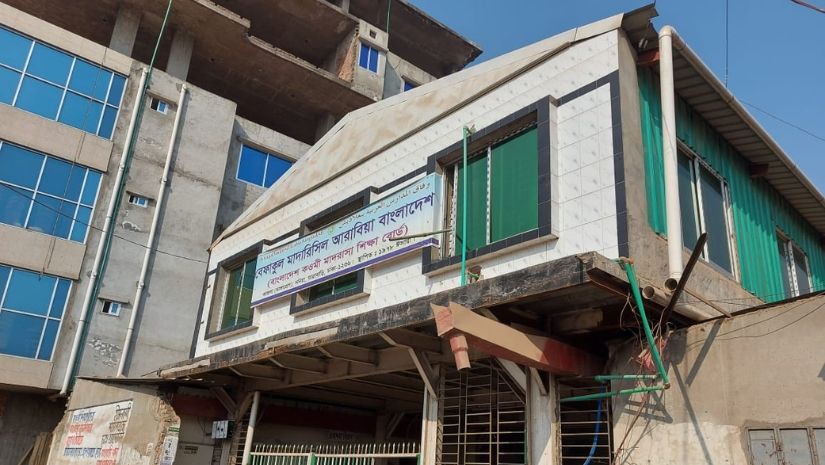
The interim government had taken several initiatives to bring these teachers under government support schemes. However, according to officials familiar with the matter, senior Qawmi scholars, known as akabir, have shown little interest in implementing the proposals. Most institutions are run on donations from the public, or qawm. Ministry officials believe concerns about financial audits have discouraged senior scholars from coming under government oversight. The Qawmi Madrasa Education Board, known as Befaqul Madarisil Arabia Bangladesh or Befaq, however, says the issue is not fear of financial audits. It argues that government involvement could undermine the Qawmi education system and erode its distinct identity.
My brother was not paid for seven months. The madrasa's muhtamim, Ozaer Amin, kept making him wait by talking only about 'lillahi' [service for the sake of Allah]. Eventually, he left the job out of frustration and distress. It is not just my brother. Teachers at most madrasas in the country, except for a handful of good ones, are not paid regularly - Abdul Karim (Alias), younger brother of Maulana Abdul Halim, a teacher at Jamia Rahmania Darul Uloom Madrasa
Ordinary teachers struggle to make ends meet
Qawmi teachers say that while some people who complete their education in this system and have sufficient financial resources go into business, a large proportion are compelled to take low-paying teaching jobs. Salaries at Qawmi madrasas across the country generally depend on donations from religiously observant members of the public, income from religious sermons and gatherings, the institutions' own revenue sources, and fees paid by students.
Teachers say Qawmi madrasa education in Bangladesh began with the establishment of Hathazari Madrasa in 1901. More than a century later, neither individual institutions nor their governing boards have introduced a salary structure. As a result, madrasa heads can set teachers' wages at their discretion. With no employment policy or fixed rules governing their jobs, teachers say they are unable to protest against unfair treatment. Many continue to teach for low salaries, silently enduring hardship in the hope of serving their religion.
Even those working in the Hifz and Kitab departments, where students memorise the Quran and study classical Islamic texts, struggle to support their families. They often cannot afford the everyday expenses and medical costs of their wives, parents and children amid rising living costs.
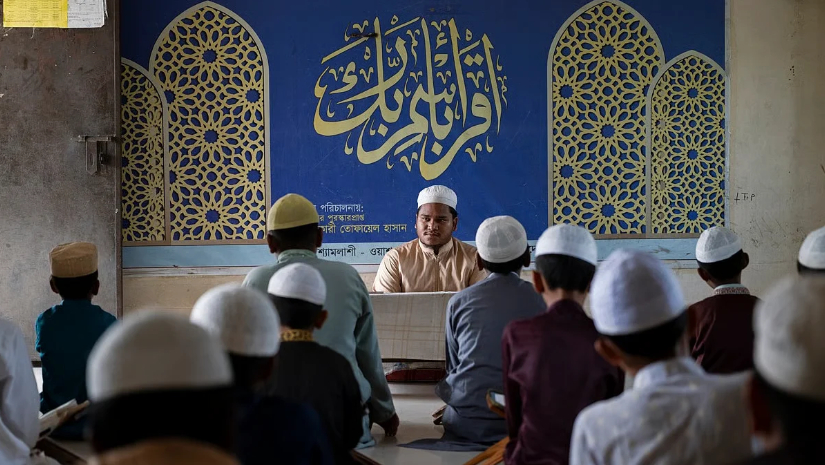
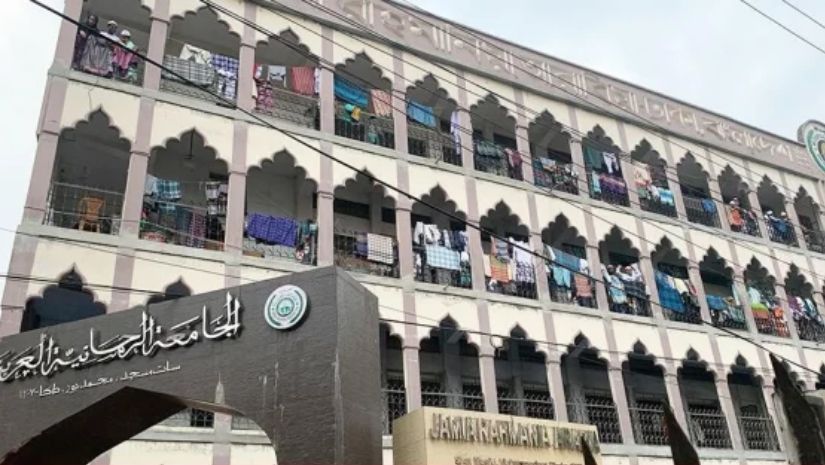
A visit to Jamia Rahmania Darul Uloom Qawmi Madrasa in Kajla, Dhaka, found that teacher Maulana Abdul Halim started working as a residential teacher in 2024 with a monthly salary of Tk 7,000. After going unpaid for seven months, he left the job out of frustration and later moved to a Middle Eastern country to work abroad. His younger brother, Abdul Karim, also completed Dawra-e-Hadith at a Qawmi madrasa. He spoke to The Daily Campus about his brother's experience.
"My brother was not paid for seven months. The madrasa's muhtamim, Ozaer Amin, kept making him wait by talking only about 'lillahi'. Eventually, he left the job out of frustration and distress. It is not just my brother. Teachers at most madrasas in the country, except for a handful of good ones, are not paid regularly. Even at good institutions, a month's salary is often paid the following month," Abdul Karim said.
He said the salaries of muhtamims at Qawmi madrasas are often kept confidential. While they receive their salaries at the beginning of the month, ordinary teachers are treated differently. Teachers generally refrain from protesting because they fear upsetting senior religious scholars, whom they are expected to respect. While muhtamims lead comfortable lives, ordinary teachers are consoled with appeals to lillahi, or serving for the sake of Allah, he said.
"The reality is different because people have families to support. Ordinary teachers at well-known Qawmi madrasas earn Tk 15,000 a month. A handful of senior teachers at these institutions may receive between Tk 17,000 and Tk 35,000. In rural areas and at district or upazila-level institutions, salaries generally start at Tk 7,000. Even there, muhtamims lead relatively comfortable lives. You could say they become financially well-off," he added.
I have not received my salary for five months. Yet the head of the madrasa, the muhtamim, regularly comes to the institution in a microbus. When I ask the hujur for my salary, he tells me to stop worrying about worldly matters. I then look at the vehicle parked in the madrasa grounds. Seeing this, he tells me again that the vehicle is a worldly matter and I should not pay attention to it - Maulana Rakibul Islam (Alias), a Qawmi teacher
Hafizur Rahman, a teacher at a Qawmi madrasa in Mymensingh Sadar upazila, told The Daily Campus that the muhtamim of his institution receives a monthly salary of Tk 25,000, while some other teachers earn between Tk 10,000 and Tk 18,000.
"Our senior scholars do not give much importance to a salary policy, although they consistently focus on developing the institution's infrastructure. Most of our teachers live on the premises. However, 95 per cent of ordinary teachers in the Qawmi sector do not receive their salaries properly," he said.
He said many teachers take up other jobs because their madrasa salaries are insufficient. Some serve as imams at one mosque and khatibs at another, earning a combined Tk 25,000 to Tk 30,000 from three different places. Such an income is not possible through madrasa teaching alone. Others visit people's homes to teach the Quran.
However, he said, not every teacher can find additional work. Most are unable to do so because employment opportunities are limited compared with the number of teachers.
Hafizur also described another aspect of the situation. Many Qawmi teachers, unable to find work outside their institutions, continue to live in severe hardship on low salaries. Some, however, occasionally receive financial gifts from the parents of well-off students. He alleged that certain teachers seek such gifts indirectly by cultivating favour with parents and hinting at their financial needs.
A large proportion of children from low-income families study at Qawmi madrasas. The state should therefore consider their circumstances positively. While allowing flexibility in academic matters, the institutions must be brought under a system of financial transparency and accountability. The government should take initiatives to provide financial assistance to teachers and improve educational standards while preserving the distinct identity of Qawmi education - Professor Dr Mohammad Shahidul Islam, Pro-Vice-Chancellor, Islamic Arabic University
Comfortable lifestyles for some madrasa heads
Teachers said that after completing their studies at Qawmi madrasas, those with personal wealth or strong connections in the community often establish new institutions for boys or girls in cities, towns and villages. This has led to the establishment of Qawmi madrasas in many locations. Those who open such institutions become muhtamims and begin recruiting teachers at low salaries.
To run their institutions, madrasa heads collect monthly or annual financial assistance from religiously observant local residents. Teachers' salaries are paid from donations, charity and monthly fees collected from students. Sometimes, teachers receive two or three months' salary at once. When salaries remain unpaid, donations collected for annual religious gatherings and sermons are used to clear arrears and cover other expenses.
Teachers say they have little knowledge of how much money religiously observant Muslims donate throughout the year or how those funds are spent.
When the hujur first established the Qawmi madrasa, he travelled by bicycle. Now he goes around on a motorcycle. His house has also improved. Yet some of us earn Tk 7,000, some Tk 10,000 and others a maximum of Tk 12,000, and even that is irregular. I cannot explain how much hardship we endure to support our families - Mufti Shafiqul Alam (Alias), Kitab department teacher at a Qawmi madrasa in Shariatpur
Many teachers alleged that some muhtamims keep a substantial portion of institutional income for themselves. As a result, they say, the living standards of madrasa heads improve while those of ordinary teachers remain unchanged year after year.
Teachers said that those who study in the Qawmi system have very limited employment options outside work as mosque attendants, muezzins, imams, khatibs or madrasa teachers.
They alleged that although some institutional income is spent on salaries and allowances, the personal living standards of muhtamims at certain madrasas continue to rise. Meanwhile, ordinary teachers' salaries have remained stagnant for years. Many cannot leave their jobs despite financial hardship because they fear facing the same conditions at another institution.
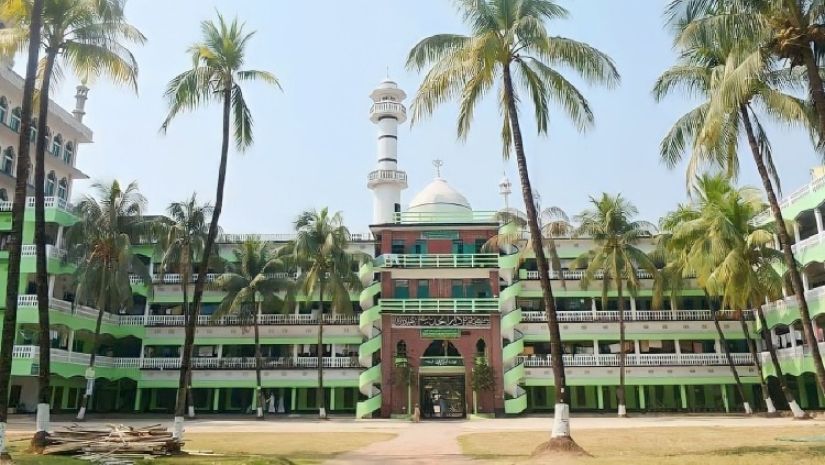
Maulana Rakibul Islam, a Qawmi madrasa teacher in the Kuril Bishwa Road area of Dhaka, told The Daily Campus that he had not received his salary for five months, although the madrasa head regularly travelled to work in a microbus.
"One day, after the head teacher arrived at the office in his vehicle, I approached him about my salary. He told me to stop worrying about worldly matters. As he said this, I looked at the vehicle parked in the madrasa grounds. He noticed and repeated, 'That is a worldly matter. You must not pay attention to it.'"
Rakibul said he was not alone in facing such treatment. He claimed that 95 per cent of ordinary teachers in the country's Qawmi madrasa sector do not receive their salaries regularly. As a result, some take up other jobs alongside teaching.
The salaries of muhtamims, or madrasa heads, are kept confidential, and they receive their pay at the beginning of the month. Our salaries are not paid regularly, so we have to rely on other professions to make a living. We do not protest because the senior scholars might be upset. While the muhtamims live comfortably, we are consoled with the word 'lillahi' - An affected teacher
Shafiqul Alam, a teacher in the Kitab department of a Qawmi madrasa in Shariatpur district town, told The Daily Campus that salaries at his institution were not paid regularly. Teachers often receive their wages every two or three months. If arrears accumulate, they are cleared using money collected through the institution's annual religious gathering.
"When the hujur established this madrasa, he travelled by bicycle. Now he travels by motorcycle, and his house has also improved. Yet some of us earn Tk 7,000, some Tk 10,000 and others a maximum of Tk 12,000, and even that is irregular. I cannot explain how much hardship we endure to support our families. If you speak to other teachers, they will tell you the same thing. It is impossible to live on this amount in today's high-cost market," he said.
A Qawmi student named Hedayatullah Usmani wrote in a Facebook post that many teachers received salaries of around Tk 15,000 or less.
"There is no problem with that amount in itself. But there are many madrasas where no bonus is given for either of the two Eid festivals. Even today, such ignorant rules and regulations remain in place at many Qawmi madrasas. Those in charge do not care about the matter. Who will explain it to them? Who has the ability to make them understand? May Allah grant those authorities the wisdom to do what is right," he wrote.
Some muhtamims, however, said they understood the difficulties faced by ordinary teachers.
Muhammad Imdadul Islam, muhtamim of Jamalul Quran Madrasa at Dhupkhola field, told The Daily Campus that teachers were paid low salaries because the Qawmi sector lacked sufficient funding. He said he understood that teachers struggled to support their families on such incomes.
Mufti Zafar Ahmad, muhtamim of Madrasa Baitul Ulum Dhalkhanagar in the Gandaria area of Old Dhaka, expressed a similar view.
Mufti Tawhidul Islam, imam of Umm-e-Kulsum Jame Mosque at Bashundhara Sports City and director of An-Nuha Children's Academy in Uttarkhan, told The Daily Campus that Qawmi teachers were finding it extremely difficult to live on their current salaries amid rising prices.
"There is also a disparity between the salaries of madrasa heads and ordinary teachers. Befaq has no salary policy or structure. We demand that the relevant authorities formulate a salary policy for us. Because Qawmi teachers receive low salaries, many take up other professions alongside teaching," he said.
Why is there no accountability?
Professor Dr Mohammad Shahidul Islam, Pro-Vice-Chancellor of Islamic Arabic University, told The Daily Campus that Qawmi madrasas provide religious and moral education to a section of society, and a large proportion of their students come from low-income families. The state should therefore take a positive approach towards them.
"The government provides salaries and various benefits to teachers involved in primary education. The situation of Qawmi madrasa teachers could also be considered positively," he said.
He noted that many Qawmi madrasas do not charge tuition fees and depend heavily on donations and assistance from affluent members of society. As a result, teachers' salaries are often uncertain.
"A teacher also has to support his own family. It is difficult to meet household expenses by relying only on 'lillahi' assistance. Therefore, an appropriate income arrangement needs to be established for teachers," he said.
He added that the income and expenditure of Qawmi madrasas should be brought under a system of transparency and accountability. Since these institutions operate outside the government's conventional financial management framework, a mechanism could be developed to establish how their income is generated and how the money is spent.
"This would increase transparency in the financial management of the institutions," he said.
Professor Shahidul Islam said Qawmi madrasas wanted to preserve their distinct identity, while the government had also maintained a flexible position on the matter. However, he said, initiatives to support teachers financially and improve educational standards could be taken without undermining that identity.
"As far as I know, the government is communicating with people associated with Qawmi madrasas at different levels and considering how the quality of education at these institutions can be improved. If teachers can be brought under an appropriate government assistance programme or scheme, they will benefit financially. I believe this would have a positive impact on Qawmi education and the broader progress of society," he said.
Several senior officials of the Technical and Madrasah Education Division of the Ministry of Education told The Daily Campus that the interim government had held a meeting with madrasa heads at a prominent five-star hotel in the capital as part of an initiative to bring Qawmi madrasas under government oversight.
At the meeting, the government proposed forming a Qawmi Madrasa Education Board. The administrator would be appointed by the government, while the remaining members would come from the Qawmi sector itself. The government-appointed administrator would remain in place until the relevant representatives were considered qualified to take over.
According to the officials, the government also assured the madrasa representatives that it would not interfere in academic matters but would monitor infrastructure and financial affairs. The proposal was rejected after the representatives were informed of these arrangements.
Asked about the matter, Maulana Abdul Jalil, examination controller of the Qawmi Madrasa Education Board, Befaq, said he would not comment on teachers' salaries.
However, he rejected the claim that the board was reluctant to work with the government because of fears of financial audits.
"It is not true that we do not want to work with the government because we fear financial audits. We have our own distinct identity," he said.
 Follow The Daily Campus on Google News