‘Moving coffins’ on highways: None of 829 sleeper buses has approval
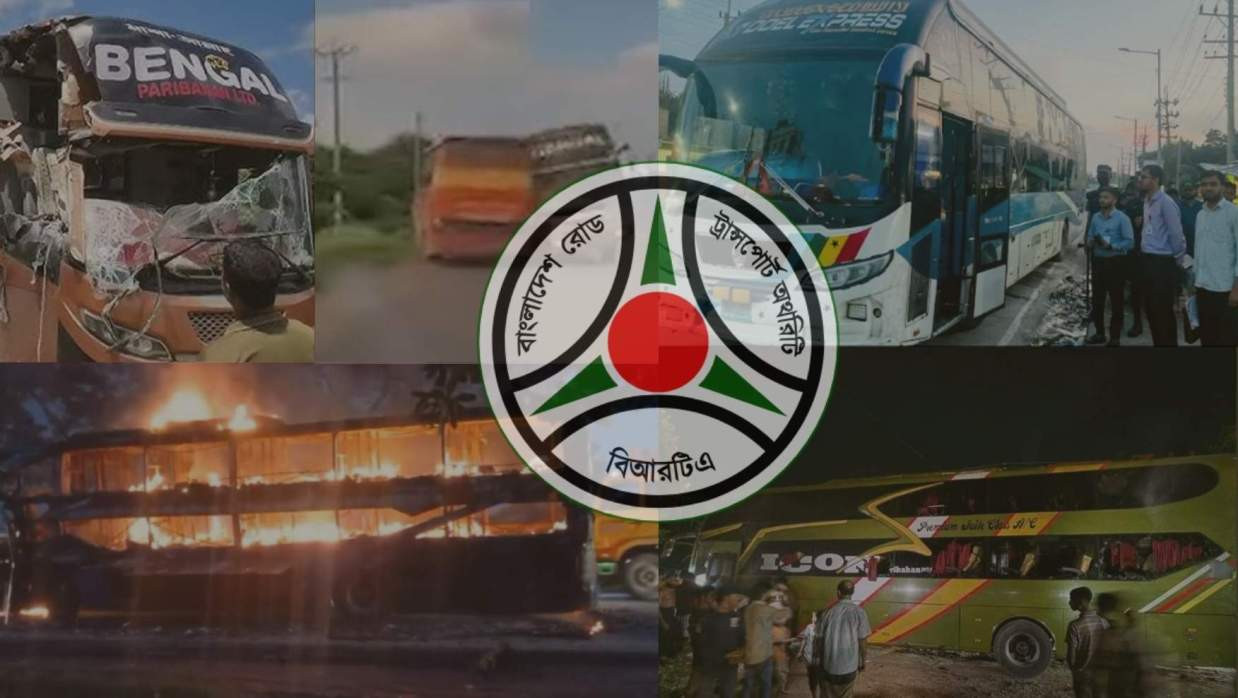
Their glossy designs and striking paintwork can easily attract attention. Inside, bright lights illuminate a narrow central corridor, with small compartments arranged on both sides, some fitted with sleeping berths and others with seats.
Known as sleeper buses, these vehicles are now operating on major highways connecting Dhaka with Cox’s Bazar, Sylhet, Khulna and other destinations. They have become popular by offering passengers the option of travelling long distances while lying down at relatively low cost.
But the absence of approval for any of the buses, along with a series of recent accidents and fires, has raised serious questions about the safety of double-decker sleeper buses. Within days, accidents and fires involving sleeper or long-distance buses in Sylhet, Cox’s Bazar, Cumilla and Feni have caused deaths, while passengers in some incidents escaped through the efforts of local residents.
Amid the incidents, allegations have also emerged that conventional buses are being structurally modified into sleeper coaches without approval. Relevant sources say importers, owners, body builders, unscrupulous officials of government agencies and authorities responsible for road safety are all responsible for allowing such vehicles to operate, increasing the risk of accidents and loss of life.
Road safety experts allege that more than 800 double-decker sleeper coaches are operating on highways after additional structures were installed on single-decker bus chassis. Many are allegedly being built or modified without approval, while adequate safety arrangements for passengers are also reportedly absent.
As a result, passengers may have limited opportunities to escape quickly in the event of an accident. Such buses therefore risk becoming “moving death traps” on long-distance routes.
Recent accidents
On August 7, nine people were killed and at least 24 injured when Bengal and Unique Paribahan buses collided on the Dhaka-Sylhet highway in Osmaninagar, Sylhet.
Dashcam footage showed the Bengal Paribahan bus losing control and hitting the Unique bus, which subsequently fell into a roadside ditch. Among the dead were a child and Baul artiste Peheli Bhairabi.
On August 17, a Royal Cox sleeper coach travelling from Cox’s Bazar to Dhaka caught fire in Elliotganj, Daudkandi, Cumilla, after hitting a vehicle in front of it. The fire subsequently spread throughout the bus, but all passengers managed to escape safely. Police recovered the bus and took it to the police station.
“There was an accident involving a sleeper bus in Cox’s Bazar yesterday. There are various allegations regarding the structures of these buses. These include allegations that ordinary single-decker buses are being modified into double-decker or sleeper buses. The issue has now come under discussion. Since discussions have begun, we are hopeful that a solution will emerge.”— Habibur Rahman Khan, DIG (Administration), Highway Police Headquarters
On August 21, around midnight, an AC bus of Icon Paribahan travelling from Cox’s Bazar to Dhaka caught fire near Kolghor Bazar in Ramu. The bus was carrying 25 to 30 passengers. Local residents broke the windows and helped passengers escape before firefighters brought the blaze under control. No one was injured or killed. A preliminary assessment attributed the fire to a mechanical fault and an overheated engine.
The incidents are not limited to August. On March 22, a sleeper bus operated by Doyel Paribahan crashed into several vehicles parked in Rampur, Feni, killing three people and injuring five others.
A traffic jam had formed there after a Shyamoli Paribahan bus hit an ambulance. The speeding sleeper bus later crashed into the vehicles standing on the road. Police seized four buses and two motorcycles.
829 sleeper buses without approval
The recent incidents have brought further concerns about sleeper buses to the fore. According to information presented by the BRTA, 829 sleeper buses are currently operating on roads and highways across the country. None of them has approval to operate as a double-decker sleeper coach, according to relevant officials.
Another major safety concern is the addition of extra passenger capacity. An ordinary AC bus generally has around 32 seats, but some double-decker sleeper buses have reportedly been modified to accommodate 45 passengers.
In other words, additional structures are being built on the same chassis to increase passenger capacity. This increases the overall weight of the bus and may place additional stress on the chassis because of the combined weight of passengers and luggage.
“Most of the single-decker buses in our country are converted into sleeper buses. This will certainly cause accidents. If more passengers are carried than the bus’s capacity, it will inevitably create danger.”— Professor Kazi Md Saifun Newaz, Assistant Professor, Accident Research Institute, BUET
BRTA launches raids
Following the recent incidents, the Bangladesh Road Transport Authority (BRTA) and law enforcement agencies have stepped up enforcement.
After High Court directives and investigations, joint drives were conducted at illegal body-building garages in Jatrabari, Gabtoli, Aminbazar and Maniknagar in the capital. Several establishments were sealed and fined, while numerous unfit and route-permit-less sleeper buses were recovered.
The BRTA has also conducted drives in Cox’s Bazar, Sylhet and several other locations.
According to BRTA information, its Mobile Court-5 conducted a drive on August 19 near Samir Mridha Jame Mosque in Jatrabari. Five establishments were fined a total of Tk 250,000 for allegedly constructing unauthorised sleeper coach bodies, modifying bus structures and operating illegal garages.
The previous day, BRTA Courts-6 and 3 jointly conducted a drive at various body-building garages in Gabtoli, Aminbazar and Maniknagar. Around 10 to 12 garages were inspected.
Four garages were fined Tk 230,000 for repairing unauthorised sleeper buses and lacking required registration. Eight vehicles were sent for dumping while under repair, and two unfit sleeper buses were seized. Officials also sealed a body-building garage named New Descent Engineering Works.
On August 19, the district administration, BRTA Cox’s Bazar Circle and district police jointly conducted another drive from noon until evening. Five long-distance luxury buses, including London Express, Doyel Express, Saint Martin Paribahan and Imperial Express, faced cases for unauthorised seat arrangements and structural modifications and for lacking fitness certificates.
The authorities also collected Tk 100,000 in fines on the spot.
“The Bangladesh Road Transport Authority has not given permission for sleeper buses to operate. The BRTA has said this in the media on several occasions. They have even informed the court in writing that they have not approved the operation of such buses. If the BRTA wants, it can take action against these buses at any time with the assistance of law enforcement agencies or the civil administration.”— Huzzatul Islam Khan, lawyer for the writ petitioner, High Court
A BRTA official told The Daily Campus that changing the length, width, height, seat arrangement or original structure of any motor vehicle without prior approval from the authority is a punishable offence under the Road Transport Act, 2018.
The official said many transport companies have recently been converting ordinary buses into sleeper buses in risky ways without complying with the law, creating a significant risk of serious accidents on highways.
Mohammad Abdullah Khan, motor vehicle inspector of the BRTA Cox’s Bazar Circle, said no permanent solution to the sleeper bus issue has yet been discussed by the relevant authorities.
He said drives are currently being conducted according to the chairman’s instructions and that no specific decision has yet been made on how to find a permanent solution.
Abdullah Khan said regular drives are being conducted against sleeper buses. After receiving a letter regarding sleeper buses on August 11, drives were conducted in different parts of the country. The first drive against sleeper buses in the Cox’s Bazar Circle was conducted on August 19.
Legality reaches High Court
The legality of sleeper coaches has also reached the High Court.
Lawyer Huzzatul Islam Khan filed a writ petition on the issue in 2025. During a hearing on August 20 this year, the BRTA informed the High Court that 829 illegal sleeper buses were currently operating on the country's roads. The authority also informed the court about its recent enforcement drives.
Khan told The Daily Campus that the BRTA has not authorised sleeper buses and has repeatedly stated this in the media and in written submissions to the court.
He said that under the law, a bus chassis must first receive approval after being imported or brought into the country. Once a body is built on the chassis, that body must also be approved by the BRTA.
But, he alleged, this procedure is not being followed for sleeper buses. According to him, buses are initially registered after obtaining body approval as ordinary single-decker buses and are later taken to garages where their bodies are modified into double-decker or sleeper buses.
He said many of the buses are built or modified at local garages where technicians lack the necessary technical equipment and capacity to ensure passenger safety. In many cases, he alleged, bodies are built or modified simply in exchange for money.
He said this leaves passengers with very limited opportunities to escape if a bus catches fire or is involved in an accident. Most sleeper buses have a single door at the front, behind the driver.
During an accident, drivers, assistants and supervisors can generally get out quickly, but passengers face the risk of being trapped inside, he said.
Referring to the recent incident in Cox’s Bazar, Khan said the driver, helper and supervisor were able to understand that the bus had caught fire and escape.
“If this continues, there is no way to describe these sleeper buses other than moving coffins,” he said.
Khan said the writ petition is currently awaiting hearing. It was listed for hearing last Thursday, but the hearing could not take place because the matter could not be heard within the scheduled time.
‘BRTA’s contradictory position’
Saidur Rahman, executive director of Road Safety Foundation, told The Daily Campus that the BRTA’s position and enforcement efforts appear contradictory.
“The BRTA is calling sleeper buses unauthorised, but no effective action is being taken against them. This is contradictory behaviour by the BRTA. If these buses are genuinely unauthorised and that is the authority’s own position, then the responsibility and accountability of those concerned must be ensured.”— Saidur Rahman, Executive Director, Road Safety Foundation
He said the buses are operating openly on highways rather than secretly.
“These sleeper buses travel from the capital to various destinations on highways. BRTA mobile courts, highway police and other law enforcement agencies perform their duties along the routes. The buses are operating in front of them. So why is legal action not being taken? That is the big question,” he said.
He said sleeper buses are frequently involved in accidents, while the failure to stop unauthorised buses from operating raises questions about the BRTA’s effectiveness.
“If these buses are genuinely unauthorised and that is the authority’s own position, then the responsibility and accountability of those concerned must be ensured. On one hand, bus owners are violating the law. On the other, the BRTA itself says these buses have no approval,” he said.
Experts call for stronger oversight
Professor Kazi Md Saifun Newaz of BUET’s Accident Research Institute said the conversion of single-decker buses into sleeper coaches is a major concern.
“Most of the single-decker buses in our country are converted into sleeper buses. This will certainly cause accidents. If more passengers are carried than the bus’s capacity, it will inevitably create danger. Government agencies should therefore increase their monitoring. Since the BRTA itself says these buses are unauthorised, it should take immediate action against them.”— Professor Kazi Md Saifun Newaz, Assistant Professor, Accident Research Institute, BUET
Habibur Rahman Khan, DIG (Administration) of the Highway Police Headquarters, said the BRTA is the primary authority responsible for deciding whether sleeper buses are legal and which vehicles should be licensed.
“The BRTA is the competent authority regarding approval of sleeper buses. If the BRTA declares a vehicle illegal and informs the Highway Police to take action, the police will certainly take the necessary measures. At different times, the Highway Police has also conducted such drives in accordance with BRTA instructions,” he said.
He said the Highway Police’s main responsibility is to ensure discipline and safety on roads, while determining whether a vehicle is legal or illegal is not its primary responsibility.
“However, if the BRTA gives any instruction or makes a request, we will certainly cooperate,” he said.
Regarding the recent allegations surrounding sleeper buses, Khan said, “There was an accident involving a sleeper bus in Cox’s Bazar yesterday. There are various allegations regarding the structures of these buses. These include allegations that ordinary single-decker buses are being modified into double-decker or sleeper buses. The issue has now come under discussion. Since discussions have begun, we are hopeful that a solution will emerge.”
He said the Highway Police would act according to instructions issued by the BRTA and the relevant ministry or authority.
 Follow The Daily Campus on Google News