1.48 lakh SSC graduates yet to apply for college admission
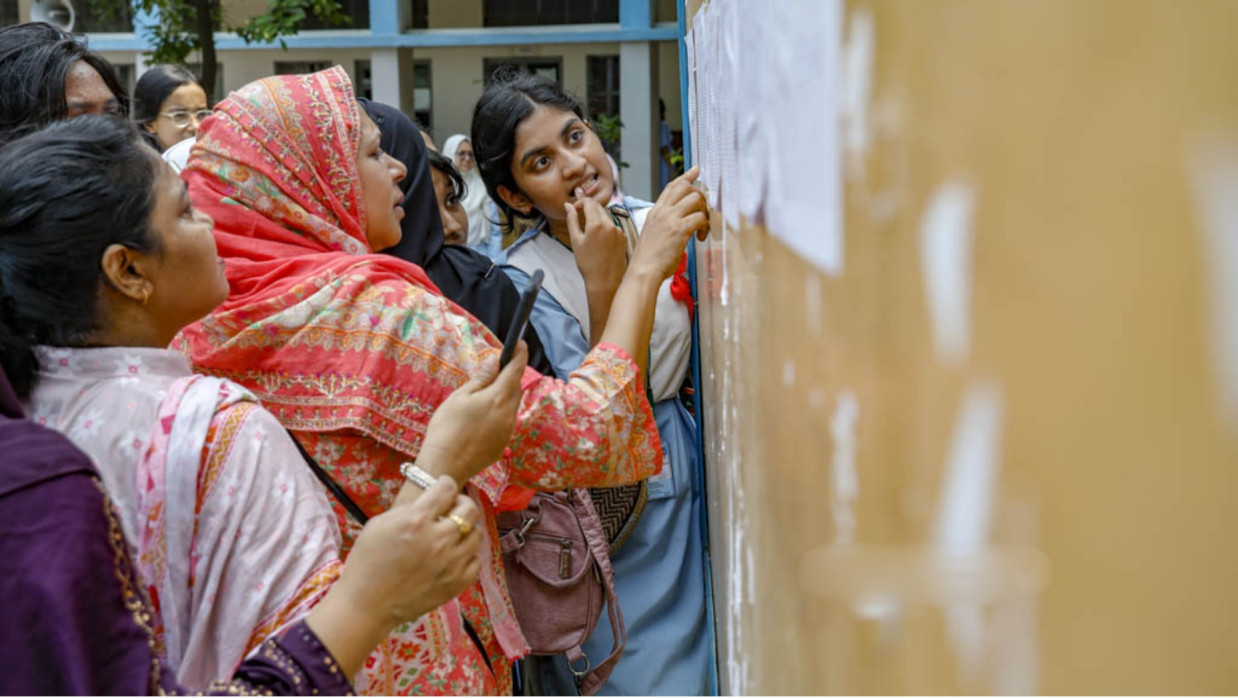
Nearly 1.48 lakh students who passed this year’s SSC and equivalent examinations have yet to apply for admission to Class XI, raising questions about whether they are continuing their education through other routes or dropping out altogether.
A total of 11,43,462 students passed the SSC and equivalent examinations this year. Of them, 9,95,230 have applied for admission to Class XI in the science, humanities and business studies streams, leaving 1,48,232 successful candidates outside the current college admission process.
The figures do not necessarily mean that all of these students have dropped out. Some may be planning to enrol in technical, madrasa or other education systems, while others may have joined the workforce or moved abroad. Financial hardship, family circumstances and early marriage may also prevent some students from continuing their education.
However, there is currently no clear nationwide database showing where these students have gone after passing the SSC or equivalent examinations.
Seats far exceed successful candidates
Government and private colleges across the country have more than 25 lakh seats for Class XI. With only 11.43 lakh students passing the SSC and equivalent examinations, around 15 lakh seats could remain vacant even if every successful candidate eventually enrols.
The mismatch is particularly visible between major cities and rural areas.
Colleges in Dhaka, divisional cities and district headquarters, especially those with strong reputations, continue to receive large numbers of applications for limited seats. At the same time, many colleges in rural and less-developed areas struggle to attract enough students to fill their available seats.
An acting principal of a private college in Jamalpur, speaking on condition of anonymity, said the institution faces uncertainty over student enrolment every year after the SSC results are published.
The principal said the number of potential students has declined because many nearby schools have lower numbers of successful candidates. Those who achieve good results, meanwhile, often prefer colleges in Dhaka or district towns.
“We face a kind of uncertainty every year after the SSC results are published over Class XI admission. The number of potential students has declined as the pass rate at nearby schools has fallen. Again, some of those who pass or achieve good results want to go to better colleges in Dhaka or district towns. It has become difficult to retain students in rural colleges.”
Where are the missing students going?
Education stakeholders say the 1.48 lakh students may be taking different paths, but there is no reliable breakdown of their destinations.
Sohel Rana, a former student of Barishal University and a media professional, said poverty, employment, migration and access to nearby institutions could all influence students’ decisions.
“There are various problems, including poverty. Some may not be able to continue their studies because of financial hardship. Some may enter government jobs, including the police. Others may go abroad to support their families. However, a large portion may move to polytechnic institutes, MATS or other technical education institutions. In the case of girls, some may not be able to continue their studies because there is no nearby institution. Many girls may also leave education because of child marriage.”
“The lack of a system to track students after they complete their SSC is itself a major weakness,” said Prof Mohammad Mojibur Rahman, chairman of the Department of Nonformal and Lifelong Education (NFLE) at the Institute of Education and Research, University of Dhaka.
“The first question is whether the state has tried to find out what the students who do not apply for admission will do. Do we have any testing system to find out? We do not. There should have been a database showing where they are now against their NID cards or roll numbers.”
He said such a database should record whether students move into polytechnic education, employment or migration.
“If a student who does not enrol goes to a polytechnic, enters employment or moves abroad, there should be an accurate database for that. But instead of working on these broader issues in education, routine work is being carried out merely as a formality. There is no specific monitoring of the hundreds of thousands of students who fail or do not enrol in college after passing.”
Calls for broader education reform
Prof Mojibur Rahman also criticised the absence of a comprehensive education policy linking the number and type of educational institutions with students’ needs and the labour market.
He argued that Bangladesh needs a clear education philosophy before making decisions on compulsory education, nationalisation of institutions, universities, subjects and skills development.
“What we fundamentally needed was to determine a proper education philosophy and restructure the education system accordingly. Instead, universities are being established at the demands of MPs and ministers, while schools close to them or recommended by them are being nationalised.”
He also criticised the introduction of initiatives such as smart boards and third-language instruction without adequate teachers, databases or research evidence.
“Without a comprehensive policy, we are currently working in this way. We need to move away from this culture.”
He called for an education reform commission to first establish a coherent education philosophy and then formulate a comprehensive education policy based on it.
Such a policy, he said, should determine how long education should remain compulsory, how many institutions should be nationalised, how many universities and subjects are needed, and how students should be prepared according to the country’s needs and labour-market demand.
 Follow The Daily Campus on Google News