
Begum Khaleda Zia passes away
- ৩০ ডিসেম্বর ২০২৫, ০৭:৪৫
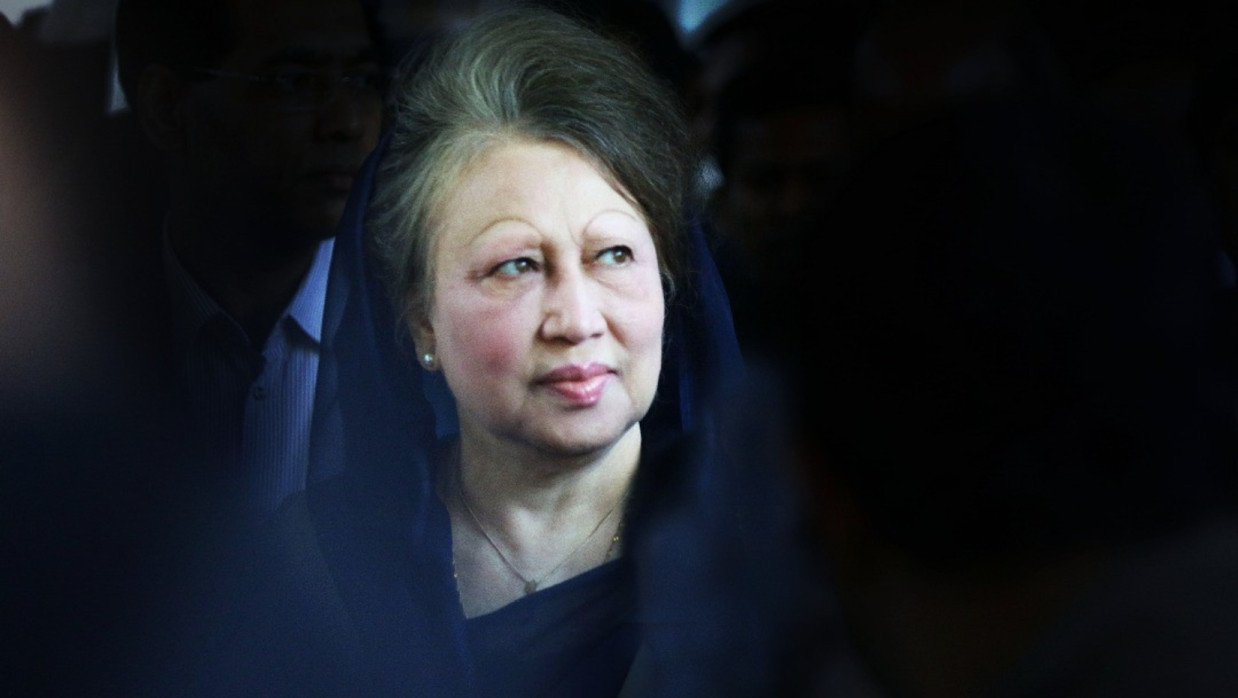
Former Prime Minister and BNP Chairperson Begum Khaleda Zia has passed away. She breathed her last at 6:00 am on Tuesday while undergoing treatment at Evercare Hospital in the capital. She was 80 years old.
BNP Chairperson’s Press Wing official Shamsuddin Didar confirmed the matter. BNP Secretary General Mirza Fakhrul Islam Alamgir also confirmed the news to The Daily Star around 7:30 am.
At the time of her death, Khaleda Zia’s eldest son and BNP Acting Chairman Tarique Rahman was by her bedside. Also present were Tarique Rahman’s wife Dr Zubayda Rahman, daughter Zaima Rahman, and the wife of her late younger son Arafat Rahman Koko, Sharmili Rahman Sinthi.
Among family members, her younger brother Shamim Iskandar and his wife, elder sister Selina Islam, and other family members were also at the hospital in her final moments. Besides them, BNP Secretary General Mirza Fakhrul Islam Alamgir and members of the medical board treating Khaleda Zia were present.
Shamsuddin Didar said the schedule for Khaleda Zia’s funeral and burial will be announced later.
The former Prime Minister had been suffering from various health complications for a long time, including liver cirrhosis, arthritis, and diabetes. She also had chronic problems with her kidneys, lungs, heart, and eyes.
After infection was detected in her heart and lungs, she was admitted to the hospital on 23 November on the advice of the medical board.
A medical board led by heart specialist Dr Shahabuddin, comprising experts from Bangladesh, the United Kingdom, the United States, China, and Australia, supervised her treatment.
Earlier this month, efforts were made to take her abroad for advanced treatment, but it was not possible considering her physical condition.
Bangladesh’s first female Prime Minister, Khaleda Zia, has left behind a powerful political legacy. Her journey began in 1991 amid the country’s march towards democracy.
In the 1991 general election, she became Prime Minister. Under her leadership, the parliamentary system was reintroduced in the country, and the caretaker government system was introduced to ensure free and fair elections.
Although she remained outside parliament since the 2014 general election, Khaleda Zia remained at the centre of political discussion. At that time, trials were ongoing in 34 cases against her.
On 8 February 2018, she was sent to prison in a corruption case. Due to the Covid-19 pandemic, she received conditional temporary release on 25 March 2020. Since then, she had to be admitted to hospital several times.
Born in 1945 in Jalpaiguri, Khaleda Zia studied at Dinajpur Missionary School. She passed her matriculation from Dinajpur Girls’ School in 1960.
Khaleda Zia’s father Iskandar Majumdar was a businessman and her mother Tayyaba Majumdar was a housewife. She was the second among three sisters and two brothers. Her nickname was ‘Putul’.
In 1960, she married then Pakistan Army Captain Ziaur Rahman and studied at Surendranath College in Dinajpur until 1965. Later, she moved to West Pakistan to stay with her husband.
When the Liberation War began in 1971, Ziaur Rahman rebelled against the Pakistan Army and joined the war. At that time, Khaleda Zia was arrested by the Pakistani forces. She was released after Bangladesh’s victory on 16 December.
After Ziaur Rahman’s assassination on 30 May 1981, BNP faced a severe leadership crisis. At that moment, Khaleda Zia, who had never been in politics, joined the party and became vice-chairperson on 12 January 1984. On 10 May the same year, she was elected chairperson. In January 2010, she was re-elected chairperson.
Under Khaleda Zia’s leadership, BNP formed the seven-party alliance in 1983 and began the movement against Ershad’s autocratic rule.
The Ershad government imposed restrictions on her movement and arrested her multiple times. Despite this, Khaleda Zia fearlessly led the anti-Ershad movement, earning the title of ‘uncompromising leader’.
In the 27 February 1991 election, BNP emerged as the single largest party. Khaleda Zia contested and won from five constituencies in three consecutive national elections.
On 20 March 1991, Khaleda Zia took oath as Bangladesh’s first female Prime Minister. On 19 September the same year, she took oath again as Prime Minister under the new system of government.
Through the 15 February 1996 national election, Khaleda Zia became Prime Minister for the second time. However, major opposition parties boycotted that election.
Under pressure from the opposition, the then government introduced a constitutional amendment to form a neutral caretaker government for overseeing elections.
After the caretaker system was introduced, parliament was dissolved, and Khaleda Zia handed over power on 30 March 1996. Subsequently, in the election held on 12 June under the caretaker government, BNP lost to Awami League.
During the Awami League government from 1996 to 2001, Khaleda Zia served as the Leader of the Opposition in parliament.
In the 1 October 2001 election under the caretaker government, the BNP-led four-party alliance won more than two-thirds of the seats.
On 10 October 2001, Khaleda Zia took oath as Prime Minister for the third time.
In 2007, when the military-backed caretaker government came to power, Khaleda Zia along with many political leaders was arrested.
Later, Khaleda Zia was released from prison. Although she participated in the 2009 election, her party could not win.
After boycotting the 2014 national election, the party remained outside parliament for the first time since 1991.
In the Zia Orphanage Trust corruption case, a Dhaka special court sentenced Khaleda Zia to five years in prison on 8 February 2018, and she was sent to jail.
On 30 October that year, the High Court increased her sentence to 10 years. Later, she was also convicted in the Zia Charitable Trust corruption case.
During the Covid-19 pandemic, the Awami League government granted her conditional temporary release on 25 March 2020 through an executive order. The condition was that she would stay at her Gulshan residence and not leave the country.
On 6 August this year, President Mohammad Shahabuddin, exercising powers under Article 49 of the Constitution, declared her sentence-free, granting BNP Chairperson complete release.